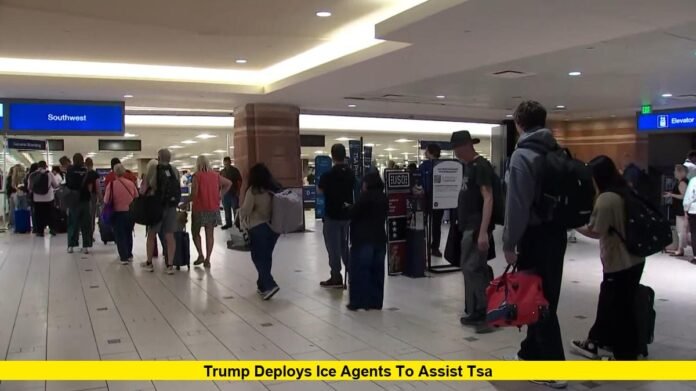

As millions of Americans scramble through airports during spring break, President Donald Trump has announced that he will send Immigration and Customs Enforcement agents into US airports beginning Monday to assist TSA workers who have been showing up to work without a paycheck for weeks. The move comes after Trump deploys ICE agents to assist TSA at US airports became the defining story of the weekend — one that exposes a bitter political standoff between the White House and congressional Democrats that shows no signs of ending soon.
The decision is dramatic, unprecedented, and deeply controversial. And for the tens of thousands of travelers stuck in two-hour security lines across the country, it raises an urgent question: Will this actually help?
Keep reading — this story is developing by the hour, and everything you need to know is right here.
How the Crisis Reached This Point
The partial government shutdown affecting the Department of Homeland Security has been dragging on for weeks. TSA’s roughly 61,000 employees have been showing up to secure America’s airports without receiving their paychecks — a situation that has pushed absentee rates to record levels and left security lines at some of the nation’s busiest airports stretching far beyond anything travelers typically experience.
For six straight days last week, TSA callout rates stayed above 9 percent nationwide. On Monday alone, the absentee rate hit a record 10.22 percent. At Atlanta’s Hartsfield-Jackson International Airport, more than a third of the scheduled workforce missed their shifts last week. On Friday, more than half of the TSA workforce at Houston’s William P. Hobby International Airport called out entirely.
The human toll behind these numbers is stark. The acting deputy TSA administrator described workers sleeping in their cars and drawing blood just to pay for the gas to drive to the airport. Over 300 TSA employees have already left the agency entirely since the shutdown began.
What Trump Announced — and Why
On Saturday, Trump posted a warning on Truth Social, threatening to send ICE agents to airports Monday if Democrats did not immediately agree to fund DHS. By Sunday, that threat became a directive. Trump posted that ICE will go to airports Monday to help TSA agents who have “stayed on the job” during the standoff.
He placed Border Czar Tom Homan in charge of the deployment and praised the ICE workforce as “brilliant and patriotic.” He also stated that ICE agents would be directed to arrest anyone suspected of being in the country illegally while stationed at airports — an element of the announcement that immediately drew sharp criticism and significant legal questions.
The funding battle traces back to a deadlock in Congress. Democrats have blocked a Republican-backed DHS funding bill, demanding reforms to immigration enforcement operations following two deadly shootings involving federal immigration agents in Minneapolis earlier this year. Democrats have tried to pass standalone funding for TSA specifically, but Republicans have blocked that approach as well. A bill to fund DHS failed to advance in the Senate on Friday, and there are currently few signs a deal will be reached before Congress heads into recess.
The Problem With Sending ICE to Screener Checkpoints
Here is what makes this deployment so unusual: ICE agents are not trained to perform airport security screening. TSA officers go through months of specialized training before they are cleared to staff a checkpoint — learning to detect weapons, explosives, and other prohibited items using sophisticated technology.
TSA union representatives were blunt in response to the announcement. One Atlanta-based TSA officer and union steward said plainly that while the president can send ICE agents, he does not see how that helps get through this period. He added that bringing in untrained personnel who do not know what they are looking for at a checkpoint could create additional problems, not fewer.
The administration has not clarified exactly what roles ICE agents will fill. The most likely scenario is that they would handle crowd management, line direction, and exit door monitoring — tasks that free up trained TSA officers to focus on actual security screening. But that has not been officially spelled out.
Airport Delays Are Already Severe
By Sunday morning, the situation at major airports was already severe. At Hartsfield-Jackson in Atlanta, wait times at TSA checkpoints stretched past two and a half hours. Travelers at LaGuardia, JFK, and Houston’s George Bush Intercontinental Airport all faced waits exceeding 40 minutes. Earlier in the week, wait times at Bush Intercontinental hit 120 minutes at peak hours.
Transportation Secretary Sean Duffy issued a direct warning to travelers and lawmakers alike: if a funding deal is not reached, what travelers are experiencing now will look minor compared to what comes next week as spring break travel peaks.
Not Every Airport Is Struggling
One important detail often lost in the coverage: 20 airports across the country are not experiencing these delays at all. These airports use private security contractors rather than TSA screeners as part of a long-standing program called the Screening Partnership Program. San Francisco International, Kansas City International, and Orlando Sanford are among the airports operating normally, their security lines moving without disruption while government-run checkpoints spiral.
This distinction is fueling fresh policy debate about the structure of airport security and whether more airports should shift to private contractors — a conversation that was largely dormant before this shutdown reignited it.
Elon Musk’s Unusual Offer
Adding a bizarre subplot to an already chaotic weekend, Elon Musk posted on Saturday that he wants to personally cover the salaries of TSA workers during the funding impasse. It is not clear how such an arrangement would legally work. Federal employees are generally prohibited from accepting outside compensation for their official duties, and any such payment could run afoul of spending laws that bar agencies from accessing funds not appropriated by Congress.
Meanwhile, local communities have stepped up in smaller ways. Pittsburgh International Airport partnered with a food bank to support affected workers. A pop-up food bank in South Florida fed nearly 200 TSA employees and their families.
What Happens Next
Monday will be the real test. ICE agents are expected to arrive at airports across the country, though exactly which airports and in what numbers has not been announced. Trained TSA officers will continue performing actual security screening. Whether the presence of ICE personnel eases the chaos — or creates new controversies at checkpoints — will become clear quickly.
Congress has shown no signs of a breakthrough deal. Bipartisan talks took place Friday evening and were described as productive by participants from both parties, but no specifics were shared and no agreement was announced. The next TSA pay period hits on March 27, creating yet another pressure point just days away.
If you have been stuck in an airport security line this week or have thoughts on ICE agents being deployed to assist TSA, share your experience in the comments — your voice is part of this story.