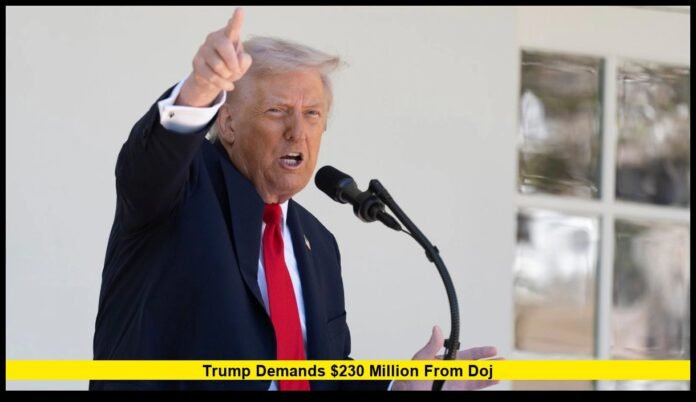

In a bold and unprecedented move, Donald Trump demands $230 million from the DOJ, alleging that the Department of Justice violated his rights during two major federal investigations. The claims—filed through official administrative channels—stem from the Russia probe and the FBI’s 2022 Mar-a-Lago raid. As of October 2025, Trump’s demand has drawn intense legal and political scrutiny, sparking debates over executive power, conflict of interest, and taxpayer accountability.
Background: What Trump’s $230 Million Demand Involves
Trump’s legal team filed two separate administrative claims with the Department of Justice:
- First Claim (2023): Seeks damages related to alleged rights violations during the 2016 election investigation into possible ties between Trump’s campaign and Russia.
- Second Claim (2024): Accuses the FBI and DOJ of malicious prosecution and privacy violations stemming from the 2022 Mar-a-Lago search, when classified documents were seized from Trump’s Florida estate.
Combined, these two filings total approximately $230 million—a figure Trump argues represents compensation for reputational damage, privacy invasion, and what he calls “unjust and politically motivated investigations.”
Why This Situation Is Historic
No U.S. president—current or former—has ever sought monetary compensation from the Department of Justice for actions taken during a federal investigation. Trump’s case stands out for several reasons:
- Conflict of Interest: Trump, as sitting president, oversees the DOJ, meaning any decision on the claim would ultimately require his administration’s approval.
- Ethical Dilemma: Senior DOJ officials, many of whom now serve under Trump, must evaluate a claim filed by their own commander-in-chief.
- Public Accountability: If approved, the payout would come from taxpayer funds, raising concerns about fiscal oversight and fairness.
Trump himself acknowledged the unusual nature of the situation, saying that it feels “odd” to be in a position to approve a claim where he is the claimant.
Timeline of Key Events
| Date | Event |
|---|---|
| Late 2023 | Trump’s attorneys file the first administrative claim related to the 2016 investigation. |
| Summer 2024 | A second claim is filed over alleged violations connected to the Mar-a-Lago raid. |
| October 2025 | Trump publicly confirms he is demanding around $230 million from the DOJ and suggests he may donate any award to charity. |
| Present | DOJ officials review the claims; congressional oversight committees announce plans to examine the process. |
Trump’s Position on the $230 Million Claim
Trump has stated publicly that he is not seeking personal enrichment from the potential payout. Instead, he insists his goal is to highlight alleged government misconduct and reclaim damages caused by “political targeting.” He added that any compensation received would be redirected to charitable causes.
In his words, “I’m not doing this for the money. I’m doing this to hold the government accountable for what they did to me—and by extension, to the American people.”
He also emphasized the irony that, as president, he would be required to review and sign off on any settlement from his own administration. “I guess I’d be paying myself,” he joked, underscoring the legal and ethical complexities involved.
The DOJ’s Position and Review Process
The Department of Justice has not issued any official response or comment on the claim’s progress. Under federal regulations, claims exceeding $4 million typically require high-level review and approval from senior DOJ leadership.
Because Trump’s claims are being evaluated during his own presidency, career ethics officials are expected to play a central role in ensuring impartiality. However, several legal analysts have noted that even this process poses challenges, as DOJ independence is being tested in ways never before seen.
Congressional and Public Reaction
House and Senate Democrats have expressed concern about the implications of Trump’s demand. Lawmakers have begun preliminary investigations into the legality of a sitting president filing monetary claims against a department he oversees.
Critics argue that the move sets a dangerous precedent—potentially allowing future presidents to seek financial compensation for legitimate government investigations. Others, including Trump supporters, see the claims as an act of accountability, asserting that the DOJ’s prior actions represented an abuse of power.
Public reaction remains deeply divided. Some Americans view Trump’s demand as justified retribution for politically motivated probes, while others see it as a conflict of interest that could undermine faith in the justice system.
Legal and Ethical Complications
Trump’s $230 million demand raises multiple legal questions:
- Federal Tort Claims Act Limits: The act typically restricts claims against the government for discretionary or policy-related actions. Whether Trump’s complaints fall within its scope remains uncertain.
- Executive Authority: Because Trump currently leads the executive branch, approving a settlement would effectively mean authorizing payments to himself.
- Constitutional Precedent: No legal precedent exists for a sitting president receiving damages from the DOJ, and any settlement could face immediate judicial challenges.
- Taxpayer Funds: Any payment from the DOJ would come from public money, prompting concerns about the ethical and fiscal justification for such a transfer.
Legal scholars predict that even if the DOJ considered the claim valid, it could be tied up in court for years due to its constitutional sensitivity.
Possible Outcomes
There are three potential paths forward:
- Denial: The DOJ may choose not to settle or take further action, effectively rejecting the claim.
- Negotiation: DOJ officials could engage in settlement discussions with Trump’s legal team, though such talks would be fraught with ethical complications.
- Litigation: If the DOJ denies the claim, Trump could pursue the matter in federal court, escalating the issue into a constitutional showdown.
Each option carries significant political and legal consequences. A denial could fuel Trump’s narrative of persecution, while any payout could trigger backlash over the use of public funds.
Broader Implications for U.S. Governance
This unprecedented episode raises fundamental questions about the balance of power in the U.S. government:
- Accountability: Should a president have the right to seek personal compensation from agencies under his control?
- Transparency: Can the DOJ remain independent if it must evaluate claims filed by the nation’s top executive?
- Public Trust: How the government handles this claim could influence Americans’ confidence in federal institutions for years to come.
For the DOJ, the case underscores the tension between maintaining institutional independence and operating under a politically charged administration. For Trump, it reinforces his long-standing claim that he was unfairly targeted by political opponents within the government.
Current Status as of October 2025
As of today, no settlement or resolution has been announced. DOJ officials have not publicly discussed the matter, and no evidence suggests active negotiations are underway. Congressional oversight hearings are expected to begin soon, focusing on transparency and potential conflicts of interest within the process.
Trump continues to assert that his claims are valid and that any recovery would serve as proof of government overreach. Meanwhile, legal experts anticipate that even if the DOJ moves to reject the claim, Trump could pursue civil remedies in federal court—prolonging the controversy well into 2026.
Frequently Asked Questions (FAQ)
Q1: Why is Trump demanding $230 million from the DOJ?
Trump alleges that the DOJ and FBI violated his rights during investigations into his 2016 campaign and the 2022 Mar-a-Lago raid, causing reputational and financial harm.
Q2: Can a sitting president legally file a claim against the DOJ?
There is no precedent. Legal experts say such claims present a significant conflict of interest and may face constitutional barriers.
Q3: Has the DOJ responded to the claims?
As of now, the DOJ has not made any public statements or taken formal action on the claims.
Q4: What happens if the DOJ agrees to pay Trump?
Any payout would need multiple levels of approval, likely including the Attorney General’s office, and would be subject to oversight due to potential conflicts of interest.
Q5: Could this affect future administrations?
Yes. This situation may set a precedent for how future presidents handle perceived government overreach, potentially reshaping executive accountability standards.
Disclaimer
This article presents verified facts and updates as of October 2025 regarding Donald Trump’s $230 million demand from the U.S. Department of Justice. It does not offer legal opinions or predictions about potential outcomes. All interpretations of events are based on currently available information.
In conclusion, the story of how Trump demands $230 million from the DOJ is not just about money—it’s about power, accountability, and the limits of presidential authority. As legal and political tensions mount, Americans across the political spectrum are watching closely to see how this unprecedented claim unfolds.
Bold: Stay tuned and share your thoughts below—this case could redefine the relationship between the presidency and the justice system.