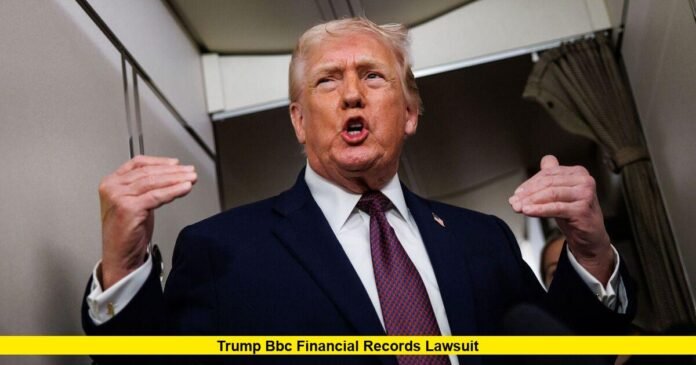

The Trump BBC financial records lawsuit has taken a dramatic turn after a federal magistrate judge ordered President Donald Trump to hand over detailed financial documents connected to his massive defamation claim against the British Broadcasting Corporation. The ruling, issued this week in Miami federal court, marks one of the most consequential developments yet in a legal battle that began late last year and could stretch well into 2027.
Background of the Lawsuit
Trump filed his defamation suit against the BBC in December 2025, accusing the British broadcaster of deceptively editing his January 6, 2021 speech to make it appear as though he had directly incited the Capitol riot. The lawsuit was filed in a federal court in Florida, seeking at least $10 billion in damages from the British broadcaster. The complaint centers on a Panorama documentary titled “Trump: A Second Chance,” which aired roughly a week before the 2024 U.S. presidential election.
According to the suit, the BBC “maliciously” strung together two comments Trump made more than 54 minutes apart, creating the impression that he had urged supporters toward violence while Congress was preparing to certify the 2020 election results. Trump’s legal team argued that such a dramatic edit could not have happened by accident, insisting it would have been “impossible” for BBC journalists to splice the remarks together unless they were acting intentionally.
The BBC had already acknowledged problems with the edit before the lawsuit was filed. BBC chairman Samir Shah had called it an “error of judgment,” and the controversy triggered leadership changes at the network, including resignations tied to the fallout. The broadcaster apologized to Trump over the edit but rejected claims that it had defamed him. That apology, however, did not stop Trump from moving forward with what became one of the largest media defamation claims in recent history.
Career and Legal Pattern Behind the Case
Trump’s legal battle with the BBC is not an isolated event but part of a broader pattern of litigation against major media organizations. In the twelve months leading up to the BBC suit, Trump secured large settlements from CBS, ABC, and Meta, and his legal team has framed these outcomes as accountability wins against what they describe as biased coverage. Trump also won a $24.5 million settlement from YouTube over the suspension of his account, according to a court filing.
Not every case has gone in his favor, though. A judge threw out his lawsuit against the Wall Street Journal earlier this year, calling it “groundless,” and a separate suit against CNN was previously dismissed as “meritless.” This mixed record adds context to the BBC case, showing that while Trump has leveraged legal pressure effectively against some outlets, courts have not universally sided with him. The BBC lawsuit is widely seen as a test of how far these tactics can go against a foreign public broadcaster operating in a U.S. court system.
The Financial Records Ruling
The most significant recent development in the Trump BBC financial records lawsuit came when U.S. Magistrate Judge Enjoliqué Lett ruled that Trump must turn over extensive financial documentation tied to his businesses. Lett concluded that Trump’s sweeping complaint placed injury to his businesses at the forefront of the case, making their financial vitality a fair subject for the BBC to investigate. During a three-hour hearing, the judge stated plainly that “all of President Trump’s brand, properties and businesses are impugned or said to have been impugned,” adding that reputational and economic damages were now central issues in the case.
The scope of the ruling is notably broad. It opens Trump’s finances across more than 400 companies to scrutiny by BBC attorneys, according to reporting from Politico. This means the BBC’s legal team may be able to examine financial records connected to a wide network of Trump-affiliated businesses, not just entities directly named in the lawsuit. Trump does have the option to appeal the ruling to U.S. District Judge Roy Altman, a Trump appointee, though it remains unclear whether that appeal will be pursued or how it might affect the discovery timeline.
Interestingly, Trump’s attorney attempted to narrow the scope of damages during the hearing. Attorney Al Brito told the judge that the case had “evolved,” arguing that Trump now sought only reputational damages rather than economic ones. Despite that argument, the judge determined that the original framing of the lawsuit — which emphasized harm to Trump’s brand and business interests — still justified financial disclosure.
The ruling also addressed how deeply the BBC can probe events surrounding January 6. Judge Lett stated that the network could explore how people interpreted Trump’s statements that day, but she drew a clear line, saying “the full relitigation of Jan. 6 is not at issue.” This distinction is important, as it limits the scope of discovery to the impact and interpretation of Trump’s words rather than reopening broader questions about the events of that day.
Public Interest and Ongoing Discovery Disputes
Public and media interest in this case remains high, partly because of the sheer size of the damages sought and partly because of what the case could reveal about Trump’s business empire. Beyond the financial records dispute, the BBC has also pushed for Trump to sit for a deposition. According to reporting, BBC attorneys said Trump’s team was “dragging their feet” on providing a date for the president’s deposition, suggesting that discovery disputes in this case are likely to continue generating headlines in the months ahead.
The case has also seen procedural friction beyond the financial records issue. In June, Trump’s legal team faced criticism from the court after missing a filing deadline, and attorneys were separately warned about submitting citations that appeared to be generated by artificial intelligence. These developments, while procedural in nature, have added to the narrative that the litigation has been unusually contentious even by the standards of high-profile defamation cases.
Latest Updates on the BBC Defendants
In a related and more recent development, Trump has agreed to narrow the list of defendants in the case. He has agreed to drop BBC Studios Productions and BBC Studios Distribution from the lawsuit, while continuing to pursue his $10 billion claim against the BBC itself. A court filing confirmed that Trump will continue prosecuting his claims against the British Broadcasting Corporation, with the BBC remaining as the sole defendant moving forward.
The BBC had argued that its studio subsidiaries had no role in creating or producing the documentary and did not broadcast it within the United States, which appears to have factored into Trump’s decision to drop them from the suit. With the defendant list simplified, the case now turns more directly toward the BBC’s own motion to dismiss. The broadcaster maintains that the Panorama documentary does not meet the legal threshold for defamation and was never made available on its U.S. platforms, a defense that could prove central to how the case unfolds in the coming months.
Trump’s legal team has pushed back forcefully on that argument. His lawyers have called the BBC’s position “an untenable proposition,” warning that dismissal on those grounds would amount to “a wrongful and unjust result.” They have also argued that the BBC’s geo-blocking technology did not reliably prevent U.S.-based viewers from accessing its UK-only iPlayer streaming platform, and that documentary production staff reportedly gave instructions to several people on how to watch the program from within the United States.
As it stands, the case is currently on track for a trial date in February 2027, though pretrial disputes over financial records, depositions, and the motion to dismiss are likely to shape the direction of the case well before it reaches a courtroom. Given the scale of the damages sought and the financial disclosure now required, legal observers may continue watching this case closely as a bellwether for how courts handle high-profile defamation claims involving international broadcasters.
Final Thoughts
The Trump BBC financial records lawsuit has evolved from a straightforward defamation claim into a sprawling legal battle touching hundreds of business entities, high-stakes discovery fights, and unresolved questions about jurisdiction over a foreign broadcaster. With the BBC now the sole remaining defendant and a February 2027 trial date on the calendar, the coming months are expected to bring further rulings on discovery, the pending motion to dismiss, and possibly an appeal of the financial records order itself. As of now, there is no official confirmation of a settlement or resolution, and both sides appear prepared for a prolonged legal fight.
Stay tuned for continuing updates on this high-profile case, and share your thoughts on how you think this legal battle will unfold.