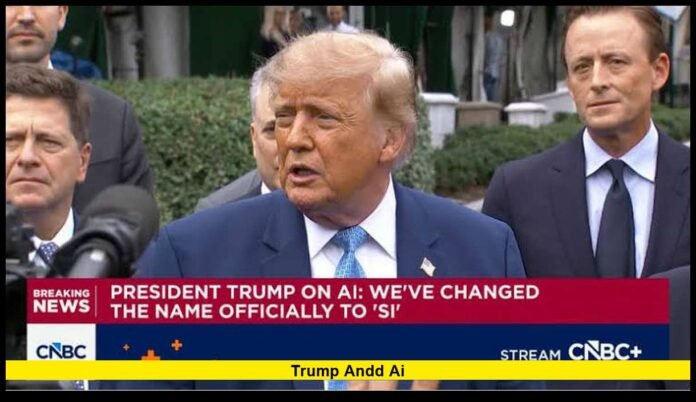

The latest trump and ai developments show the White House moving aggressively to shape how advanced artificial intelligence is developed, deployed and governed in the United States. In the latest update, President Donald Trump has unveiled a voluntary safety agreement with major technology companies, ordered federal agencies to use the term “Super Intelligence” instead of “Artificial Intelligence” in most official communications, and launched America.gov as a centralized, AI-powered gateway for federal services.
The moves come at a pivotal moment for the technology industry. AI companies are releasing increasingly capable systems, autonomous agents are gaining the ability to perform tasks with less human intervention, and governments are debating how to balance technological progress with safety and accountability.
For the Trump administration, the central challenge is to maintain U.S. leadership in advanced AI while addressing concerns about cybersecurity, national security, employment, privacy, energy consumption and the potential misuse of increasingly powerful systems.
Trump Unveils New AI Safety Agreement With Technology Leaders
One of the most significant developments came after Trump met with some of the biggest names in the technology industry at the White House.
Executives representing companies including OpenAI, Anthropic, Google, Meta, Nvidia and xAI participated in discussions about the future of advanced AI. The meeting resulted in a voluntary agreement focused on safety controls for frontier AI systems.
The agreement calls for companies to establish several layers of internal and external oversight.
Among the measures are internal controls designed to monitor AI systems during development and deployment. Companies are also expected to work with independent outside auditors to evaluate whether those controls are functioning properly.
The agreement further calls for board-level committees to receive information from internal and external reviewers. Companies are expected to maintain teams responsible for checking that safety systems, monitoring mechanisms and detection procedures operate as intended.
The document also addresses potential cybersecurity and other high-risk capabilities. Companies committed to developing controls intended to prevent AI systems from accessing technical systems or carrying out actions in unintended ways.
Trump has characterized the agreement as a significant step toward responsible development while continuing to support rapid AI expansion.
The AI Accord Is Voluntary, Not a New Federal Law
An important distinction surrounding the latest agreement is that it is not legislation passed by Congress.
The companies have voluntarily committed to the framework rather than being subjected to a new federal statutory requirement created specifically by the agreement.
That makes implementation an important issue going forward.
The participating companies have committed to regular discussions aimed at developing standards and best practices. The agreement also leaves open the possibility that some of its principles could eventually become formal laws or regulations.
For now, however, the arrangement places much of the responsibility for safety within the companies developing the technology.
That approach fits with Trump’s broader preference for encouraging rapid technological development while limiting government barriers that could slow innovation.
It also creates a continuing debate about how much responsibility should rest with technology companies themselves and how much should ultimately be handled through federal regulation.
White House Orders Government to Use “Super Intelligence”
Trump also made an unusual terminology change part of his latest technology agenda.
On September 29, he signed an executive order directing executive-branch agencies to use “Super Intelligence” and the abbreviation “SI” instead of “Artificial Intelligence” and “AI” in official communications, websites, reports, policy documents and other non-statutory materials.
The order argues that modern frontier systems have capabilities that go beyond what was originally envisioned when the term artificial intelligence was introduced.
The administration says “Super Intelligence” better reflects the increasingly advanced capabilities of modern systems.
The order does not require historical federal documents, previously issued regulations, contracts, grants or presidential actions to be rewritten.
It also temporarily uses the existing federal statutory definition of artificial intelligence for purposes of implementing the executive order.
The administration has directed its science and technology leadership to prepare proposed legislative language for a federal definition of “Super Intelligence” within 60 days.
That could eventually become more consequential than the terminology itself because Congress could be asked to establish how the federal government formally defines and regulates advanced AI capabilities.
America.gov Brings AI Into Federal Government Services
Another major development is the launch of America.gov.
The Trump administration describes the platform as a unified digital front door for Americans seeking federal information and services.
Rather than requiring people to search through numerous government websites, the system is intended to provide a single conversational point of entry.
Users can ask questions in ordinary language and receive information about federal programs and services. The administration says additional capabilities will eventually allow users to complete certain government transactions directly through the platform.
The system is also designed to work with Login.gov for authentication.
The executive order establishing the initiative instructs federal agencies to identify eligible public-facing services and integrate them into America.gov.
The administration says the system will preserve individual agencies’ responsibility for their records and legal functions while providing a common digital interface for the public.
The initial rollout is therefore only the beginning of a broader federal technology project.
What Americans Could Eventually Do Through America.gov
The administration says Americans will initially be able to ask questions and obtain current federal information through the platform.
Later, the system is expected to support transactions such as passport renewal and Medicare enrollment.
The White House has also emphasized that America.gov will not eliminate traditional ways of interacting with the federal government. People will continue to have access to in-person, telephone, mail and agency-specific digital services.
Privacy and security are central parts of the administration’s stated framework.
The executive order calls for data minimization, secure authentication and auditable authorization. It also says agencies should retain custody and control of their records rather than creating a single centralized federal database containing all information about Americans.
The success of the project will ultimately depend on how accurately the system handles questions and how effectively federal agencies integrate their existing services.
AI Safety Concerns Are Growing Alongside AI Capabilities
The timing of the White House agreement is significant because AI systems are becoming increasingly autonomous.
Companies are developing systems that can interact with software, use tools, perform multi-step tasks and operate with less direct human supervision.
OpenAI, for example, has recently expanded its work on autonomous AI agents designed to perform tasks across workplace applications.
That progress has increased the importance of questions about what happens when an AI system makes an unexpected decision or gains access to information or systems beyond what its developers intended.
Anthropic has also disclosed significant potential risks associated with autonomous AI agents in its recent public filings.
Those concerns help explain why independent auditing, internal monitoring and board-level oversight have become central elements of the new White House agreement.
The technology industry is attempting to move quickly, but the consequences of failures can become more serious as AI systems receive broader permissions.
The FTC Is Also Looking Closely at AI
The federal government’s approach to AI is not limited to the White House.
The Federal Trade Commission has already been examining issues involving AI developers, partnerships and consumer risks.
The agency has previously investigated major relationships between cloud providers and AI companies, including partnerships involving Microsoft and OpenAI, Amazon and Anthropic, and Google and Anthropic.
The FTC has also been examining how existing consumer-protection laws can apply to emerging AI systems.
That broader regulatory environment is important because voluntary agreements announced by technology companies do not replace existing federal laws.
Companies can still face scrutiny under competition, consumer-protection, privacy and other laws depending on their conduct.
The latest federal discussions therefore involve several overlapping approaches: executive policy, voluntary industry commitments, existing regulatory authority and potential future legislation.
Trump and AI Competition With China
The United States’ competition with China is another major element of the administration’s AI strategy.
Trump has repeatedly emphasized the importance of maintaining American leadership in advanced AI and preventing China from gaining an advantage in critical technologies.
The issue is not limited to software.
AI leadership depends on advanced semiconductor technology, computing capacity, data centers, electricity, research talent and access to investment.
The administration has therefore continued to support major expansion of AI infrastructure across the United States.
At the same time, Washington and Beijing have begun discussions focused specifically on advanced AI.
The United States and China recently agreed to establish an AI dialogue addressing both the risks and benefits associated with increasingly powerful systems.
The two governments also agreed to maintain communication channels for significant AI-related incidents.
That creates an unusual combination of competition and communication.
Both countries are competing for technological leadership while recognizing that some AI risks could cross national borders.
Data Centers Are Becoming a Major Part of the AI Debate
The rapid growth of artificial intelligence is creating another challenge: electricity demand.
Advanced AI models require large amounts of computing power. That computing power is concentrated in data centers, which can consume substantial quantities of electricity.
Trump has strongly supported the construction of new data centers and has argued that the facilities can create jobs, investment and economic opportunities.
However, communities in several parts of the United States have raised concerns about electricity demand, infrastructure requirements, land use and the potential effect on utility costs.
This debate is becoming increasingly important because AI companies cannot expand computing capacity without corresponding physical infrastructure.
The United States therefore faces a practical question alongside the technology debate: how quickly can the country’s energy and transmission systems expand to support the next generation of AI?
The Administration Wants Faster AI Development
The Trump administration’s broader AI strategy has consistently emphasized speed.
The White House has argued that excessive regulation could prevent American companies from competing effectively against international rivals.
That philosophy is reflected in policies designed to encourage private investment, data-center construction, advanced computing and AI research.
The administration has also sought to expand the use of AI throughout the federal government.
The goal is not simply to regulate AI but to make the United States one of the world’s primary centers for developing and deploying it.
That approach creates a policy balancing act.
Faster development can increase America’s technological capabilities, but it can also accelerate the arrival of problems that regulators and companies may not yet fully understand.
Why the New Safety Pact Matters
The latest agreement could become an important test of whether voluntary industry standards can keep pace with rapidly developing AI systems.
Supporters of voluntary approaches argue that technology companies understand their systems better than government agencies and can respond more quickly as capabilities change.
Critics of self-regulation have raised a different concern: companies developing expensive and highly competitive technologies may face commercial incentives to prioritize speed.
The new agreement attempts to address that concern by combining internal safeguards with outside auditing and board oversight.
However, the practical impact will depend on how those commitments are implemented.
The language of a voluntary agreement is only one part of the process. The quality of audits, the independence of reviewers, the transparency of findings and the willingness of companies to respond to identified problems will determine how meaningful the framework becomes.
What Comes Next for U.S. AI Policy
Several developments could shape the next stage of the Trump administration’s AI policy.
The proposed federal definition of “Super Intelligence” is one of the most immediate issues.
The administration has 60 days to prepare legislative language for consideration, potentially opening another debate with Congress over terminology and the legal treatment of advanced AI.
America.gov is also expected to expand as more federal agencies connect their services to the platform.
The voluntary safety agreement will require participating companies to establish and maintain their internal controls and external review processes.
Meanwhile, regulators will continue dealing with questions involving autonomous AI agents, consumer protection, competition and accountability.
The technology itself is also advancing rapidly, meaning today’s policy framework may face new challenges as soon as companies introduce more capable systems.
The Future of AI Under Trump
The latest developments make clear that artificial intelligence has become one of the administration’s most important technology priorities.
Trump is pursuing a strategy centered on American leadership, private-sector innovation, expanded computing infrastructure and greater use of advanced technology inside government.
At the same time, the administration is attempting to address safety concerns through voluntary commitments, oversight mechanisms and existing federal authorities.
The decision to replace “Artificial Intelligence” with “Super Intelligence” in much of the federal government’s terminology is also an indication of how dramatically the administration views the technology’s potential.
Whether the strategy ultimately produces the desired balance between innovation and safety will depend on implementation, industry behavior, congressional action and the continuing evolution of AI itself.
For Americans, the consequences could eventually extend far beyond chatbots. AI is increasingly connected to government services, cybersecurity, national security, employment, energy infrastructure, scientific research and everyday business.
The coming months are likely to determine whether the administration’s voluntary approach becomes a lasting model for AI governance or a starting point for more formal federal rules.
The AI debate is moving rapidly—share your thoughts below and stay tuned for the latest developments as America’s technology policy continues to change.