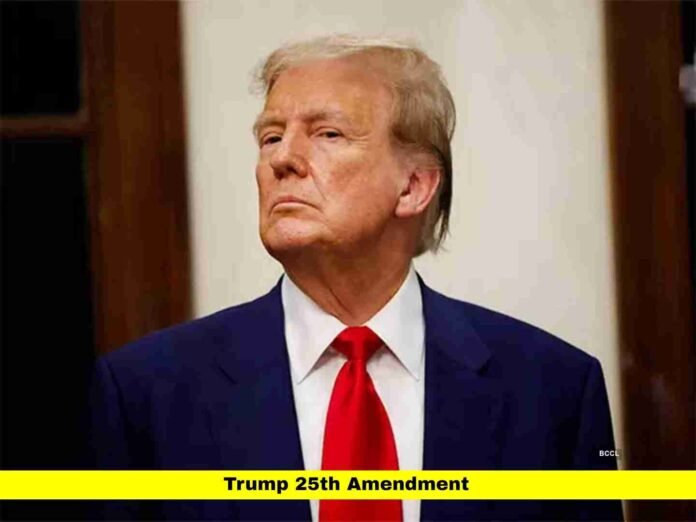

In 2026, the question of trump 25th amendment dominated political discussions in Washington and across the United States, spotlighting whether the U.S. Constitution’s provisions for presidential incapacity should be invoked amid controversy surrounding President Donald Trump’s conduct, statements, and decision-making. This debate drew public calls from lawmakers, civil rights leaders, activists, and commentators who argued that the amendment — rarely used and historically sensitive — was worth considering as a constitutional response to what they described as alarming actions and statements from the White House.
But what does this constitutional measure actually involve? Why has it resurfaced with such intensity now? And how does the current political climate shape both the feasibility and implications of potentially using this amendment? This comprehensive article takes readers through the full context of the debate, the legal framework, its historical background, and the specific events that thrust the amendment into public discourse in 2026.
What Is the 25th Amendment and Why It Matters Today
The 25th Amendment to the U.S. Constitution addresses presidential succession and the unforeseen incapacity of a sitting president to fulfill official duties. Ratified in 1967, it has four sections that lay out procedures for handling situations where a president dies, resigns, refuses to serve, or becomes unable to discharge the powers and duties of the office.
Section 4 of the amendment is the most controversial and also the least invoked. It allows the vice president and a majority of the Cabinet — or another designated body — to declare the president unable to carry out his duties, triggering the transfer of presidential powers to the vice president as acting president. If the president disputes that declaration, Congress must decide the issue by a two-thirds vote in both the House and Senate.
In 2026, this part of the amendment became central to national discussion because critics argued that certain actions by the president raised questions about his fitness to serve. Politicians, civil rights leaders, and advocacy groups cited mental fitness, erratic rhetoric, and specific diplomatic actions as reasons to revisit Section 4.
How the Debate Resurfaced in 2026
The debate around invoking this constitutional clause gained traction in early 2026 following a series of high-profile actions by the president that drew criticism from both political opponents and some within his own party.
One especially notable flashpoint was the president’s renewed push to assert U.S. control over Greenland. Analysts described the public messaging as aggressive and historically inaccurate, which sparked public backlash and renewed calls to consider whether the president was fit to lead.
In response, some Democratic lawmakers publicly suggested that the amendment should be used to remove him from office based on what they described as erratic behavior and unpresidential conduct. Social media discussions and public petitions echoed these concerns, with some urging immediate constitutional action.
While these calls have not resulted in any formal invocation of the amendment, they illustrate the heightened anxiety and division over presidential decision-making and accountability.
Civil Rights Leaders Add Momentum to the Discussion
On February 18, 2026, civil rights leaders took the debate a step further by urging key executive branch figures — including the vice president and Cabinet officials — to consider using the amendment to remove the president from office.
Figures within the National Urban League and other influential organizations referenced past events in U.S. history, including the violent insurrection at the U.S. Capitol in 2021, as foundational reasons to act. They framed their calls as necessary for the preservation of democratic institutions and public safety, arguing that past events had already tested constitutional boundaries.
While these calls were forceful, they also underscored how rarely the constitutional measure has been invoked in American history, and how high the threshold remains for action under Section 4.
Political Landscape: Support and Opposition to the Amendment
The push to consider the amendment has emerged amid intensifying partisan divide. Some Democratic lawmakers and progressive commentators have embraced the idea, arguing that recent presidential behavior and public statements reveal an inability to discharge the duties of the office at the level required for national leadership.
They contend that the amendment was specifically designed for situations where the health or conduct of a president calls into question his capacity to govern effectively. They note that invoking Section 4 would require the vice president and a majority of the Cabinet to agree that the president is unfit, a high bar rooted in constitutional design.
Opposition to invoking this provision has come from Republican leaders, conservative commentators, and White House allies who dismiss the calls as politically motivated or without sufficient legal basis. They argue that the amendment is a safeguard intended for clear medical incapacity, not for policy disagreements or controversial statements.
The White House has publicly downplayed calls for invoking the constitutional measure, with officials arguing that the president remains capable of fulfilling his duties and that such discussions are distractions from policy objectives.
Key Public Statements Rekindling the Debate
Several public figures have weighed in on the debate over whether the amendment should be considered.
Some elected officials publicly stated that presidential rhetoric — including statements about foreign policy, military actions, and diplomatic relations — raised concerns about clarity of thought and judgment. These concerns contributed to intensified calls for constitutional intervention.
Civil rights organizations, alongside grassroots movements, also amplified the discussion, leveraging social media and public petitions to demand congressional attention and executive branch review of the president’s performance.
These movements underscore how political polarization intersects with constitutional mechanisms designed to ensure continuity of effective governance.
What Section 4 Really Entails
Section 4 of the amendment spells out a clear, yet complex process for presidential removal based on incapacity:
- The vice president and the majority of principal executive department officers — typically interpreted as the Cabinet — must agree that the president cannot discharge the powers and duties of office.
- They must transmit that declaration in writing to the president pro tempore of the Senate and the Speaker of the House.
- The vice president immediately becomes acting president.
- If the president disputes the declaration, Congress must convene and decide the issue within 21 days. A two-thirds vote in both chambers is required to sustain the determination that the president is unable to serve.
This process prevents unilateral action and places significant authority in the hands of multiple constitutional actors, reflecting the founders’ intent that such a grave step should remain difficult and deliberate.
Historical Use of the 25th Amendment
Although invoked several times for medical reasons when presidents temporarily transferred power during surgeries or medical procedures, Section 4 has never been used to remove a president permanently from office.
Past presidents have used Section 3 voluntarily when they received anesthesia or underwent medical treatment that temporarily impaired their ability to serve. But no president has faced an involuntary declaration of incapacity.
The fact that this clause has never been successfully executed — even in moments of public outcry — highlights how challenging it is to meet the constitutional requirements, let alone build broad political support for such an action.
Political Reactions to 2026 Calls for Action
In 2026, reactions to calls for using the amendment were sharply divided.
Supporters argued that current presidential actions posed enough concern to consider constitutional remedies. They emphasized that the amendment exists precisely to address situations where the commander-in-chief may be compromised.
Opponents countered that using this measure for political disagreement rather than clear medical incapacity would set a dangerous precedent. They maintained that the amendment was never intended to resolve policy disputes or unpopular decisions.
The administration maintained that the president remained capable of fulfilling his duties and dismissed suggestions of invoking extraordinary constitutional measures as politically motivated.
Public Opinion and Social Media Engagement
Public engagement around the amendment surged on digital platforms. Individuals and groups launched petitions calling for immediate review of presidential fitness and accountability.
These petitions highlighted the power of grassroots engagement in modern political discourse — even for constitutional mechanisms that require action by specific institutional actors.
While these petition efforts reflected widespread activism, they did not meet any legal requirements or procedural thresholds necessary to trigger official review.
Legal Experts on the Amendment’s Feasibility
Legal experts in Washington repeatedly emphasized that Section 4 is deliberately difficult to enact. It requires unanimous or near-unanimous agreement among the vice president and the Cabinet, a prospect political analysts consider unlikely unless there is clear, incontrovertible evidence of incapacity.
Even if all executive branch leaders agreed to act, the president could challenge that declaration and take the question to Congress. There, two-thirds majorities in both chambers are required, a high bar that speaks to the framers’ intent to protect the presidency from partisan removal efforts.
These legal realities underscore why Section 4 is considered a constitutional measure of last resort, reserved for extreme circumstances rather than routine political disagreement.
How the Debate Impacts the Political Climate
The ongoing discussion about invoking the amendment has helped shape broader debates about presidential accountability, fitness, and constitutional checks and balances.
It has prompted renewed focus on:
- The role of the executive branch in upholding democratic norms
- How institutional mechanisms safeguard against incapacity
- The interplay between political disagreement and constitutional safeguards
- Perceptions of presidential capability among both supporters and critics
This debate — while centered on a specific legal provision — ripples through larger conversations about governance, public trust, and how constitutional mechanisms function in deeply divided political environments.
Broader Conversations on Presidential Fitness
The debate has also intersected with discourse about presidential speech, decision-making, and public conduct.
Observers noted episodes that sparked scrutiny, including public misstatements and controversial diplomatic overtures, as contributing to narratives that prompted constitutional debate. Critics argued these actions raised questions about judgment and temperament, while supporters defended them as part of robust executive decision-making.
These contrasting views highlight how political interpretation and constitutional standards can diverge, even when reviewing the same set of actions.
How the Amendment Differs from Impeachment
Many Americans conflate the 25th Amendment with impeachment, but they serve distinct purposes and processes.
Impeachment is a political process designed to remove a president for “high crimes and misdemeanors.” It is initiated in the House of Representatives and, if approved, leads to a trial in the Senate.
The amendment, by contrast, addresses incapacity — whether a president is mentally or physically unable to fulfill duties. It involves executive branch actors and, if contested, Congress in a constitutional judgment rather than a criminal or political offense.
Understanding this distinction clarifies why invoking one mechanism has different legal and political implications than invoking the other.
Recent Public Momentum and Civic Engagement
In early 2026, grassroots movements, public demonstrations, and social media activism elevated the conversation about the amendment. Groups organized rallies and petitions urging accountability and constitutional review. These efforts reflect how modern civic engagement can amplify constitutional questions even when they do not directly result in legal action.
While these movements drew attention, they did not create legal authority to compel action. Only the vice president, the Cabinet, and, if necessary, Congress can execute the amendment’s Section 4 process.
Real World Implications for Governance
The debate over using the amendment has ramifications beyond political rhetoric. It forces institutional consideration of what constitutes incapacity, how to balance competing branches of government, and how to uphold constitutional norms during times of political stress.
Even without invocation, the public discussion itself serves as a reminder of the constitutional foresight that allows for peaceful transitions of power if a president cannot serve.
This ongoing debate reinforces the need for clarity and communication between government officials, lawmakers, and the public when interpreting constitutional tools.
What Happens Next in the 2026 Political Environment
As 2026 continues, there has been no official use of Section 4 of the amendment to remove or temporarily replace the president. The debate, however, remains a central topic in political discourse.
Lawmakers, civil leaders, and activists continue to discuss presidential fitness, constitutional safeguards, and how democratic systems respond when confidence in leadership erodes.
Whether the amendment will ever be invoked remains uncertain. The constitutional procedures require cooperation among multiple government actors and clear evidence of incapacity — conditions that have not been met at this time.
But the mere fact that such discussions are taking place shows how constitutional mechanisms remain relevant even decades after ratification.
Conclusion: A Constitution Under Scrutiny and Debate
The discussion surrounding the constitutional measure and the presidency in 2026 reveals how foundational the U.S. Constitution remains in guiding debates about leadership, accountability, and governance.
While no invocation has occurred, the continuing conversation underscores:
- How citizens interpret presidential behavior
- The weight of constitutional language in modern politics
- The balance between legal authority and political will
- How institutions safeguard democratic continuity
For many Americans, this debate is about more than one individual. It is about how constitutional systems function when norms are strained.
What are your thoughts on the role of constitutional safeguards in modern politics? Share your perspective below and stay informed as events continue to unfold.