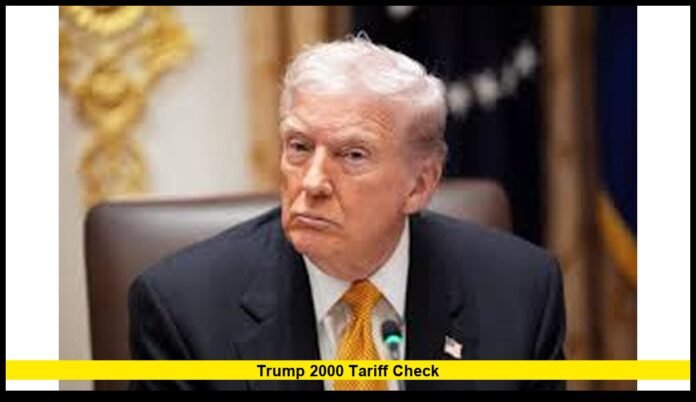

Trump 2000 tariff check is once again under national spotlight after a November 9, 2025 announcement by President Donald Trump. In that announcement, he declared that most Americans—excluding “high-income people”—would receive a $2,000 “tariff dividend,” a payday tied to the success of his administration’s aggressive tariff policies. That single statement ignited a wave of public interest, speculation, and scrutiny across Washington, D.C. and beyond.
As of late November 2025, the plan remains in a state of flux. While the administration has touted growing tariff revenues as a funding source, no concrete legislation has passed. Treasury officials have offered only vague suggestions about delivery methods. At the same time, lawmakers, economists, and even some within the president’s party have raised serious fiscal, legal, and political questions. This article unpacks every major aspect of the proposed refund, what is known and unknown, and why ordinary Americans should pay attention.
How the “tariff check” idea came about
Over the past year, the Trump administration broadened what it calls “reciprocal tariffs.” These tariffs targeted hundreds of imported goods ranging from electronics to clothing, aiming to boost U.S. manufacturing and to collect extra revenue. Tariff revenue, officials argue, surged significantly — enough, they claim, to consider rebating some of it to American households.
On November 9, 2025, the president used his social platform to tell Americans they could expect a $2,000 rebate. He framed this as a “tariff dividend,” a reward for enduring higher import costs and for supporting the administration’s trade strategy. The announcement sparked immediate excitement among voters — especially in states where political support has shifted — and created pressure on Capitol Hill to respond.
However, despite widespread media coverage and public discussion, the administration has not drafted or introduced a formal bill to authorize the rebate. Treasury officials have said publicly that they are “exploring all options,” but stopped short of saying the rebate will take the form of a direct check. As of November 30, 2025, neither Congress nor the White House has submitted an actual plan for approval.
What Trump has said — and what he hasn’t
- What he said: The president promised a “tariff dividend” of $2,000 for every American except those deemed “high-income.” He described this as a share of tariff revenues — a payoff for voters enduring higher cost of imports.
- What he hasn’t said: He has not defined “high-income.” He has not disclosed how or when the payment would arrive. He has not explained whether the payment would be a check, direct deposit, tax credit, or other form of relief. He has not proposed legislation to authorize the payment.
Because of these gaps, many Republicans in Congress have publicly urged caution. They point to the enormous cost and logistical challenge of administering such a payment, especially without a clear funding or legal structure. Some have warned that rushing legislation could deepen the already massive federal debt.
The financial math — is it even possible?
Behind the bold promise lies a costly reality. To appreciate the challenge, consider how federal government revenues and expenses compare. Tariff receipts — even after aggressive tariff hikes — remain only a small sliver of overall federal income.
- Tariffs typically generate just a few percentage points of total annual federal revenue — even when imports are taxed heavily.
- To pay a $2,000 rebate to every adult — let alone every eligible household — the total cost would balloon into the hundreds of billions.
- If the rebate applies to all adults, or to all taxpayers, the required revenue would likely exceed what tariffs could realistically deliver.
Even supporters acknowledge these constraints. Absent major new sources of revenue, applying the rebate broadly — especially at $2,000 per person — would almost certainly require additional funding from general tax revenue or new borrowing. That has already drawn concern from budget hawks and fiscal conservatives alike.
Legal and procedural obstacles
Beyond revenue concerns, the rebate proposal faces serious legal and bureaucratic hurdles.
- Tariffs are enforced under trade laws and regulatory frameworks that allow for import taxes. Using tariff revenue to fund a mass rebate — especially one targeting individuals — would likely require new legislation.
- Congress controls federal spending. Without its approval, the executive branch cannot unilaterally issue checks or credits to citizens.
- Administering a mass rebate would involve the Internal Revenue Service or another agency. That agency would need criteria: who qualifies, how to distribute funds, how to verify identity and income, how to prevent fraud. That requires time and resources.
- Courts could get involved. If legal challenges are raised — for example on fairness, constitutionality, or misuse of tariff receipts — the process could stall entirely.
In short, even if the political will existed, the logistical and legal steps are significant.
Political context and divisions
The “tariff check” idea has created sharp divisions — even within the president’s own political base.
Supporters
- Many voters hit by inflation and rising costs see the rebate as a potentially welcome financial boost. For those struggling with higher grocery bills, energy costs, or housing expenses, $2,000 could ease pressure.
- Some lawmakers anticipate the proposal could improve the party’s standing in swing districts ahead of the 2026 midterm elections. They view the rebate as a tangible benefit to offer voters.
- Pro-tariff advocates argue that the rebate could show the public that strong trade enforcement pays off — literally. They hope the plan could help rally support for continued trade restrictions and border enforcement.
Opponents
- Fiscal conservatives argue that the federal government already runs large deficits; adding a multi-hundred-billion-dollar rebate would worsen debt.
- Fiscal hawks urge caution, pointing out that relying on volatile tariff revenue to fund recurring payments is risky. Global supply changes, trade wars, or court rulings could disrupt collections.
- Some lawmakers worry about setting a precedent: if tariff revenue can be redistributed as rebates, what stops future administrations from promising similar payouts tied to taxes or user fees?
The divisions reflect deeper philosophical questions — about the role of tariffs, the size of government, and how best to use taxpayer money.
Recent policy shifts that complicate the story
Adding to the uncertainty, the administration recently rolled back tariffs on many food imports, including beef, coffee, and tropical fruit. That move came as part of a broader effort to ease inflation pressures on everyday goods.
This rollback suggests a tension within the administration: tariffs can raise revenue, but they also raise prices for consumers — a politically sensitive issue when inflation remains high. By removing tariffs on staples, the government may have reduced its expected tariff revenue.
That reduction could undermine the funding base for any rebate, especially at the $2,000-per-person level. If import tariffs on essential goods remain low, the administration would need much higher taxes on other goods — or a broader tax increase — to cover the cost.
What Americans should watch next
If you care about whether the “tariff check” becomes reality, three key developments will matter most:
- Any proposed legislation — Watch whether Congress introduces a bill authorizing the $2,000 rebate. Until then, the idea remains a statement, not a plan.
- Detailed rules or guidelines — If legislation moves forward, expect debates over who qualifies, income thresholds, payment mechanisms, and how to prevent abuse or fraud.
- Economic and revenue data — Tariff receipts fluctuate with global trade dynamics. If imports drop, tariff revenue will shrink. That can directly affect whether the rebate is financially viable.
Until those pieces fall into place, the rebate remains more promise than plan.
What people are saying — responses from across the country
Among consumers and ordinary Americans, the reaction is mixed.
- Some express optimism. A working parent in Ohio told local reporters that even a one-time $2,000 could help with holiday bills and mortgage payments.
- Others remain skeptical. Retirees and lower-income earners worry the rebate could get bogged down in politics, or that high-income individuals might still end up benefiting indirectly.
- The business community is watching closely. Manufacturers exporting to the U.S. worry that tariffs could rise again if this rebate becomes law, while import-reliant retailers warn of further cost increases for consumers.
The atmosphere remains cautious: many hope for relief, but few count on it until they see actual payments.
What a $2,000 payment could — and could not — achieve
What it could do
- Provide short-term relief to individuals and families, especially those under financial strain.
- Stimulate consumer spending, which could boost retail sales, especially during holiday seasons.
- Improve public perception for leaders who support the rebate — especially among voters concerned about inflation, cost-of-living, and stagnant wages.
What it likely won’t do
- Solve long-term economic problems, such as wage stagnation, rising housing costs, or persistent inflation.
- Provide equal benefit to everyone. Without clear eligibility criteria, many households might miss out — or receive less than promised.
- Generate a stable, recurring benefit. If the payment is a one-time rebate, it may provide a temporary boost but nothing long lasting.
A one-time boost, therefore, may offer relief — but it will not fix structural economic challenges.
Challenges ahead — why the plan may stall
Even supporters acknowledge there are many ways the rebate could fail before it ever reaches your mailbox:
- Congressional resistance — Passing a rebate law will require votes from plenty of lawmakers who already fret about deficits and debt.
- Budget constraints — Even with robust tariffs, federal revenues might not cover the total cost. The rebate could require borrowing or cuts elsewhere.
- Administrative complexity — Verifying eligibility, distributing funds, preventing fraud — all at national scale — could delay payments indefinitely.
- Political pushback — Opponents may frame the rebate as fiscal irresponsibility, especially if the deficit grows.
Given all these hurdles, many analysts believe the rebate could be quietly shelved before anyone receives a dollar.
What Americans can do now
If you’re watching this story from home, here are some practical steps:
- Follow legislative developments. Track bills in Congress. If a measure authorizing the rebate moves forward, watch for hearings, amendments, and votes.
- Stay alert for eligibility guidelines. Even if a law passes, distributions may come months later, with paperwork or online registration required.
- Consider economic trade-offs. A rebate might provide one-time relief — but if tariffs stay high or rise further, costs on goods could increase, offsetting benefits.
- Think long-term. Use possible rebate money carefully. Save or invest if possible. Don’t rely on it to solve recurring financial needs.
Final thoughts
The idea behind the Trump 2000 tariff check is simple: raise money through tariffs, then return some of it to American households. On paper, it offers a clean, populist message: You paid more, you get paid back.
In practice, however, the path from promise to payment runs through a maze of fiscal, legal, and political obstacles. As of now, no bill exists, no funding has been secured, and no payment date has been announced.
If you want to stay informed — or might benefit from the rebate if it ever materializes — now is the time to pay attention. Watch for congressional action, proposed guidelines, and official announcements. Until those steps happen, treat talk of $2,000 as what it really is: an idea — not a guarantee.
Let me know if you’d like a simple “What to Know / What to Watch” summary for your readers, or a short explainer for quick social media posting.
FAQ
Q: Who exactly qualifies for the $2,000 rebate?
A: The plan — as stated by the president — targets “everyone except high-income people.” However, no official threshold has been published. Until Congress or the administration releases formal eligibility criteria, it remains unclear who qualifies.
Q: When would the payment arrive?
A: No payment date has been set. Treasury officials have only suggested that if the rebate happens, it could come sometime in 2026 — and possibly not as a direct check.
Q: Is this rebate guaranteed?
A: No. As of late November 2025, no legislation has been passed. The payout depends on congressional approval, legal and administrative steps, and actual tariff revenue performance.
Disclaimer:
The information presented in this article reflects the latest updates available at the time of writing. Policies, government decisions, and economic conditions can change, and readers should verify developments through official announcements. This content is intended for general informational purposes only and should not be taken as financial, legal, or political advice. Individuals should consult qualified professionals for guidance related to their personal circumstances.