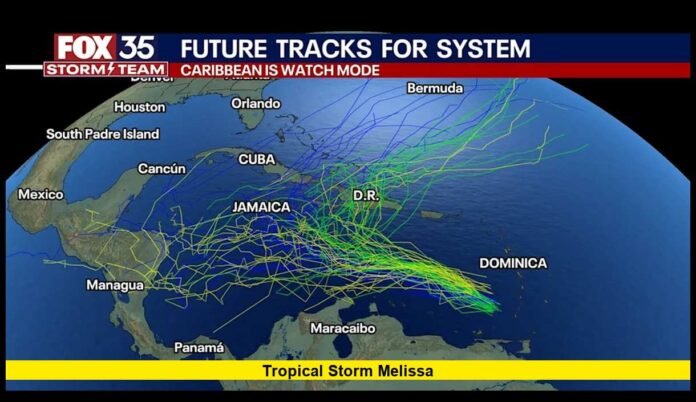

Tropical Storm Melissa has officially formed in the Caribbean Sea and is now being closely monitored by meteorologists. As of October 21, 2025, the storm was located about 300 miles (480 km) south of Port-au-Prince, Haiti, with maximum sustained winds of 50 mph (80 km/h) and moving west at 14 mph (23 km/h). Government agencies across the Caribbean have issued warnings and watches for hurricane-force winds and heavy rainfall as the storm continues to organize.
Here’s a detailed look at what we currently know about Tropical Storm Melissa — its origin, forecast path, potential impacts, and what U.S. readers should be aware of.
Storm Overview and Current Status
Tropical Storm Melissa formed early Tuesday, October 21, becoming the 13th named storm of the 2025 Atlantic hurricane season. The storm’s center of circulation was established south of Haiti, with bands of thunderstorms wrapping around its developing core.
Key current facts:
- Location: 300 miles south of Port-au-Prince, Haiti
- Winds: 50 mph sustained, with higher gusts
- Movement: West at approximately 14 mph
- Pressure: 1003 mb (estimated)
- Status: Strengthening tropical storm
Meteorologists have noted that environmental conditions are conducive to gradual strengthening over the next 24–48 hours. Sea surface temperatures in the Caribbean remain above 85°F, and wind shear is low — both ideal factors for tropical development.
Forecast Track and Evolution
Forecast models currently show two primary tracks for Tropical Storm Melissa, and both are being monitored closely.
- Northern Track:
The storm could curve northward toward Hispaniola and Haiti if it strengthens rapidly. This path would bring strong winds and heavy rainfall to Haiti and the Dominican Republic over the next two days. - Western Track:
A slower-developing system might continue westward, potentially impacting Jamaica, eastern Cuba, or Central America by the weekend.
Forecast summary:
| Parameter | Forecast / Track Notes |
|---|---|
| Formation | Confirmed October 21 with 50 mph winds |
| Direction | Westward at 14 mph, expected to slow slightly |
| Land Threats | Haiti, Jamaica, eastern Cuba |
| U.S. Risk | Low at present, but indirect impacts possible |
The storm is expected to maintain tropical storm strength for the next several days. However, some models suggest potential intensification into a Category 1 hurricane later this week if upper-level winds remain favorable.
For now, the United States is not expected to experience a direct landfall from Tropical Storm Melissa. Still, late-season storms like this can change direction quickly, especially as atmospheric steering patterns shift.
Potential Impacts in the Caribbean and Beyond
Haiti and Jamaica:
These areas face the most immediate threat from Tropical Storm Melissa. Heavy rainfall is likely to cause flash flooding and landslides, particularly in mountainous regions. Winds may strengthen to near-hurricane force in localized areas. Coastal regions should expect rough seas, storm surge, and dangerous surf.
Cuba and Central America:
If the system tracks farther west, it could bring heavy rain and localized flooding to eastern Cuba, the Cayman Islands, and parts of Central America later in the week.
For the United States:
At this time, no direct impact is projected for the U.S. mainland. However, forecasters warn that the storm may still produce indirect effects:
- High surf and rip currents along Florida and the southeastern coastline
- Rough seas and elevated tides in the Bahamas and Florida Keys
- Enhanced moisture potentially affecting weather patterns in the Gulf of Mexico
Even if the storm does not make landfall in the U.S., tropical moisture could still contribute to isolated rainfall events in southern Florida late in the week.
Why Tropical Storm Melissa Matters
Tropical Storm Melissa’s formation marks another milestone in what has been an active 2025 Atlantic hurricane season. As the 13th named storm of the year, Melissa continues a trend of above-average tropical activity in the Atlantic basin.
Despite forming late in the season — hurricane season officially ends November 30 — the storm serves as an important reminder that tropical development remains possible well into the fall months. Historically, late-October storms can intensify rapidly due to warm Caribbean waters and evolving jet stream patterns.
Melissa also underscores the need for continuous preparedness in coastal communities. Many regions relax storm readiness after early October, yet conditions can still support strong tropical systems this time of year.
Preparedness Tips for U.S. Readers
Although the United States is not currently in Melissa’s projected path, tropical storms can influence U.S. weather and safety conditions even from a distance. Here are key reminders for residents in coastal and southeastern states:
- Monitor official updates: Follow forecasts from the National Hurricane Center and local weather authorities.
- Avoid dangerous surf: Rip currents and strong waves can extend hundreds of miles from a storm’s center.
- Check travel plans: Those traveling to or from the Caribbean this week should check airline and cruise updates.
- Stay ready: Keep basic emergency kits stocked, including flashlights, batteries, bottled water, and nonperishable food.
- Support Caribbean neighbors: Haiti, Jamaica, and surrounding islands may require international aid and assistance if flooding or storm damage occurs.
What to Watch for Next
Meteorologists are keeping a close eye on several key indicators that will determine the storm’s future strength and direction:
- Wind shear levels: If wind shear remains low, Melissa could strengthen into a hurricane.
- Sea surface temperatures: Warm waters over 85°F will continue to fuel the storm.
- Steering currents: A high-pressure ridge north of the system could shift the track westward or northwestward.
- Speed changes: A slower storm typically produces heavier rainfall and greater flooding risk.
Updates will be issued every six hours by the National Hurricane Center. Residents in the Caribbean should remain alert to potential warning upgrades.
Historical Context: October Storms in the Atlantic
Late-season storms like Tropical Storm Melissa are not unusual. Over the past two decades, several significant storms have developed in the Caribbean during October, including Hurricane Sandy (2012) and Hurricane Zeta (2020). These systems often form under similar environmental conditions — warm seas, reduced wind shear, and unstable air masses.
While Melissa is far weaker at present, it shares the same development zone that has historically produced rapidly intensifying systems. This reinforces the importance of continued vigilance through the end of hurricane season.
Bottom Line
Tropical Storm Melissa is an active system in the Caribbean, bringing heavy rain and gusty winds to Haiti and Jamaica. The United States faces minimal direct risk right now, but indirect effects like high surf and rip currents are possible later in the week.
As the storm continues its westward track, the next 48 hours will be critical in determining whether it intensifies further. For now, Melissa serves as a timely reminder that even in late October, the Atlantic hurricane season is far from over.
Stay informed, stay cautious, and share your thoughts or storm updates below as we continue to track Tropical Storm Melissa.