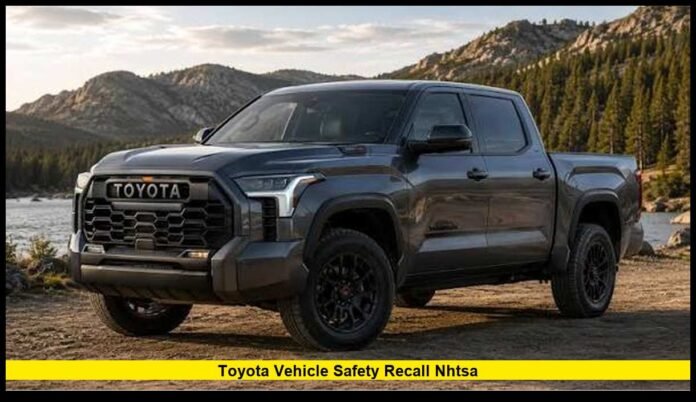

Toyota vehicle safety recall NHTSA information is drawing renewed attention after Toyota announced a major recall involving 314,029 Toyota and Lexus vehicles in the United States because certain front passenger airbag inflators may rupture and send dangerous metal fragments into the vehicle cabin. The latest recall, filed in November 2026, covers several older models, including the Toyota Corolla, Tundra, Sequoia, and 4Runner, as well as certain Lexus vehicles.
The recall is particularly important for owners of older vehicles because airbag inflators can deteriorate over time. Even vehicles that have been driven for years without any apparent problems may face a safety risk if the affected airbag deploys during a crash.
Owners should not rely solely on the model name or vehicle age to determine whether their car is affected. The safest way to confirm recall status is to check the vehicle’s identification number (VIN) through the official recall lookup system.
Latest Toyota Safety Recall: What Happened?
Toyota Motor Engineering & Manufacturing filed a new safety recall on November 12, 2026, involving certain Toyota and Lexus vehicles equipped with Takata front passenger airbag inflators.
The recall is identified by NHTSA Campaign Number 26V748. The affected inflators may experience deterioration of their propellant after prolonged exposure to environmental conditions, including high temperatures, humidity, and repeated temperature changes.
If the front passenger airbag deploys, a deteriorated inflator may rupture instead of functioning as intended. A rupture can propel metal fragments into the passenger compartment, potentially causing serious injuries or death.
The recall affects 314,029 vehicles potentially involved in the campaign. Toyota has stated that it is conducting the recall as a precautionary safety measure related to the inflators’ estimated service life.
Which Toyota and Lexus Vehicles Are Included?
The latest Toyota airbag recall covers certain vehicles from model years 2002 through 2017. However, not every vehicle from the listed model years is affected. The recall applies to vehicles equipped with specific Takata passenger-side airbag inflators.
| Vehicle brand | Model | Model years |
|---|---|---|
| Toyota | Corolla | 2003–2008 |
| Toyota | Tundra | 2005–2006 |
| Toyota | Sequoia | 2005–2007 |
| Toyota | 4Runner | 2016–2017 |
| Lexus | SC 430 | 2002–2010 |
| Lexus | IS 250 | 2011 |
| Lexus | GX 460 | 2017 |
The vehicle list is important for owners of older Toyota and Lexus models who may have assumed that previous airbag recalls had already addressed every possible issue.
Some vehicles may have received replacement inflators during earlier recall campaigns. However, the newest recall includes certain inflators installed either as original equipment or as replacement parts under previous recall work.
Being listed in the table does not automatically mean every vehicle of that model and year is affected. Owners must check their individual VIN to determine whether their vehicle is included.
Why the Takata Airbag Inflators May Be Dangerous
Takata airbags have been at the center of one of the largest automotive safety recall campaigns in U.S. history.
The problem involves the chemical propellant used inside certain airbag inflators. Over time, exposure to environmental conditions can cause the propellant to degrade. When an airbag is activated during a collision, the degraded material may generate excessive pressure, potentially causing the inflator housing to rupture.
Instead of safely inflating the airbag, the ruptured component may release metal fragments at high speed.
The potential consequences include:
- Serious injuries to the driver or passengers
- Metal fragments entering the vehicle cabin
- Facial, head, neck, or chest injuries
- Potentially fatal injuries in severe cases
The concern is particularly significant for older vehicles because the risk associated with certain inflators may increase as they age and experience prolonged exposure to heat and humidity.
Does Toyota Report Any Injuries or Airbag Ruptures?
Toyota’s recall filing indicates that the company is conducting the campaign because certain inflators may approach the end of their estimated safe service life.
The recall documentation does not identify the campaign as being triggered by a specific newly reported incident involving the affected vehicles. Toyota’s decision is based on its safety assessment of the inflators and their potential deterioration over time.
This distinction is important for vehicle owners. A recall can be issued even when a manufacturer has not identified a recent crash, injury, or rupture involving the specific recalled components.
A lack of reported incidents does not mean the recalled component is safe to continue using. The purpose of a recall is to address a potential safety defect before it causes harm.
What Toyota Will Do to Fix the Recall
Toyota and Lexus dealerships will provide the required repair free of charge to owners of affected vehicles.
Depending on the vehicle, the repair may involve:
- Replacing the front passenger airbag inflator
- Replacing the complete front passenger airbag assembly
The exact repair procedure will depend on the vehicle’s configuration and the component involved in the recall.
Owners should contact an authorized Toyota or Lexus dealership after confirming that their vehicle is affected. Dealerships can provide information about parts availability, appointment scheduling, and the repair process.
The recall remedy is intended to eliminate the safety risk associated with the affected inflator.
How to Check a Toyota Vehicle Safety Recall Through NHTSA
Checking for an open recall is one of the most important steps Toyota and Lexus owners can take.
The National Highway Traffic Safety Administration (NHTSA) provides an official recall lookup service that allows drivers to search using a vehicle’s identification number.
Steps to Check Your Vehicle
- Locate your vehicle’s 17-character VIN.
- Visit the official NHTSA recall lookup page.
- Enter your VIN into the search box.
- Review the results for open safety recalls.
- If a recall appears, read the details and follow the manufacturer’s instructions.
- Contact an authorized dealership to schedule the repair.
The VIN is commonly located on the driver’s side of the dashboard near the windshield. It may also appear on the driver’s door-jamb label, vehicle registration, and insurance documents.
You can check your vehicle through the official NHTSA Vehicle Recall Lookup.
Toyota owners can also use the manufacturer’s dedicated Toyota Recall Information Center to review recall information and determine whether additional action is necessary.
Why Checking by VIN Is More Accurate Than Checking by Model
A model-year recall list is useful for identifying vehicles that may be affected, but it is not a definitive confirmation.
Automakers frequently recall only certain vehicles within a production period because components may have been installed during specific manufacturing dates, supplied by particular manufacturers, or used in limited production batches.
For example, two Toyota Corollas from the same model year may not necessarily have the same airbag inflator. One vehicle could be included in the recall while another may not be.
The VIN-based lookup provides a more precise way to determine whether a specific vehicle has an open recall.
Owners should also remember that recall databases may not immediately reflect every newly announced campaign. If a recall has just been announced, checking again after some time may be worthwhile.
What Should Owners Do If Their Vehicle Is Affected?
Owners who discover an open airbag recall should take the notice seriously and arrange for the repair as soon as practical.
Recommended steps include:
- Confirm the recall: Verify the VIN through NHTSA or Toyota’s recall website.
- Read the safety instructions: Follow any specific guidance included in the recall notice.
- Contact the dealership: Ask about the repair procedure and parts availability.
- Schedule the repair: Make an appointment with an authorized dealer.
- Keep documentation: Retain the repair paperwork for your records.
- Check again later: Make sure the recall is marked as completed after the repair.
If a vehicle has multiple open recalls, owners should ask the dealership whether the repairs can be completed during the same visit.
Will Toyota Owners Have to Pay for Recall Repairs?
No. Safety recall repairs covered by the campaign are generally provided without charge to the vehicle owner.
Toyota and Lexus dealers are expected to replace the affected inflator or airbag assembly at no cost to eligible owners.
Owners should not be required to pay for the recall repair itself. However, if a vehicle needs unrelated maintenance or additional work outside the recall campaign, the dealership should explain those charges separately before proceeding.
Drivers who previously paid for a repair involving a component that is now covered by a recall may want to contact Toyota to ask whether reimbursement eligibility applies to their circumstances.
How the Toyota Recall Fits Into the Larger Takata Airbag Recall History
The Takata airbag crisis has affected millions of vehicles from multiple automakers over many years.
The underlying issue has involved certain airbag inflators that can deteriorate and potentially rupture. Because the condition can develop over time, some older vehicles have continued to be included in additional recall campaigns as manufacturers review inflator types, replacement parts, and long-term safety considerations.
The latest Toyota recall demonstrates that older vehicles can remain subject to new safety campaigns even after earlier recall work has been completed.
For owners of older Toyota and Lexus vehicles, this makes periodic recall checks especially important.
Toyota owners can review the official campaign documentation through the NHTSA Toyota Recall 26V748 Report for additional details about the latest airbag recall.
Other Recent Toyota Safety Recalls Owners Should Know About
The November airbag campaign is not the only recent Toyota safety recall. Additional recall campaigns have involved different vehicle systems, including seats, engine components, fuel systems, and software-related issues.
For example, a separate November 2026 recall involved certain Toyota Tundra vehicles potentially equipped with camshafts from a specific production lot. The campaign is separate from the Takata airbag recall and involves different vehicles and safety concerns.
Toyota owners should therefore avoid assuming that checking for one recall automatically covers every potential safety issue affecting their vehicle.
The company’s official recall announcements and vehicle-specific information can be reviewed through the Toyota USA Recall News and Updates page.
What Toyota Owners Should Watch for Next
Owners of affected vehicles should watch for recall notification letters and additional information from Toyota. Notification letters are expected to provide details about the campaign, the affected component, and instructions for arranging repairs.
However, owners do not need to wait for a mailed notice if their vehicle’s recall status can already be confirmed online.
The most useful next steps are to:
- Check the VIN through NHTSA’s recall database.
- Confirm the results through Toyota’s recall information system.
- Contact a dealership if an open airbag recall appears.
- Follow any specific safety instructions issued by Toyota.
- Recheck the VIN periodically if the vehicle is not currently showing an open recall.
Recall information can change as manufacturers identify additional vehicles or update their repair procedures.
Why This Recall Matters to Owners of Older Toyota Vehicles
Toyota vehicles have a reputation for longevity, and many owners continue driving their vehicles well beyond a decade of ownership. That durability makes recall awareness especially important because a vehicle’s age can create additional safety considerations involving components that may deteriorate over time.
Airbags are designed to operate only when needed, but their components remain exposed to aging and environmental conditions throughout the vehicle’s life.
The latest Toyota recall highlights a broader point for drivers: a vehicle can continue running reliably while still having an unresolved safety defect.
Owners of older Corolla, Tundra, Sequoia, 4Runner, and Lexus models should make VIN recall checks part of their routine vehicle ownership responsibilities.
Frequently Asked Questions
Q1. How many vehicles are affected by the latest Toyota airbag recall?
The latest Toyota and Lexus airbag recall involves 314,029 potentially affected vehicles in the United States.
Q2. Which Toyota models are included in the recall?
The recall covers certain 2003–2008 Toyota Corolla, 2005–2006 Toyota Tundra, 2005–2007 Toyota Sequoia, and 2016–2017 Toyota 4Runner vehicles. Certain Lexus models are also included.
Q3. What is the NHTSA recall number?
The latest airbag campaign is identified as NHTSA Recall Number 26V748.
Q4. Is the Toyota airbag recall repair free?
Yes. Eligible vehicles will receive the recall repair free of charge at authorized Toyota or Lexus dealerships.
Q5. Can I check my Toyota recall using my VIN?
Yes. Drivers can enter their 17-character vehicle identification number into the NHTSA recall lookup system or Toyota’s recall website to check for open safety recalls.
Final Takeaway
The latest Toyota vehicle safety recall NHTSA announcement is an important reminder for owners of older Toyota and Lexus vehicles to verify their recall status. With 314,029 vehicles potentially affected by the Takata airbag inflator issue, drivers should not assume their vehicle is safe simply because it has not experienced a problem or because an earlier recall was completed.
Checking the VIN, reviewing official recall information, and arranging a free repair when required are practical steps that can help protect drivers and passengers.
Do you own one of the Toyota or Lexus models listed in the latest recall? Check your VIN and share your experience in the comments to help other vehicle owners stay informed.