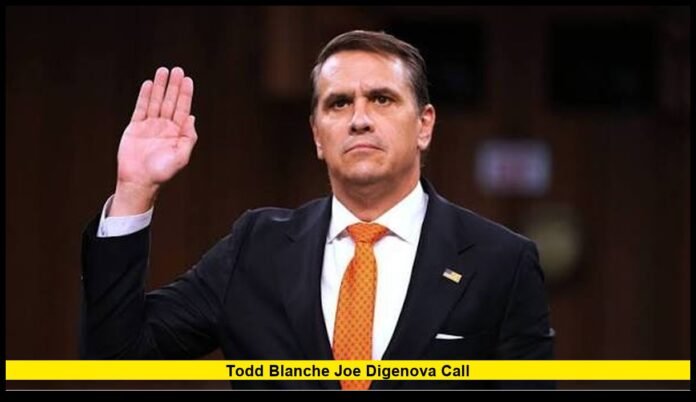

The Todd Blanche Joe Digenova call has drawn attention after a tense conversation between the two Justice Department officials preceded Joe diGenova’s resignation from a major investigation involving former officials who examined President Donald Trump.
DiGenova resigned on September 10 after about five months at the Justice Department. He had taken charge of a South Florida investigation that sought to determine whether former law enforcement and intelligence officials had participated in a broader effort against Trump.
The latest reporting places the phone conversation at the center of the final dispute. The call took place one day before DiGenova resigned, as disagreements had grown over the investigation’s management, staffing and pace.
The investigation remained active when DiGenova left. Prosecutors had continued issuing subpoenas, interviewing witnesses and presenting testimony to a federal grand jury.
The Phone Call Before DiGenova’s Resignation
DiGenova and Acting Attorney General Todd Blanche spoke by phone on Wednesday, September 9, according to people familiar with the investigation.
The conversation reportedly became tense over DiGenova’s effort to prevent lawyers sent from Justice Department headquarters from assisting his investigative team.
That disagreement reflected a larger dispute over how the South Florida investigation should operate.
DiGenova had sought greater control over the team. Justice Department officials in Washington had become increasingly involved as the inquiry continued.
The following day, DiGenova submitted his resignation.
He told CBS News that he delivered the resignation letter to Blanche at 3 p.m. on September 10. DiGenova did not provide a detailed public explanation for his decision.
His departure came while investigators were still actively working on the case.
What Led to the Disagreement
The conflict did not appear to stem from one isolated issue.
Several disagreements had developed between DiGenova and senior Justice Department officials. They involved the pace of the investigation, staffing and the practical handling of classified evidence.
One major issue concerned lawyers from Justice Department headquarters.
Officials in Washington had sent attorneys to South Florida to assist with the investigation. DiGenova objected to their involvement, according to people familiar with the matter.
The disagreement eventually became part of the final confrontation with Blanche.
The dispute raised an important management question: how much independence should DiGenova have while leading an investigation that remained under the broader authority of the Justice Department?
That question became more pressing as the investigation widened and attracted increasing attention from senior officials.
DiGenova’s Role in the Investigation
DiGenova joined the Justice Department in April and was selected to oversee the South Florida investigation.
The inquiry examined whether former government officials had participated in a conspiracy connected to investigations involving Trump.
Its work covered events stretching back to the 2016 presidential campaign and included scrutiny of actions by intelligence and law enforcement officials.
The investigation also examined the government’s handling of matters involving Trump after his first presidency.
Former CIA Director John Brennan became one of the most prominent subjects of the inquiry. Investigators examined allegations surrounding Brennan’s statements to Congress concerning the intelligence community’s assessment of Russian interference in the 2016 election.
No criminal charges had been brought in the investigation as of DiGenova’s resignation.
The probe had nevertheless generated substantial investigative activity.
Why Justice Department Headquarters Became Involved
The South Florida investigation operated through the U.S. Attorney’s Office for the Southern District of Florida.
Jason Reding Quiñones serves as the U.S. attorney for that district and retained broad jurisdiction over the office.
DiGenova was brought into the department specifically to lead the investigation.
As the case progressed, Justice Department headquarters became more involved in its operations.
That involvement produced friction.
DiGenova wanted additional resources for his team and pushed for greater control over the lawyers working on the investigation. Headquarters officials, meanwhile, sent attorneys to South Florida.
The disagreement eventually became one of the issues discussed during the Blanche phone call.
The Dispute Over Classified Information
Another source of tension involved the handling of highly classified material.
DiGenova requested a Sensitive Compartmented Information Facility, commonly known as a SCIF, at the Fort Pierce office.
A SCIF is a specially secured location designed for handling information that requires a high level of classified protection.
The investigation involved sensitive government records, making secure facilities important to the team’s work.
Justice Department officials instead told DiGenova and his team to use an existing SCIF at an FBI facility located several miles away.
That arrangement became another point of disagreement.
DiGenova also sought additional attorneys for the investigation. Justice Department officials disputed claims that his team had been denied adequate resources.
The disagreements over staffing and facilities added to the tension between the South Florida team and department leadership in Washington.
The Investigation Was Still Active
DiGenova’s resignation did not end the investigation.
The inquiry was active on the day he left.
A witness was being presented to the grand jury that day, according to people familiar with the matter.
Investigators had also issued multiple subpoenas in the weeks before his departure.
Some subpoenas sought documents. Others requested testimony before the grand jury.
The investigative activity indicated that prosecutors were continuing to gather evidence despite the internal disagreements.
The resignation therefore occurred during an important stage of the inquiry rather than after the investigation had concluded.
Recent Subpoenas and Witness Interviews
Investigators had recently contacted several people connected to previous federal investigations involving Trump.
Former FBI lawyer Lisa Page received a grand jury subpoena seeking her testimony.
Attorney Dan Richman also received a grand jury subpoena. Richman had been closely connected with former FBI Director James Comey during the period of the Russia investigation.
Investigators also interviewed a former FBI supervisor who had worked on the Russia investigation. That witness received immunity for the interview.
Other former intelligence officials were questioned about the 2016 election assessment and Brennan’s role.
Investigators also sought information connected to later investigations involving Trump, including the federal investigation into classified documents at Mar-a-Lago.
The range of witnesses showed how broadly the inquiry had developed under DiGenova.
The Investigation Reached Back to 2016
A central part of the investigation involved events surrounding the FBI’s investigation into possible links between Russia and the 2016 Trump campaign.
That earlier investigation became one of the most contentious subjects of Trump’s first presidency.
DiGenova has repeatedly argued that the government’s actions against Trump were politically motivated.
The current Justice Department investigation sought to examine whether individual officials had committed crimes while participating in those earlier government activities.
Investigators questioned people who had knowledge of the FBI’s work during that period.
Some witnesses had access to senior officials, including Comey, while others had worked in intelligence agencies.
The investigation therefore involved a wide range of former government employees.
The Investigation Also Covered Later Trump Cases
The inquiry was not limited to events surrounding the 2016 election.
Under DiGenova, investigators also examined government actions involving Trump after he left office.
That included investigations into classified documents and the federal cases involving the events surrounding January 6.
The broad scope created a complicated investigative structure.
Prosecutors were examining conduct from different periods and involving different agencies.
The investigation therefore required substantial coordination among prosecutors, investigators and government officials.
Its wide scope also created questions about how the various matters could be connected legally.
Why the Pace Became a Major Issue
The speed of the investigation became one of the most significant sources of tension.
Justice Department officials had hoped to see progress toward criminal charges.
However, the investigation had not produced indictments when DiGenova resigned.
The inquiry had already been underway for roughly a year, while investigators continued gathering evidence.
Senior officials had expected possible charges during September.
DiGenova defended the time required to develop cases.
He said that, as a prosecutor with more than 50 years of experience, he believed cases should be built through witnesses and evidence.
His comments reflected his view that prosecutors should not rush to seek charges before completing their investigation.
DiGenova’s Explanation After Leaving
DiGenova did not publicly accuse Blanche of forcing him out.
When asked about his resignation, he described his service to the president and Justice Department as an honor and privilege.
He also said that he had resigned.
After criticism of the investigation’s pace, DiGenova defended the work of his team.
He argued that evidence existed to support the theories being investigated but that prosecutors needed time to develop those cases.
His comments did not identify the Blanche phone conversation as the sole reason for his departure.
Instead, the available reporting points to several disagreements that had developed during his time leading the investigation.
Blanche’s Position and the DOJ Response
Blanche became closely involved with the investigation after bringing DiGenova into the Justice Department.
The department publicly thanked DiGenova for his service after his resignation.
A Justice Department spokesperson said Blanche appreciated DiGenova’s work during his approximately five months with the department.
The department also emphasized the experience of the prosecutors who remained in the Southern District of Florida.
That response indicated that the investigation would continue despite the change in leadership.
The department did not publicly provide a detailed account of the phone call or explain every disagreement between Blanche and DiGenova.
What the Todd Blanche Joe Digenova Call Reveals
The reported conversation provides an important look at the internal management dispute surrounding the investigation.
The central issue involved DiGenova’s attempt to prevent headquarters lawyers from assisting his team.
That dispute occurred against a wider backdrop of disagreements involving resources, classified information and the pace of the investigation.
The timing was significant.
The phone call occurred Wednesday.
DiGenova resigned Thursday.
However, the available facts do not establish that Blanche ordered DiGenova to resign during the conversation.
They also do not establish that the phone call alone caused his departure.
The confirmed sequence shows a tense discussion followed by a resignation the next day.
What Happened to the Investigation After DiGenova Left
The investigation continued after DiGenova’s departure.
Prosecutors in South Florida remained responsible for the case.
The grand jury process also continued.
Investigative activity had not stopped, and Justice Department officials expressed confidence in the team that remained.
DiGenova himself indicated that the investigation would continue.
That means his resignation changed the leadership structure without automatically ending the underlying inquiry.
The next phase will depend on how Justice Department leadership handles the existing investigative team and the evidence already collected.
Why the Departure Matters to the DOJ Probe
DiGenova’s resignation created uncertainty because he had been specifically selected to lead one of the department’s most politically sensitive investigations.
His role was different from that of a career prosecutor who had spent years working within the office.
He entered the department in April with a specific mandate to pursue the investigation.
His departure only months later therefore represented a significant leadership change.
The timing also matters because investigators were actively pursuing witnesses when he left.
The department now has to maintain continuity while determining how the inquiry should proceed.
What Is Confirmed About the Dispute
Several facts are established by current reporting.
- Joe diGenova resigned from the Justice Department on September 10, 2026.
- He submitted his resignation to Todd Blanche at approximately 3 p.m.
- DiGenova joined the Justice Department in April.
- He had been leading the South Florida investigation.
- Blanche and DiGenova had a tense phone conversation on September 9.
- The disagreement involved Justice Department lawyers sent from Washington to assist the investigation.
- DiGenova had requested a SCIF at the Fort Pierce office.
- Justice Department officials directed the team toward an existing FBI SCIF.
- Investigators continued issuing subpoenas and conducting interviews.
- A grand jury remained active when DiGenova resigned.
- No criminal charges had been announced from the investigation when he left.
These facts provide the clearest picture of the situation without relying on unsupported explanations.
What Remains Unknown
The complete contents of the phone conversation have not been publicly released.
There is no public transcript establishing exactly what Blanche and DiGenova said to one another.
The Justice Department has not released a detailed account of the disagreement.
DiGenova has also not provided a complete explanation of the reasons behind his resignation.
That leaves some aspects of the dispute unresolved.
The confirmed information does show that disagreements existed and that the final phone conversation occurred immediately before DiGenova’s departure.
It does not establish additional motives beyond what has been publicly reported.
The Latest Status of the Probe
As of September 14, the South Florida investigation remains active.
DiGenova is no longer leading the inquiry.
Investigators continue to pursue witnesses and evidence involving former intelligence and law enforcement officials.
The grand jury process remains part of the investigation.
Justice Department officials have expressed confidence in the prosecutors who remain involved.
The resignation therefore represents a change in leadership rather than the conclusion of the investigation.
The Todd Blanche Joe Digenova call remains significant because it occurred at the moment when disagreements over the investigation’s management reached a critical point.
What do you think the latest developments mean for the future of the DOJ investigation? Share your thoughts and stay with the latest confirmed updates.