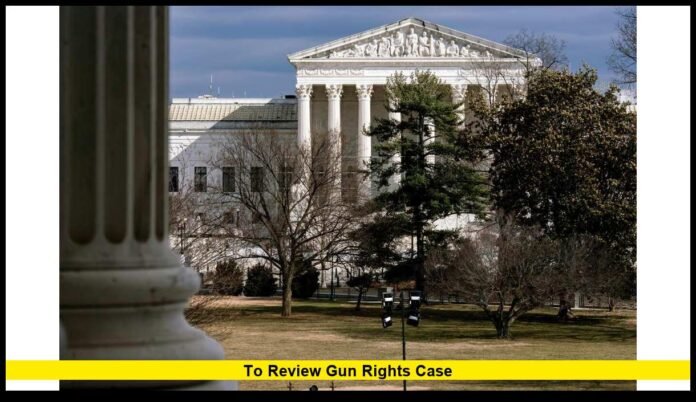

The U.S. Supreme Court has officially agreed to review gun rights case involving the federal law that prohibits illegal drug users from possessing firearms. This decision signals a significant moment for Second Amendment jurisprudence, as it could reshape the boundaries of federal firearm restrictions across the nation.
Latest Updates on the Supreme Court’s Review
The case centers around Ali Danial Hemani, whose conviction under 18 U.S.C. §922(g)(3) — a law barring gun ownership by anyone who uses or is addicted to illegal drugs — was previously overturned by a lower court. The Fifth Circuit Court of Appeals ruled that this law violated the Second Amendment because it lacked a clear historical precedent for disarming individuals based solely on drug use.
Now, the Supreme Court has stepped in to determine whether that ruling stands. The Department of Justice has appealed, arguing that the law aligns with historical efforts to restrict firearms from those considered dangerous or irresponsible. The justices are set to hear oral arguments during the 2025–26 term, with a final decision likely by mid-2026.
This case comes amid growing legal challenges that test how the Court’s 2022 decision in New York State Rifle & Pistol Association v. Bruen applies to modern firearm regulations.
Why This Case Matters
The upcoming review is about far more than one man’s charges — it could redefine how the government applies gun laws nationwide. At stake are key questions about whether federal and state restrictions must strictly mirror 18th- or 19th-century firearm regulations.
Key issues include:
- Scope of the Second Amendment: The Court must decide whether the government can bar entire categories of people — such as drug users — from owning guns without violating constitutional rights.
- Consistency with Historical Tradition: Since Bruen, gun laws must align with historical patterns of firearm regulation. The Court will analyze whether drug-use restrictions have any comparable precedent in early American law.
- National Implications: The outcome could affect other firearm disqualifications, including those involving alcohol abuse, mental illness, or nonviolent felony convictions.
Timeline of the Case
| Date | Event |
|---|---|
| 2022 | Federal agents discover a firearm and controlled substances at Hemani’s residence in Texas. |
| Feb 2024 | A district court dismisses the federal indictment, citing constitutional grounds. |
| Jan 2025 | The Fifth Circuit Court of Appeals upholds the dismissal, finding §922(g)(3) unconstitutional. |
| Oct 2025 | The Supreme Court agrees to review the ruling during its 2025–26 term. |
This timeline illustrates the rapid legal trajectory that brought the issue before the highest court in the nation.
Legal Context: The Second Amendment Landscape
The modern interpretation of the Second Amendment has evolved significantly in the past two decades. Landmark cases such as District of Columbia v. Heller (2008) established an individual right to possess firearms for self-defense, while McDonald v. City of Chicago (2010) extended that right to state and local laws.
Then, in 2022, the Bruen ruling imposed a new standard requiring all gun-control measures to be consistent with the nation’s “historical tradition of firearm regulation.” This decision reshaped the legal landscape and has since led to dozens of challenges against long-standing firearm restrictions — including those related to domestic violence, felon possession, and now, drug use.
The Court’s decision to review gun rights case builds directly on this line of cases, making it one of the most closely watched constitutional questions of the term.
Key Questions the Court Will Consider
As the justices prepare to hear arguments, they will focus on several constitutional questions:
- Is drug use comparable to historical disqualifications?
The Court will evaluate whether habitual or occasional drug users fall within categories historically considered “dangerous” or unfit for firearm ownership. - Does §922(g)(3) overreach?
Critics argue that the law punishes individuals for past or occasional drug use rather than for any act of violence or immediate threat, thus violating the Second Amendment’s protections. - How should the historical-tradition test be applied?
The case will test how strictly courts must adhere to 18th- and 19th-century precedents when evaluating modern gun laws. - What are the implications for other firearm restrictions?
The ruling could influence challenges to laws involving medical marijuana users, individuals under restraining orders, or those with certain nonviolent convictions.
Potential Outcomes and Implications
If the Supreme Court upholds the law:
- The federal government will maintain the authority to bar gun ownership for individuals who use illegal drugs.
- The ruling would reinforce the idea that public safety considerations can justify some firearm restrictions under the Constitution.
If the Supreme Court strikes down the law:
- The decision could nullify prosecutions under §922(g)(3) nationwide, potentially freeing defendants previously convicted under the statute.
- It may restrict Congress’s and state legislatures’ ability to impose categorical firearm bans without strong historical parallels.
- It could lead to further challenges against other subsections of §922, including bans on gun ownership by individuals with certain misdemeanors or mental-health histories.
Broader Impact on Gun Policy in the U.S.
This case is poised to influence the future of firearm regulation more broadly. If the Court takes a narrow view of what counts as a “historical analogue,” many existing gun-control measures could come under renewed scrutiny.
Legal analysts expect ripple effects across several key areas:
- Medical Marijuana and Gun Rights: In states where cannabis is legal, users are still classified as unlawful under federal law — making gun possession a potential crime.
- State-Level Gun Restrictions: States like California, New York, and Illinois may face challenges to their broader gun laws if the Court rules that federal restrictions are unconstitutional.
- Political Ramifications: With gun rights remaining a major election issue, the decision could energize both gun-rights advocates and gun-safety proponents ahead of 2026 midterms.
What Happens Next
The Supreme Court is expected to schedule oral arguments for early 2026. Briefs from advocacy groups on both sides — including gun-rights organizations and public-safety coalitions — will be filed over the coming months.
A decision is anticipated by June 2026, closing one of the most significant Second Amendment cases since Bruen. Whatever the outcome, the ruling will have lasting effects on the legal balance between individual rights and public safety in the United States.
The Supreme Court’s decision to review gun rights case marks another pivotal moment in America’s ongoing debate over the meaning and limits of the Second Amendment. As the justices weigh centuries-old traditions against modern realities, the outcome will shape how the nation defines gun ownership for years to come.
What do you think about the Supreme Court taking up this case? Share your views below and stay tuned for further developments as the story unfolds.