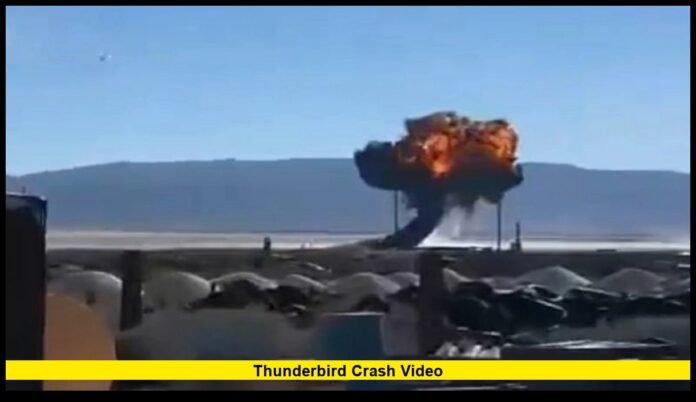

The Thunderbird crash video that emerged on social media this week has captured national attention after a U.S. Air Force F-16 Fighting Falcon from the Thunderbirds demonstration team crashed during a training flight in southern Nevada.
The incident occurred on Wednesday, December 3, 2025, near Creech Air Force Base, northwest of Las Vegas. The pilot successfully ejected from the aircraft seconds before impact and survived with non-life-threatening injuries. Officials have confirmed that no civilians were harmed and no property damage occurred.
Details of the Thunderbird Jet Crash
The Air Force confirmed the accident in a public statement early Thursday morning, describing the event as a “training mishap” involving one of its precision-flying F-16C jets. The aircraft, painted in the Thunderbirds’ trademark red, white, and blue colors, went down during a standard formation maneuver in the Nevada Test and Training Range area.
Witnesses in the nearby Amargosa Valley reported seeing the jet flying unusually low before a loud boom and a rising plume of smoke appeared moments later. The pilot’s ejection system deployed successfully, with recovery teams locating the individual approximately a mile from the crash site.
Key Facts at a Glance
| Detail | Information |
|---|---|
| Date of Incident | December 3, 2025 |
| Aircraft Type | F-16C Fighting Falcon |
| Unit | U.S. Air Force Thunderbirds |
| Location | Near Creech Air Force Base, Nevada |
| Pilot | Ejected safely, non-life-threatening injuries |
| Ground Damage | None reported |
| Investigation | Conducted by Air Force Safety Center and Nellis AFB |
Emergency response teams from Creech Air Force Base and Nellis Air Force Base reached the crash site within minutes. Officials quickly secured the area, halting public access as investigators began analyzing debris and flight data.
Thunderbird Crash Video Circulates Online
Videos of the accident surfaced on social media within hours of the crash, with the Thunderbird crash video showing the jet’s rapid descent before exploding upon impact in the Nevada desert. The footage, captured by bystanders driving along U.S. Highway 95, shows the aircraft tilting nose-down and a flash of light followed by smoke.
Multiple clips were posted across TikTok, Instagram, and X (formerly Twitter), drawing millions of views and sparking discussions about pilot safety and Air Force procedures.
Officials confirmed that some of the circulating videos are authentic but urged the public not to spread unverified versions that could include altered or misleading footage. The Air Force Office of Public Affairs stated that verified visuals will aid the investigation into what caused the mechanical or operational failure.
Pilot’s Condition and Response from the Air Force
The pilot, whose name has not been released publicly due to ongoing protocols, is an experienced member of the Thunderbirds demonstration team with thousands of logged flight hours.
After ejecting, the pilot was rescued by a Search and Rescue (SAR) helicopter from Creech Air Force Base and transported to the Mike O’Callaghan Military Medical Center in Las Vegas for observation.
The Thunderbirds Commanding Officer praised the pilot’s composure and professionalism, noting that the safe ejection demonstrated the effectiveness of the aircraft’s advanced safety systems.
“Our pilot is in stable condition and receiving excellent care,” said the commander. “We are grateful for the quick response from rescue teams and thankful that no one on the ground was harmed.”
Air Force officials also confirmed that all Thunderbirds aircraft are temporarily grounded pending safety inspections.
Investigation Underway
The Air Force Safety Investigation Board (SIB) and Nellis Air Force Base Safety Office are conducting a joint investigation to determine the cause of the crash. Experts will review flight data, maintenance records, and weather conditions from the day of the incident.
The investigation will also analyze the pilot’s communications and control inputs leading up to the crash. A preliminary report is expected within 30 days, followed by a detailed final report later in 2026.
While the cause remains under review, early analysis indicates the aircraft suffered a sudden systems failure during high-speed maneuvering. There is no indication of external interference or human error at this time.
Cleanup teams began removing debris Thursday morning under tight security, ensuring no classified or hazardous materials were exposed to the public.
Background on the U.S. Air Force Thunderbirds
The Thunderbirds are the official demonstration squadron of the U.S. Air Force, established in 1953. The team showcases precision aerobatics in F-16 Fighting Falcons, representing the Air Force at more than 70 airshows each year.
Each pilot is a commissioned officer with years of operational flying experience. Team members serve two-year rotations before returning to active duty assignments.
The Thunderbirds’ performances highlight the Air Force’s capabilities and serve as recruitment and public outreach tools. Their airshows attract millions of spectators annually across the United States and abroad.
History of Previous Thunderbird Incidents
Though the Thunderbirds maintain an exceptional safety record, a few accidents have occurred over their 70-year history — mostly during training missions rather than public performances.
- 1982: Four Thunderbird pilots were killed in a training crash near Indian Springs, Nevada, after a formation dive went wrong.
- 2003: An F-16 crashed during an airshow in Mountain Home, Idaho; the pilot ejected safely.
- 2017: A Thunderbird jet overturned while landing in Dayton, Ohio, during wet conditions; both crew members survived.
The most recent 2025 crash marks the first Thunderbird aircraft loss in over eight years.
Eyewitness Reactions
Residents of the Amargosa Valley and commuters along Highway 95 described the moment the jet went down.
“It was fast — just a streak of white and red, then smoke,” said one motorist who filmed the Thunderbird crash video from their dashboard camera. “I saw a small parachute a few seconds later, and that’s when I realized the pilot made it out.”
Others reported hearing a low rumble followed by a brief explosion. Some described seeing emergency vehicles rushing toward the desert within minutes.
The quick appearance of first responders underscored the proximity of the training site to Creech Air Force Base, one of the Air Force’s most active aviation facilities.
Public Reaction and Online Response
News of the crash spread rapidly online, with thousands expressing concern for the pilot’s well-being. Fans of the Thunderbirds, many of whom have attended their airshows over the years, flooded social media with messages of support and relief.
Military aviation enthusiasts also analyzed the Thunderbird crash video, noting the precision of the ejection timing — a testament to the pilot’s skill and training.
Air Force veterans highlighted the inherent risks of demonstration flying, which involves executing split-second maneuvers at speeds exceeding 500 miles per hour.
The U.S. Department of Defense reminded the public that aviation safety investigations take time, emphasizing the importance of verified information over online speculation.
Modern Ejection Technology Saves Lives
A major factor in the pilot’s survival was the aircraft’s Advanced Ejection System, designed to activate automatically if the jet reaches critical angles of descent.
The system used in the F-16C Fighting Falcon employs microsecond response technology, capable of ejecting the pilot even at low altitude.
Military analysts credit advancements in ejection seat design and pilot safety gear for significantly reducing fatalities in modern air incidents. The pilot’s helmet and harness system reportedly functioned perfectly during the December 3 crash.
Impact on Upcoming Airshows
The Thunderbirds were scheduled to perform at several events in early 2026, including airshows in Phoenix, San Antonio, and Pensacola. Those appearances are currently under review pending the outcome of the investigation.
The Air Force has not announced any cancellations but stated that safety remains the top priority. Each aircraft in the Thunderbirds fleet will undergo extensive inspection before returning to flight.
Performances may resume in spring 2026 once all safety certifications are complete.
Statements from Military Leadership
Air Force Chief of Staff Gen. David Allvin released a brief comment expressing gratitude for the pilot’s survival and the swift coordination of response teams.
“Our training and safety systems worked as intended, and our focus now is on determining the exact cause of this accident,” he said. “We are thankful for the professionalism of every Airman who responded.”
The Department of the Air Force has emphasized that flight demonstrations will continue to serve as a vital part of public outreach once all aircraft are cleared for operations.
Community and Military Coordination
Local Nevada authorities, including the Nye County Sheriff’s Office, assisted the Air Force in securing the area. The crash site lies within restricted military airspace, preventing any civilian intrusion.
Environmental crews from the U.S. Environmental Protection Agency (EPA) are also assessing soil conditions to ensure that no fuel or hydraulic fluids contaminated nearby desert ecosystems.
Residents of Indian Springs and surrounding communities were notified about the recovery operation through local emergency management alerts.
Ongoing Recovery Operations
Recovery teams are expected to complete debris removal by the end of the week. Components of the F-16 will be transported to Nellis Air Force Base for mechanical and forensic examination.
Air Force engineers will focus on flight control systems, engine performance data, and ejection timing to pinpoint what triggered the failure.
The investigation’s findings will contribute to safety training and may influence upgrades across the F-16 fleet.
The Thunderbird Legacy and the Road Ahead
Despite the incident, the Thunderbirds remain one of the most trusted and admired aviation demonstration teams in the world. Their precision flying continues to symbolize U.S. Air Force excellence and inspire future aviators.
In the aftermath of the crash, officials have reaffirmed their commitment to maintaining the highest safety standards. Every maneuver performed during public shows undergoes months of testing and risk assessment before being added to the demonstration routine.
The squadron’s resilience and dedication ensure that the Thunderbird legacy will continue to soar long after the investigation concludes.
The viral thunderbird crash video serves as a sobering reminder of the risks military pilots face each day — and the extraordinary skill, preparation, and courage required to represent the United States in the skies.