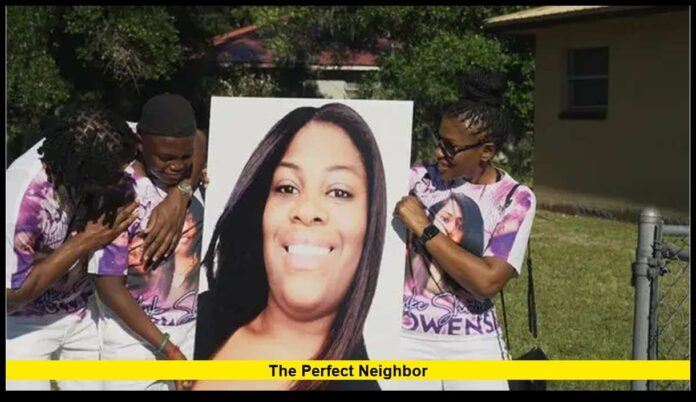

The Perfect Neighbor has become one of the most discussed true-crime documentaries in the United States, drawing nationwide attention for its unfiltered portrayal of a real neighborhood conflict that ended in a fatal shooting. As of today, the film continues to shape conversations about self-defense laws, racial tension, community policing, and how everyday disputes can escalate into irreversible loss.
Released on Netflix in late 2025, the documentary reconstructs the 2023 killing of Ajike “AJ” Shantrell Owens in Ocala, Florida, using verified police footage, emergency call recordings, courtroom audio, and surveillance video. Its impact has only grown through early 2026 as award recognition and streaming viewership have brought the case back into the public spotlight.
The Incident That Shook a Quiet Neighborhood
Ajike Owens was a 35-year-old mother of four living in a residential complex in Ocala. On June 2, 2023, she was shot during a confrontation with her neighbor, Susan Louise Lorincz, a retired schoolteacher in her late fifties.
The conflict did not begin that day. Court records and police logs show that tension had been building for months. Lorincz had repeatedly contacted authorities to complain about children playing near her home, noise, and what she described as harassment. Officers responded several times but found no criminal behavior that warranted arrests.
Owens and her children were among those frequently mentioned in the complaints. Body-camera footage reveals officers attempting to calm both sides and encourage them to avoid further confrontations.
On the day of the shooting, another argument erupted over the children’s presence near Lorincz’s apartment. Owens went to Lorincz’s front door to address the situation directly. What followed lasted only moments but changed many lives permanently.
From inside her home, Lorincz fired a single round through the door. The bullet struck Owens, who collapsed outside. Emergency responders arrived quickly, but she later died from her injuries.
Investigation and Arrest
Law enforcement immediately secured the scene and recovered video and audio evidence from multiple sources. The recordings captured the heated verbal exchange and the gunshot.
Lorincz was taken into custody the same day. During questioning, she stated that she feared for her life and believed she was acting in self-defense. She cited Florida’s stand-your-ground law, which allows the use of deadly force without a duty to retreat if a person claims to face an imminent threat.
Prosecutors, however, argued that the evidence showed Owens was unarmed, standing outside the home, and had not attempted to force entry. Investigators found no sign that the door was being broken or that Lorincz was in immediate physical danger at the moment the shot was fired.
The Trial and Its Outcome
The case went to trial in 2024 and drew national attention because of the legal questions it raised and the racial dynamics involved.
Key elements presented to the jury included:
- Police body-camera footage from prior neighborhood calls.
- The full 911 recording placed after the shooting.
- Surveillance video from the apartment complex.
- Testimony from responding officers, forensic experts, and witnesses.
The defense maintained that Lorincz believed Owens posed a serious threat and that the law protected her actions. The prosecution countered that the use of deadly force was neither necessary nor justified under the circumstances.
After deliberation, the jury found Lorincz guilty of manslaughter with a firearm. The stand-your-ground claim was rejected.
At sentencing, the court emphasized that Owens was unarmed, that no forced entry occurred, and that the decision to fire through a closed door showed a disregard for human life. Lorincz received a 25-year prison sentence.
Inside the Documentary
The Perfect Neighbor stands out for how it tells the story. Rather than relying on narration or reenactments, the film allows official recordings to guide the viewer.
The structure follows a chronological path:
- Early police visits responding to noise and disturbance complaints.
- Escalating tension documented through repeated calls for service.
- The fatal confrontation and the immediate aftermath.
- Court proceedings and the final sentencing.
By presenting events almost entirely through real footage, the film places viewers in the position of witnesses. The approach reveals how quickly routine neighborhood friction can spiral when fear, anger, and access to firearms intersect.
National Response and Awards Recognition
Since its release, the documentary has received significant attention from both audiences and the film industry. It has earned top honors at major documentary festivals and national awards ceremonies and has been recognized by the Academy Awards in the documentary category.
These accolades have helped bring renewed focus to the underlying issues rather than just the crime itself. Panel discussions, legal forums, and community groups across the country have used the film as a starting point for conversations about conflict resolution and public safety.
Stand-Your-Ground Laws Under Scrutiny
A central reason the film resonates so strongly is its connection to self-defense statutes that exist in many states.
Stand-your-ground laws remove the obligation to retreat before using lethal force if a person claims to perceive an imminent threat. Supporters argue these laws empower individuals to protect themselves without hesitation. Critics contend they can legitimize impulsive decisions and escalate situations that might otherwise be defused.
In the Owens case, the jury’s rejection of the self-defense claim highlighted a key point: the law does not grant unlimited license to use deadly force. The threat must be real, immediate, and supported by evidence.
The documentary shows how that legal threshold was examined in detail, and how subjective fear alone was not enough to justify the shooting.
Impact on the Victim’s Family and Community
For Owens’s children, the loss of their mother was sudden and devastating. The film captures moments from police footage in which officers attempt to comfort them in the immediate aftermath.
Community members in Ocala have described the incident as a turning point that forced residents to confront long-standing tensions and the need for better communication between neighbors.
Local leaders have since promoted mediation programs, youth engagement initiatives, and community policing strategies designed to prevent minor disputes from escalating.
Ongoing Legal Activity
Although the criminal case has concluded, legal proceedings connected to the aftermath continue. Post-conviction motions and civil filings have kept the matter in court records, though no ruling has altered the original verdict or sentence.
These developments underscore how a single act of violence can generate years of legal, emotional, and social consequences.
Why the Story Connects With a National Audience
The setting of The Perfect Neighbor is not an isolated or extreme environment. It is a typical residential complex, much like those found in cities and suburbs across the country.
The film resonates because it reflects common experiences:
- Disputes over noise and children at play.
- Frustration between neighbors who feel unheard.
- Repeated calls to law enforcement for issues that seem minor at first.
The tragedy lies in how these familiar elements combined with fear and a firearm to produce a fatal outcome.
For many viewers, the documentary serves as a stark reminder that everyday conflicts carry real risks when empathy and restraint give way to confrontation.
A Broader Conversation About Responsibility
Beyond the courtroom and the awards circuit, the documentary has fueled deeper questions:
- How should communities address recurring disputes before they become dangerous?
- What role should law enforcement play in mediating non-criminal conflicts?
- How can laws balance the right to self-defense with the responsibility to preserve life?
By focusing on verified evidence and allowing events to unfold in real time, the film avoids speculation and instead invites viewers to consider these issues through the lens of a real family and a real neighborhood.
Cultural Significance Moving Into 2026
As of today, The Perfect Neighbor remains one of the most influential true-crime releases of the past year. Its continued presence on streaming platforms and its recognition within the film industry have ensured that the story of Ajike Owens is not forgotten.
The documentary has become part of a larger national dialogue about safety, justice, and how society defines reasonable fear.
It illustrates that the concept of a “perfect neighbor” is not about silence or isolation, but about coexistence, patience, and the willingness to resolve conflict without resorting to violence.
The conversation sparked by The Perfect Neighbor is far from over. What lessons do you think communities across the U.S. should take from this case? Share your thoughts and stay connected as this story continues to shape the national discussion.