
Key Points Summary
╔════════════════════════════════════════════════════════════════════╗
║ – Wendell Berry’s celebrated nature poem was first published in 1968 as part of Openings. ║
║ – The poem examines anxiety, fear about the future, family concerns, and the calming power of the natural world. ║
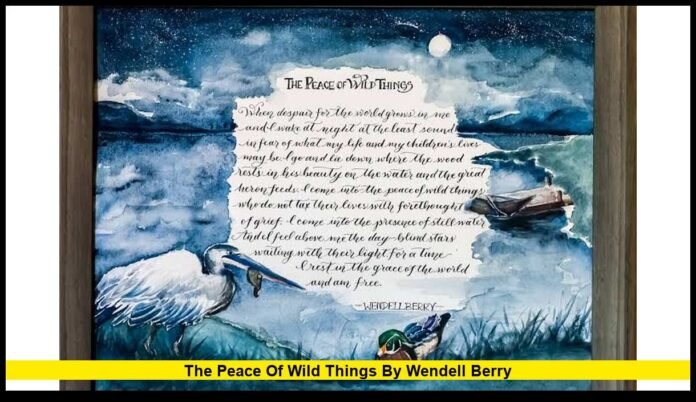
║ – Its central images include a wood drake, a great heron, still water, stars, and the quietness of the night. ║
║ – Berry’s lifelong connection to farming, Kentucky, conservation, and rural life strongly shaped his literary philosophy. ║
║ – Berry died at age 92 on August 31, 2026, at his home in Port Royal, Kentucky, bringing renewed attention to his writing and environmental legacy. ║
║ – The poem remains widely read because its message about stepping away from anxiety and reconnecting with nature continues to resonate with modern readers. ║
╚════════════════════════════════════════════════════════════════════╝
Why Wendell Berry’s Most Beloved Nature Poem Is Receiving New Attention
The Peace of Wild Things by Wendell Berry has become one of the most recognizable pieces of American nature poetry, offering readers a quiet meditation on fear, uncertainty, family, and the restorative power of the natural world. First published in 1968, the poem has remained relevant for generations because it addresses a feeling that is difficult to escape: worrying about what the future may bring.
Berry’s poem is particularly meaningful now because the Kentucky writer, farmer, environmental advocate, and poet died at age 92 on August 31, 2026. His death has prompted renewed interest in a body of work that consistently explored humanity’s relationship with land, community, agriculture, and the living world.
Rather than presenting nature as a decorative backdrop, Berry treats it as a source of perspective. His speaker begins in a state of fear and ends in a temporary experience of freedom. The movement between those two emotional states gives the poem its lasting power.
When Was Wendell Berry’s Famous Poem Published?
The poem first appeared in Berry’s 1968 collection Openings: Poems. The collection was published during a period of enormous social and political tension in the United States, and several poems in the volume engage with war, environmental destruction, human responsibility, and the natural world.
Berry was already developing the ideas that would become central to his career. He was not simply writing about beautiful landscapes. He was examining how modern society affected the relationship between people and the places where they lived.
The poem eventually appeared in later collections of Berry’s work, helping introduce it to new generations of readers. Its short length and direct language have also made it particularly accessible to students, poetry readers, environmental organizations, educators, and people searching for writing about anxiety and nature.
What Is the Poem About?
At its most basic level, the poem is about a person struggling with anxiety during the night.
The speaker is concerned about his own future and, importantly, the future of his children. Those fears are not presented as abstract philosophical questions. They are personal. The speaker is awake, listening to sounds in the darkness and thinking about everything that could go wrong.
Instead of remaining trapped in those thoughts, he turns toward nature.
He goes outside and finds a place near water. There he observes wildlife and becomes surrounded by stillness. The experience changes his emotional state.
The transformation is subtle rather than dramatic.
Nothing in the world has necessarily been fixed. The speaker has not discovered a political solution, solved a family problem, or eliminated uncertainty about tomorrow. What changes is his relationship to his fear.
For a short time, he is able to rest.
That distinction is central to understanding Berry’s work.
The Meaning of the “Wild Things”
The wild creatures in the poem symbolize a form of existence that is free from the human tendency to constantly anticipate future suffering.
Berry contrasts the human mind with the natural world. People can imagine events that have not happened, worry about possible disasters, replay past mistakes, and attempt to predict what may come next.
Animals do not appear to operate in the same way.
The wood drake rests on the water. The great heron feeds. Their lives are presented through simple acts of existence.
Berry is not arguing that wildlife is literally free from danger or suffering. Instead, he uses the natural world to remind the speaker of another way of being: living in the present rather than mentally carrying every possible future burden.
That idea gives the poem much of its emotional force.
Why the Nighttime Setting Matters
The poem begins during the night, and darkness is an important part of its emotional structure.
Night often amplifies uncertainty. A person lying awake may find that small concerns become enormous. Without the distractions of daytime activity, the mind can become focused on questions that have no immediate answers.
Berry’s speaker experiences precisely that kind of unease.
The movement outdoors therefore becomes more than a physical journey. It is an emotional transition.
The speaker moves from an enclosed human environment into an open natural space. He moves from fear toward observation, from mental noise toward silence, and from imagined futures toward the immediate physical world.
The night that initially represents uncertainty eventually becomes part of the source of comfort.
The Importance of the Birds
Two creatures receive particular attention: the wood drake and the great heron.
The wood drake is associated with beauty and stillness on the water, while the heron is observed feeding. Berry does not need elaborate descriptions to establish the scene.
The birds simply exist within their environment.
That simplicity is important because the speaker has become overwhelmed by complicated thoughts. The animals offer an alternative.
Their presence reminds him that life continues outside the concerns occupying his mind.
The birds do not solve his problems. They do something more basic: they interrupt his obsessive attention to those problems.
Still Water as a Symbol of Calm
Water is one of the poem’s most memorable images because it contrasts sharply with the speaker’s troubled mind.
The speaker approaches still water and becomes aware of its quiet presence. The image suggests emotional stability and a kind of inner clearing.
Throughout literature, water has often represented renewal, movement, reflection, and transformation. Berry’s use of still water emphasizes another quality: peace.
The water does not demand anything from the speaker.
It does not ask him to make a decision or predict the future.
It simply exists.
By paying attention to it, the speaker begins to experience the same kind of stillness internally.
The Stars and the Larger World
The stars broaden the poem’s perspective.
The speaker’s anxiety is intensely personal. He is thinking about his own life and his children’s lives. The stars, by contrast, suggest a world vastly larger than any individual human concern.
This does not make personal problems meaningless. Instead, it places them within a larger natural order.
Berry’s language suggests that the world continues to exist beyond human fear.
The stars are present even when the speaker cannot see the future clearly.
That image contributes to the poem’s spiritual quality without requiring the reader to interpret it through a single religious tradition.
Nature Does Not Erase Fear
One of the most important aspects of Berry’s poem is that it does not promise permanent escape.
The speaker does not claim that going outside solves everything.
The peace he experiences is temporary.
That makes the poem more convincing.
Berry understands that people cannot permanently avoid difficult responsibilities. Parents will continue worrying about their children. Communities will continue facing problems. Political and environmental crises will continue. Death and loss remain part of life.
The value of nature is therefore not that it eliminates reality.
Its value is that it gives people enough distance from their fears to face reality without being completely consumed by it.
Wendell Berry’s Life and Connection to Nature
Berry’s personal history helps explain why nature plays such an important role in his writing.
Born in Kentucky in 1934, Berry grew up in a farming family and eventually returned to rural Kentucky. His life became closely connected with agriculture, land stewardship, writing, and community.
He was not an environmental writer who approached nature only as an observer. Farming was part of his lived experience.
Berry’s writing repeatedly challenged the consequences of industrial agriculture and encouraged a more responsible relationship between people and land. His essays, poems, novels, and nonfiction frequently returned to questions of sustainability, local economies, community responsibility, and the importance of knowing a particular place.
Those concerns are already visible in the worldview behind his poetry.
Why Berry’s Death Has Renewed Interest in the Poem
Wendell Berry died Monday, August 31, 2026, at his home in Port Royal, Kentucky, at the age of 92. His daughter Mary Berry confirmed his death, and a cause was not immediately disclosed.
The news has naturally led readers back to his best-known works.
Among those works, this particular poem has special significance because it captures many of the values associated with Berry’s life: attention to the natural world, humility, concern for future generations, and the belief that human beings remain connected to the places where they live.
His death also creates a moment for readers to reconsider how much of contemporary environmental and literary culture has been influenced by his ideas.
Why the Poem Feels Modern
Although it was written in the 1960s, the poem fits remarkably well into today’s cultural landscape.
Modern life provides constant access to information. Smartphones, social media, news alerts, streaming platforms, email, and other technologies make it possible to remain mentally connected to events almost without interruption.
That connectivity can be useful, but it can also make it difficult to rest.
Berry’s poem offers a contrasting rhythm.
Instead of consuming more information, the speaker pays attention to the physical world. Instead of trying to anticipate every possible problem, he watches birds and water. Instead of attempting to control the future, he accepts a brief period of stillness.
That is one reason the poem continues to resonate with contemporary readers.
The Poem’s Connection to Anxiety
The emotional starting point of the poem is anxiety about the future.
The speaker’s fear is particularly powerful because it involves his children. Concern for future generations is one of the most universal forms of anxiety. Parents and caregivers often worry about the kind of world younger generations will inherit.
Berry does not dismiss that concern.
Instead, he recognizes it and then shows what can happen when a person temporarily steps outside the cycle of fear.
The poem therefore offers neither denial nor a simplistic solution. It proposes a pause.
That pause may be the most important part of its message.
A Spiritual Interpretation
Many readers view Berry’s poetry as spiritual because his descriptions of the natural world often contain reverence.
The poem’s final movement toward grace and freedom can be read through a religious lens. At the same time, readers do not need to share a particular faith to understand its central idea.
Nature itself becomes a place of humility and restoration.
The speaker encounters something larger than his own thoughts. That experience gives him relief.
For some readers, that may feel explicitly spiritual. For others, it may feel ecological, philosophical, or psychological.
The poem leaves room for all of those interpretations.
Why the Poem Continues to Be Read
There are several reasons for its longevity.
First, the poem is short enough to be approachable but deep enough to support repeated interpretation.
Second, its imagery is concrete. Birds, water, stars, darkness, and the natural landscape are easy to visualize.
Third, its emotional conflict is universal. Nearly everyone has experienced a night when worries seem larger than they do during the day.
Finally, the poem does not pretend that life can be controlled.
Instead, it offers a different possibility: sometimes peace comes from accepting that not everything can be controlled.
That message has allowed Berry’s work to remain relevant across generations.
The Lasting Legacy of Wendell Berry
Berry leaves behind an extensive body of poetry, fiction, essays, and agricultural writing. His influence reaches beyond literary circles into conversations about farming, conservation, community, sustainability, and responsible relationships with land.
His death marks the end of a long life, but it does not end the questions that shaped his work.
How should people live with the land?
What responsibilities do humans have toward future generations?
Can communities remain connected in an increasingly industrialized society?
And where can people find peace when the world feels overwhelming?
Those questions remain open.
That is why this poem continues to matter. It does not offer a grand theory for eliminating suffering. Instead, it offers an intimate scene in which a worried person steps outside, pays attention to the living world, and discovers that peace can still be found.
The Peace of Wild Things and the Future of Berry’s Work
As readers revisit Berry’s writing following his death, the poem may become an especially important entry point for people discovering him for the first time.
It captures in a few lines many of the ideas that appeared throughout his career: the importance of place, the dignity of the natural world, the dangers of excessive human control, and the need to remain grounded in the physical realities of life.
Berry’s writing was never simply about escaping modern life. It was about reconsidering how modern people live.
That distinction makes the poem more than a comforting nature meditation.
It is also a challenge.
It asks readers to consider whether constant anticipation is actually helping them live better, and whether paying closer attention to the natural world might provide a healthier perspective.
For readers encountering The Peace of Wild Things today, the poem can therefore function as both literature and reflection.
Its world is quiet.
Its message is simple.
But its questions remain surprisingly large.
What does Wendell Berry’s work mean to you, and has his poetry changed the way you think about nature, anxiety, or the future? Share your thoughts and stay tuned for more updates on influential writers and enduring works of literature.