
The Hunting Party continues to define NBC’s crime-drama slate in 2026, delivering a serialized manhunt story that blends high-risk investigations, moral conflict, and character-driven tension for U.S. audiences seeking more than a standard procedural.
The Current Moment for The Hunting Party
The Hunting Party is firmly established in its second season, airing weekly on NBC and maintaining a steady presence in primetime. The show enters 2026 with clear narrative direction, rising audience engagement, and growing attention around its darker tone and ambitious storytelling choices.
Rather than resetting after its first year, the series doubles down on consequences. The collapse of a secret prison and the escape of its inmates remain the catalyst for every case, decision, and ethical struggle faced by the task force. With multiple fugitives still unaccounted for, the sense of urgency no longer feels episodic. It is constant.
This sustained tension is one of the reasons The Hunting Party continues to resonate as the season progresses.
A Premise Built on Secrecy and Fallout
At its core, The Hunting Party is built around a concept rarely explored with this level of continuity. A covert government facility once housed the most dangerous serial offenders in the country. Known only to a select group, the prison operated outside public knowledge and legal scrutiny.
When that system collapsed, the aftermath became impossible to contain.
Season 2 explores the ripple effects of that failure. Each escaped inmate represents not only a threat to public safety, but also proof that the system designed to control them was flawed. The task force is now forced to operate in a narrowing space between secrecy and exposure, where every success risks revealing the truth they are ordered to protect.
Melissa Roxburgh and the Emotional Core
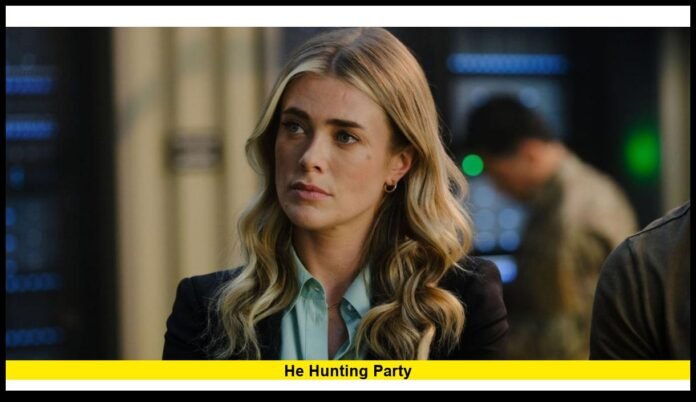
At the center of The Hunting Party is Melissa Roxburgh, whose portrayal of profiler Bex Henderson anchors the series emotionally.
Bex is not presented as an untouchable hero. She is capable, driven, and intelligent, but increasingly weighed down by what she knows. Season 2 deepens this internal conflict. Her role has shifted from hunter to guardian of a secret that may be doing more harm than good.
Her leadership style evolves as pressure mounts. Trust becomes harder to maintain. Decisions feel heavier. Roxburgh’s performance grounds the show’s larger themes in personal consequence, ensuring the story never drifts into abstraction.
An Ensemble Under Pressure
The returning ensemble cast provides continuity and depth, allowing Season 2 to focus on evolution rather than reintroduction.
Key members of the task force include:
- Nick Wechsler as Oliver Odell, navigating shifting loyalties
- Patrick Sabongui as Jacob Hassani, balancing authority and restraint
- Josh McKenzie as Shane Florence, whose past decisions continue to echo
- Sara Garcia as Jennifer Morales, representing the intelligence side of the operation
Season 2 places these characters in morally ambiguous situations that test their limits. The group dynamic feels less stable, reflecting the reality that secrets erode even the strongest alliances.
Season 2’s Narrative Direction
The Hunting Party does not treat its second season as a reset. Instead, it treats it as escalation.
Several story elements define this phase of the series:
- A wider range of escaped inmates with unpredictable methods
- Increased scrutiny from outside agencies
- Internal disagreements over mission boundaries
- Growing awareness that containment may no longer be possible
Each episode advances both a specific capture and the broader institutional mystery. Viewers are not simply watching criminals get caught. They are watching a system unravel.
Guest Performances That Reshape the Story
Season 2 leans heavily into guest casting as a storytelling tool rather than a novelty.
One of the most discussed appearances comes from Josh Dallas, whose portrayal of Elliot Carr introduces a villain defined by control and calculation. His presence adds psychological tension rather than spectacle, forcing the task force to confront a criminal who thrives on manipulation rather than chaos.
Another standout role is delivered by Eric McCormack, who appears as Ron Simms, a killer whose story unfolds across timelines. His real-life son Finnigan McCormack portrays the younger version of the same character, adding continuity and emotional depth to the narrative.
Additional guest roles throughout the season continue this pattern. The villains are not interchangeable. Each one brings a distinct worldview shaped by isolation, control, or betrayal.
Why the Antagonists Feel Different
The Hunting Party avoids portraying its criminals as abstract threats. Season 2 reinforces the idea that prolonged secrecy and isolation can warp behavior in extreme ways.
These fugitives are:
- Highly intelligent and adaptive
- Emotionally fractured by confinement
- Aware of the systems that failed them
- Capable of exploiting public blind spots
This approach forces the task force to confront uncomfortable truths. Capturing a fugitive does not erase what created them. That tension adds depth to every resolution.
Production Choices That Match the Story
Season 2 introduces a deliberate shift in visual tone that closely mirrors the series’ evolving narrative. The look of The Hunting Party is noticeably grittier and more grounded, favoring realism over polished stylization. This change reflects a world that feels increasingly unstable, where control is slipping and certainty is harder to maintain.
Urban locations now dominate the landscape, placing the action in environments that feel crowded, exposed, and unpredictable. The camera frequently lingers in tight corridors, busy streets, and confined interiors, reinforcing a sense of pressure and limited escape. Natural lighting replaces dramatic visual flourishes, while restrained camera movement keeps the focus on character reactions rather than spectacle.
These production choices heighten immediacy and vulnerability. The task force no longer feels insulated by secrecy or distance. They operate in plain sight, navigating spaces where mistakes are harder to conceal and consequences unfold quickly. As margins for error shrink, the visual language reinforces the urgency of the mission, making every pursuit feel closer, riskier, and more personal.
Pacing and Structure
The Hunting Party benefits from deliberate pacing. Rather than rushing reveals, the series allows information to unfold gradually.
Each episode serves multiple functions:
- Advancing a specific investigation
- Revealing more about The Pit
- Developing character relationships
- Raising new ethical questions
This layered structure rewards attentive viewing and strengthens long-term engagement.
Audience Response and Momentum
Audience engagement has continued to build throughout Season 2. Viewers respond strongly to the show’s refusal to rely on shock alone.
Online discussion often centers on:
- Moral dilemmas faced by the task force
- Psychological depth of the fugitives
- Long-term consequences of secrecy
- Character evolution rather than plot twists
This sustained conversation reflects a growing appetite for serialized crime stories that prioritize payoff over immediacy.
Broadcast and Viewing Access
The Hunting Party airs weekly on NBC, holding a consistent primetime slot that reinforces appointment viewing and supports the show’s serialized structure. This scheduling allows audiences to follow the unfolding story in sequence, preserving narrative momentum and encouraging real-time discussion as each episode builds on the last.
In addition to its broadcast run, episodes are made available for streaming shortly after airing, giving viewers flexibility without disrupting continuity. This viewing option supports different audience habits, from traditional live television watchers to those who prefer on-demand access. By maintaining strong visibility across both platforms, the series continues to reach a broad and engaged audience while ensuring that no segment falls behind as the season progresses.
Why The Hunting Party Still Stands Out
In a crowded genre, The Hunting Party distinguishes itself through commitment to consequence. Actions matter. Secrets linger. Characters are shaped by what they protect and what they allow.
Season 2 emphasizes erosion rather than escalation. Confidence fades. Boundaries blur. The story gains strength from restraint rather than excess.
This consistency has allowed the series to grow into a clearly defined identity rather than chasing trends.
What Lies Ahead
As the season continues, several unresolved questions remain central to The Hunting Party. The origins of The Pit are still only partially understood, leaving uncertainty around who authorized its creation, who benefited from its secrecy, and how deeply that knowledge extended within the system. At the same time, the full scope of the escape has yet to be revealed, with the task force operating under the constant pressure that additional fugitives may still be active and undiscovered.
Each episode moves the team closer to a breaking point where containment alone may no longer be enough. The mission has begun to shift from quiet retrieval to confrontation, forcing difficult conversations about responsibility, oversight, and the cost of long-term secrecy. Internal divisions grow sharper as ethical boundaries blur, and loyalty to the mission is tested against personal conscience.
The pursuit is no longer defined solely by capturing those who escaped. It has become a search for accountability at every level, with the potential to expose decisions that were once protected by silence. As the truth edges closer to the surface, the task force faces the reality that uncovering it may permanently change both their role and the system they serve.
The Importance of The Hunting Party in 2026
The Hunting Party reflects a broader shift in crime television toward serialized narratives that question institutional power. Its relevance lies in its willingness to explore the cost of secrecy without losing narrative focus.
By blending suspense with character-driven storytelling, the series offers a model for how broadcast crime dramas can evolve without abandoning structure.
In 2026, The Hunting Party stands as a reminder that the most compelling threats are often created by the systems meant to contain them.
What are your thoughts on where The Hunting Party is headed next? Join the conversation and keep following as the hunt continues.