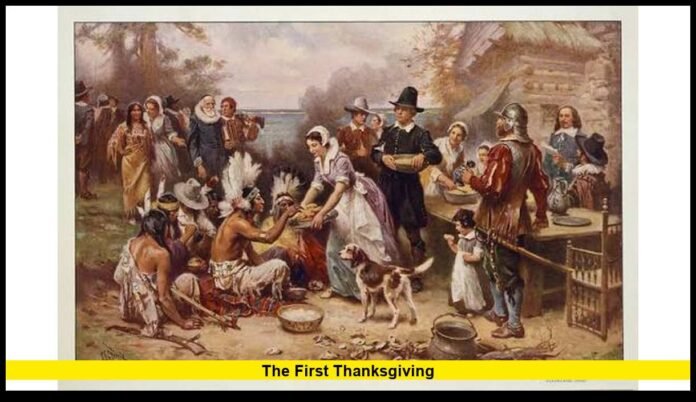

The First Thanksgiving is commonly associated with a harvest celebration held in Plymouth, Massachusetts, in the autumn of 1621, when English colonists and members of the Wampanoag Nation gathered for a multiday celebration following the colonists’ first successful harvest. The event is remembered as an important chapter in American history, but the story is more complicated than the traditional classroom image of Pilgrims and Native Americans sitting together around a table filled with turkey, pumpkin pie, and other familiar Thanksgiving foods.
The historical gathering took place nearly 400 years ago, before Thanksgiving became a national holiday. It involved cooperation, survival, diplomacy, and the relationship between English settlers and Indigenous people whose communities had existed in the region for thousands of years.
Today, Thanksgiving remains one of the most widely celebrated holidays in the United States. In 2026, Thanksgiving Day falls on Thursday, November 26, giving Americans another opportunity to reflect on gratitude, family traditions, history, and the different experiences that shaped the holiday.
Understanding The First Thanksgiving requires looking beyond the familiar holiday imagery and examining what historians know about the 1621 gathering, the people involved, the food they ate, and how the event eventually became connected to the modern American Thanksgiving celebration.
What Was the First Thanksgiving?
The First Thanksgiving refers to a harvest celebration held in 1621 by English colonists living in Plymouth Colony and members of the Wampanoag Nation. The gathering followed a difficult period for the colonists, who had arrived in North America the previous year and faced severe challenges during their first winter.
The celebration lasted several days and involved food, outdoor activities, and interaction between the two communities. Historical accounts indicate that approximately 52 English colonists and at least 90 Wampanoag men were involved in the gathering, although exact details about the event remain limited.
The occasion was not officially called Thanksgiving at the time. Instead, it was a harvest celebration connected to the colonists’ successful agricultural season and their ability to survive in a new environment.
The event became known as the First Thanksgiving much later, as Americans developed a national tradition surrounding the story of Plymouth and the relationship between the English settlers and Native Americans.
When Did the First Thanksgiving Take Place?
The First Thanksgiving took place during the autumn of 1621, following the colonists’ first successful harvest in Plymouth.
Historians generally place the gathering sometime between September and November, although the precise date is unknown. There is no surviving record that identifies an exact day for the celebration.
The event reportedly lasted three days. During that time, the English colonists and Wampanoag participants shared food and participated in activities that reflected the seasonal harvest and the relationships developing between the communities.
Unlike today’s Thanksgiving, which is celebrated on a fixed date determined by federal law, the 1621 gathering was a one-time harvest celebration without a standardized calendar date.
Where Did the First Thanksgiving Take Place?
The First Thanksgiving is associated with Plymouth, Massachusetts, in what is now the southeastern portion of the state.
The English settlers established Plymouth Colony in territory that belonged to the Wampanoag people. The settlement was located near the Indigenous community of Patuxet, a place that had experienced devastating disease outbreaks before the arrival of the Mayflower settlers.
The colonists established their settlement in an area where many Indigenous residents had died from epidemics. The landscape was not an untouched wilderness, as many traditional illustrations suggest. It was part of a homeland occupied, cultivated, and used by Native communities for generations.
Plymouth is now one of the most important historic destinations associated with Thanksgiving. Visitors can explore museums, historic sites, educational programs, and locations connected to the early English settlement.
Who Participated in the First Thanksgiving?
The gathering included English colonists commonly identified today as Pilgrims and members of the Wampanoag Nation.
The English settlers were part of the Plymouth Colony, which had been established after the Mayflower arrived in 1620. The colonists faced serious hardships during their first year, including illness, hunger, cold weather, and limited knowledge of local agricultural conditions.
The Wampanoag were an Indigenous people with a longstanding presence in the region. Their communities had established social systems, leadership structures, agricultural practices, trade networks, and cultural traditions long before Europeans arrived.
The gathering involved people from two communities with different backgrounds and circumstances. The relationship was shaped by diplomacy, survival, mutual interests, and the broader political environment of the region.
The Wampanoag People and Their Role
The Wampanoag played a critical role in the early survival of the Plymouth settlers.
Their knowledge of the local environment, agriculture, fishing, hunting, and seasonal food resources helped the English colonists adapt to their surroundings. The relationship between the two communities was not simply a story of generosity or friendship. It also involved strategic considerations, political alliances, and the changing balance of power in the region.
Wampanoag leadership recognized the English settlers as potential allies in a complicated political environment. At the same time, Native communities had experienced European contact before the Mayflower arrived, including kidnapping, enslavement, disease, and disruption.
The Wampanoag people were therefore not unfamiliar with Europeans, nor were they simply passive participants in the events of 1621.
For readers seeking a more complete Indigenous perspective, the Smithsonian’s educational resource provides a valuable historical overview of Native experiences surrounding Thanksgiving:
Smithsonian National Museum of the American Indian – Thanksgiving and Native Perspectives
Why the Pilgrims Needed Help
The Mayflower settlers arrived in North America in 1620 after a difficult journey across the Atlantic Ocean. Their first months in the region were marked by harsh weather, limited food supplies, illness, and unfamiliar environmental conditions.
The winter of 1620–1621 was particularly devastating. A significant portion of the original group died during the first winter, leaving the surviving colonists struggling to establish a functioning settlement.
Their survival depended on several factors, including access to food, local knowledge, agricultural development, and assistance from people familiar with the region.
The Wampanoag and other Indigenous individuals provided important knowledge that helped the colonists understand how to grow crops and use local resources. This assistance contributed to the successful harvest that became associated with the 1621 celebration.
The Importance of Tisquantum, Also Known as Squanto
One of the most frequently discussed individuals in the history of the First Thanksgiving is Tisquantum, commonly known as Squanto.
Tisquantum was a member of the Patuxet community and had experienced extraordinary circumstances before returning to his homeland. He had been kidnapped and taken across the Atlantic, experienced life in Europe, and eventually returned to North America.
His knowledge of English and familiarity with European customs made him an important intermediary between the Plymouth colonists and Indigenous communities.
Tisquantum helped the colonists communicate with local Native people and provided information about agriculture and regional resources. His assistance was particularly valuable because the English settlers were unfamiliar with the local environment.
His life story also highlights the difficult and often violent history of early European contact with Indigenous people. Tisquantum’s experiences included captivity, displacement, and the devastating effects of disease on his community.
His role in the history of Plymouth is significant, but his story should not be reduced to a simple narrative about helping the Pilgrims. He was an Indigenous person whose life had been profoundly affected by European expansion and whose knowledge and experience became important during a period of major historical change.
What Did People Eat at the First Thanksgiving?
The food served during the First Thanksgiving was likely very different from the traditional Thanksgiving meal Americans prepare today.
The surviving historical descriptions mention hunting, poultry, deer, and other food resources. Historians believe the gathering probably included a combination of wild game, seafood, vegetables, grains, and seasonal foods available in the region.
The exact menu is unknown because no complete food list survives.
Likely foods included:
- Wild birds: The colonists hunted birds for the gathering, although the surviving account does not specifically identify turkey.
- Venison: Wampanoag participants reportedly brought five deer to the celebration.
- Seafood: Fish, shellfish, and other seafood were important foods in the region.
- Corn: Indigenous agricultural knowledge helped the colonists cultivate corn.
- Squash and other vegetables: Seasonal crops were likely part of the food supply.
- Wild berries and other local ingredients: Native plants and regional foods were important resources.
The gathering probably involved more food variety than the familiar images of a single turkey served with mashed potatoes, gravy, cranberry sauce, and pumpkin pie.
Was Turkey Served at the First Thanksgiving?
Turkey is strongly associated with modern Thanksgiving, but historians cannot confirm that a turkey was served at the 1621 gathering.
The surviving account describes the colonists hunting birds, but it does not specifically identify turkey as one of the foods prepared.
Wild turkey existed in North America and could have been available to the colonists. However, there is no definitive historical evidence establishing that turkey was the centerpiece of the 1621 meal.
The modern tradition of serving turkey developed over time and became firmly associated with Thanksgiving as the holiday evolved during the 19th and 20th centuries.
Did They Eat Pumpkin Pie at the First Thanksgiving?
Pumpkin and other squash varieties were known in the region, and Indigenous communities cultivated them long before European settlement.
However, the familiar pumpkin pie served during modern Thanksgiving dinners was not documented as part of the 1621 celebration.
The colonists lacked many of the ingredients and cooking methods associated with today’s desserts. Traditional pumpkin pie requires a prepared pastry crust, sweeteners, and other ingredients that were not necessarily available in the same form during the early Plymouth settlement.
Pumpkin or squash may have been consumed in other preparations, but the presence of modern pumpkin pie at the First Thanksgiving is not supported by historical evidence.
Did the First Thanksgiving Include Cranberry Sauce?
Cranberries are native to North America and were known to Indigenous communities.
However, modern cranberry sauce made with sugar was not documented as part of the 1621 harvest gathering. Cranberries may have been used in different ways, but there is no reliable evidence that the familiar sweet cranberry sauce served today was present at the celebration.
This distinction illustrates how Thanksgiving food traditions evolved over time rather than being directly copied from a single historical meal.
What Did the First Thanksgiving Actually Look Like?
Popular paintings and school illustrations often depict the First Thanksgiving as a formal dinner with English colonists and Native Americans seated around a long table.
The historical evidence suggests a less formal event.
The celebration was likely held outdoors, with food prepared and consumed in a setting reflecting the practical conditions of a 17th-century settlement. The gathering reportedly involved activities beyond eating, including hunting and other forms of recreation.
The event lasted several days, and the Wampanoag participants were not necessarily seated in the carefully arranged manner shown in later illustrations.
The familiar visual image of the First Thanksgiving was largely shaped by later artists, popular publications, school materials, and national storytelling traditions.
The Relationship Between the Pilgrims and the Wampanoag
The relationship between the English colonists and the Wampanoag was complex.
In 1621, the communities had reasons to cooperate. The colonists needed assistance and resources to survive, while Wampanoag leadership had strategic reasons to establish diplomatic relationships with the newcomers.
The relationship included a mutual agreement and cooperation, but it should not be understood as an uncomplicated or permanent friendship.
As English settlement expanded, Native communities faced increasing pressure on their land, resources, and political independence. Colonists established additional settlements, claimed territories, and increasingly disrupted Indigenous ways of life.
The history of Thanksgiving therefore includes both cooperation in 1621 and the larger history of colonization that followed.
Was the First Thanksgiving Really the First Thanksgiving in America?
The Plymouth celebration of 1621 is widely known as the First Thanksgiving, but it was not necessarily the first thanksgiving celebration or religious observance held in what is now the United States.
European settlers held earlier thanksgiving services and celebrations in other locations. Some historical accounts point to earlier gatherings in Virginia and other colonial regions. Indigenous communities also had longstanding traditions of giving thanks for harvests, seasonal changes, food, and community wellbeing before European settlers arrived.
The word “first” therefore requires context.
The 1621 Plymouth harvest celebration is best understood as the event that eventually became the most widely recognized historical origin story of the modern American Thanksgiving tradition, rather than an unquestionable first celebration of gratitude on the continent.
The Historical Records Behind the First Thanksgiving
Only a small amount of firsthand documentation survives describing the 1621 gathering.
One of the most important accounts comes from Edward Winslow, an English colonist who described the harvest celebration in a letter written in December 1621. His account provides information about the successful harvest, hunting activities, the arrival of Wampanoag participants, and the gathering that lasted several days.
The surviving records do not provide a complete description of every activity, participant, meal, or conversation that took place.
Historians must therefore distinguish between details directly supported by written evidence and elements that became part of the Thanksgiving story through later interpretations.
The National Archives provides historical context about the celebration and the evolution of the Thanksgiving narrative:
National Archives – Thanksgiving: Historical Perspectives
How the First Thanksgiving Became a National Tradition
The 1621 gathering did not immediately become an annual national holiday.
For many years, thanksgiving observances occurred at different times and for different reasons. Communities and governments occasionally declared days of thanksgiving following successful harvests, military victories, or other significant events.
The holiday gradually developed through colonial, state, and national traditions.
During the 19th century, Thanksgiving became increasingly connected to the story of the Plymouth harvest celebration. Writers, educators, artists, publishers, and advocates helped popularize the connection between the 1621 gathering and the national holiday.
One important figure in this process was Sarah Josepha Hale, a writer and editor who campaigned for a nationally recognized Thanksgiving holiday for many years.
Abraham Lincoln and the National Thanksgiving Holiday
Thanksgiving became a nationally recognized annual observance during the Civil War.
In 1863, President Abraham Lincoln issued a proclamation establishing a national day of thanksgiving to be observed in November. His proclamation came during a period of national division and conflict, and it encouraged Americans to reflect on blessings, national unity, and gratitude.
Lincoln’s proclamation helped establish the holiday as a national tradition.
Thanksgiving continued to evolve after 1863, eventually becoming the familiar federal holiday celebrated on the fourth Thursday of November.
Why Thanksgiving Is Celebrated on the Fourth Thursday of November
Thanksgiving was not always celebrated on the same date each year.
Presidents and state governments had previously issued proclamations setting different dates. The holiday’s timing eventually became standardized.
In 1941, Congress established Thanksgiving as a federal holiday on the fourth Thursday of November. This created the consistent schedule Americans follow today.
The fourth Thursday rule means Thanksgiving can fall between November 22 and November 28.
For 2026, the holiday falls on Thursday, November 26.
Thanksgiving 2026: What Americans Should Know
Thanksgiving 2026 is approaching, and the holiday will be observed nationwide on Thursday, November 26.
For many Americans, Thanksgiving is a major family and community holiday involving travel, meals, gatherings, volunteering, and seasonal traditions.
Common Thanksgiving activities include:
- Family and friends gathering for dinner
- Preparing turkey and traditional side dishes
- Watching Thanksgiving Day football
- Traveling to visit relatives
- Participating in community food drives
- Volunteering at food banks and shelters
- Watching holiday parades
- Beginning holiday shopping and seasonal activities
The holiday also marks a major travel period in the United States, as millions of people typically travel by car, air, rail, and other transportation methods to spend time with family and friends.
Thanksgiving and Native American Perspectives
The First Thanksgiving is an important historical event, but its meaning is different for many Native Americans.
For some Indigenous people, Thanksgiving represents a complicated history involving colonization, loss of land, disease, cultural disruption, and the struggle to preserve Native identity and sovereignty.
The traditional story often focuses on cooperation between the Pilgrims and Wampanoag people while giving limited attention to what happened after the 1621 gathering.
As English settlements expanded, Indigenous communities faced increasingly severe pressure. Land was taken, traditional resources were disrupted, and Native political independence was threatened.
Some Native Americans participate in Thanksgiving celebrations, while others observe the day through reflection, remembrance, activism, or community gatherings.
The National Day of Mourning
In Plymouth, Massachusetts, some Native Americans and supporters observe Thanksgiving as a National Day of Mourning.
The observance began in 1970 and provides an opportunity to remember Indigenous people who experienced colonization, displacement, violence, and the loss of land and cultural resources.
The National Day of Mourning challenges simplified versions of Thanksgiving history and calls attention to Indigenous experiences that are often overlooked in traditional holiday narratives.
The observance does not mean every Native American views Thanksgiving in the same way. Indigenous communities are diverse, and their perspectives on the holiday vary.
However, the National Day of Mourning has become an important part of the broader historical discussion surrounding Thanksgiving.
How Thanksgiving History Is Taught Today
Modern educational approaches increasingly emphasize a broader understanding of Thanksgiving history.
Rather than focusing only on a traditional story of Pilgrims and Native Americans sharing a meal, educators often explore:
- Indigenous history before European arrival
- The Wampanoag Nation and its homeland
- The Mayflower journey and Plymouth Colony
- The challenges faced by English settlers
- Indigenous knowledge and agricultural practices
- European disease and its impact on Native populations
- The political relationship between the colonists and Wampanoag
- The expansion of English settlements
- The evolution of Thanksgiving into a national holiday
- Native American perspectives on Thanksgiving today
This approach helps students understand the historical event in its full context rather than treating it as an isolated story.
Why the First Thanksgiving Still Matters Today
The First Thanksgiving remains an important part of American history because it connects several major themes, including migration, survival, agriculture, diplomacy, cultural exchange, colonization, and national identity.
The 1621 gathering represents a moment when two communities came together during a period of uncertainty. The colonists’ survival depended partly on knowledge and assistance from Indigenous people, while Wampanoag leadership navigated a complicated political environment involving the arrival of European settlers.
However, the event also represents the beginning of a historical period that would bring major changes to Indigenous communities throughout New England and beyond.
Understanding the First Thanksgiving means recognizing both the cooperation that occurred during the gathering and the larger historical developments that followed.
The Smithsonian’s historical overview offers additional context on how the harvest celebration became connected to the modern national holiday:
Smithsonian Institution – Thanksgiving: From Local Harvests to National Holiday
What Historians Know and What Remains Uncertain
Despite the importance of the First Thanksgiving, several details remain uncertain because the historical record is incomplete.
Historians can confirm that a harvest celebration occurred in Plymouth in 1621 and that Wampanoag participants were present. They can also rely on surviving accounts to understand some of the activities and circumstances surrounding the gathering.
However, the following details are not definitively established:
- The exact date of the celebration
- The complete number of people who attended
- The full menu
- Whether turkey was served
- Whether pumpkin pie or cranberry sauce was served
- The exact location of every activity
- The precise conversations that took place
- Whether the participants understood the event in the same way
The limited surviving documentation is an important reason historians avoid treating every detail of popular Thanksgiving imagery as fact.
Readers interested in the surviving historical accounts can explore the Pilgrim Hall Museum’s historical explanation of the 1621 gathering.
The First Thanksgiving Compared With Modern Thanksgiving
The differences between the 1621 gathering and today’s Thanksgiving are substantial.
| The 1621 Harvest Celebration | Modern Thanksgiving |
|---|---|
| Took place during autumn 1621 | Celebrated on the fourth Thursday of November |
| Lasted several days | Usually centered around one holiday day, with extended gatherings |
| Celebrated a successful harvest | Celebrates gratitude, family, community, and tradition |
| Included English colonists and Wampanoag participants | Celebrated by Americans from diverse backgrounds |
| Food included seasonal resources and hunted foods | Often includes turkey, stuffing, potatoes, vegetables, pies, and other dishes |
| Was not an official national holiday | Is a federal holiday |
| Had no fixed annual date | Has a standardized calendar date each year |
The comparison illustrates how a historical gathering gradually became a national holiday with traditions that developed over generations.
Thanksgiving Traditions That Developed Over Time
Many modern Thanksgiving traditions did not originate in 1621.
The holiday’s familiar customs developed through changing cultural practices, commercial influences, regional traditions, family habits, and national celebrations.
Today, Thanksgiving may include:
Turkey Dinner: Turkey became one of the most recognizable Thanksgiving foods, although its presence at the 1621 celebration is unconfirmed.
Stuffing and Side Dishes: Recipes vary widely, with families serving traditional favorites or regional specialties.
Pumpkin Pie: Pumpkin-based desserts became associated with autumn and Thanksgiving over time.
Football: Thanksgiving football became a major American entertainment tradition during the modern era.
Parades: Thanksgiving parades, including major events in large American cities, became part of the holiday’s popular culture.
Family Gatherings: Thanksgiving is often a time when relatives and friends travel to spend time together.
Giving Back: Food donations, volunteer activities, and charitable programs have become important parts of Thanksgiving for many communities.
These traditions show that Thanksgiving is not frozen in the 17th century. It continues to evolve as Americans develop new ways of celebrating.
The Meaning of Thanksgiving in 2026
As Thanksgiving approaches in 2026, the holiday remains a time of gratitude, reflection, family connections, and community participation.
For many households, the holiday is centered on preparing meals, welcoming guests, and sharing traditions. Others may spend the day volunteering, supporting local food programs, or remembering people who are no longer present.
The historical meaning of Thanksgiving has also become more widely discussed. Americans increasingly recognize that the traditional story does not capture the complete experience of the Wampanoag people or the wider history of Indigenous communities.
The holiday can therefore serve as an opportunity to appreciate personal and community blessings while also learning more about the history of the country.
Why the First Thanksgiving Is More Than a Holiday Story
The First Thanksgiving is more than a familiar image of Pilgrims and Native Americans sharing a meal.
It was a historical gathering shaped by survival, diplomacy, harvest conditions, cultural differences, and the political realities of 17th-century New England. The event later became a powerful symbol of American identity and gratitude, even though many elements of the popular story developed long after 1621.
Understanding the First Thanksgiving means examining both the historical gathering and the way Americans have remembered it over time.
The story continues to matter because it reflects the country’s complicated history, the importance of Indigenous knowledge and contributions, and the way traditions can change as generations reinterpret the past.
The First Thanksgiving remains an important part of American history, and understanding its complete story makes the holiday more meaningful—share your thoughts on how Thanksgiving traditions and historical perspectives have changed over the years.