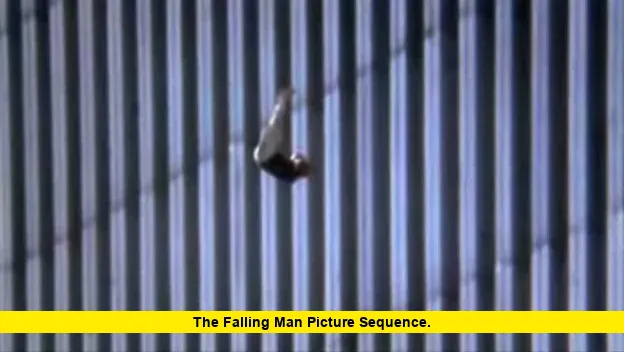

The falling man picture sequence remains one of the most haunting photographic records of September 11, 2001, capturing a moment of human vulnerability during the World Trade Center attacks. Taken by Associated Press photographer Richard Drew, the image shows a man descending from the North Tower against the geometric lines of the buildings.
As the United States marks the 25th anniversary of 9/11 in 2026, the photograph continues to generate discussion about journalism, memory, human dignity, and the unanswered question of who appears in the frame.
The photograph itself lasts only an instant. However, it came from a rapid sequence of images taken as the man fell. That sequence provides important context because the famous frame can make the descent appear controlled and almost motionless. The surrounding photographs reveal a much more complicated movement.
What Is the Falling Man Picture Sequence?
The falling man picture sequence refers to a series of photographs Richard Drew made while tracking a person falling from the World Trade Center on September 11, 2001.
Drew was not initially assigned to cover the terrorist attacks. He had been working at a fashion event in Midtown Manhattan when the Associated Press newsroom contacted him about the plane crash at the World Trade Center.
He traveled downtown and began photographing the unfolding disaster.
While looking toward the burning towers, Drew saw people falling from the buildings. He raised his camera and followed them through the viewfinder, taking multiple frames in rapid succession.
Drew later explained that he believed he had captured roughly eight or nine frames of the particular man who became associated with the famous photograph. The camera continued firing as he tracked the person’s movement.
One frame caught the man almost perfectly vertical, creating the image that eventually became known as The Falling Man.
The photograph was made at approximately 9:41 a.m., during the period when people were still trapped in the upper floors of the North Tower.
Who Took the Falling Man Photograph?
Richard Drew took the photograph for the Associated Press.
Drew was an experienced photojournalist long before September 11. His career included coverage of major political and historical events, including the 1968 assassination of Robert F. Kennedy.
On 9/11, however, his assignment quickly changed from routine news coverage to documenting an unprecedented national tragedy.
Drew later said that the camera acted almost like a barrier between him and what was happening. He concentrated on recording events as they unfolded rather than immediately processing their emotional meaning.
He did not initially realize that he had captured the specific frame that would become famous.
After returning to the AP office, Drew reviewed his photographs and saw the image among the frames from the sequence.
That detail is important. The photograph was not created through a carefully planned portrait or a staged composition. It emerged from a fast-moving sequence captured during an extraordinary and chaotic event.
What Does the Sequence Show?
The best-known frame shows the falling figure almost perfectly aligned vertically with the World Trade Center’s architecture.
That alignment is one reason the photograph became so visually distinctive.
The man appears almost still, even though he was falling at tremendous speed. His body forms a narrow vertical shape while the surrounding buildings create strong horizontal and vertical lines.
Other photographs from the sequence provide a different impression.
The falling figure changes position and orientation as he moves through the air. Those surrounding frames make clear that the famous photograph represents only one instant in a continuous movement.
This distinction matters because the iconic frame can create an impression of calmness that the broader sequence does not necessarily support.
The sequence therefore offers a more complete visual record than the single photograph alone.
It also demonstrates how a fraction of a second can dramatically change the meaning of a photograph.
Where Was the Falling Man Falling From?
The Falling Man was photographed descending from the North Tower of the World Trade Center in Lower Manhattan.
American Airlines Flight 11 struck the North Tower at 8:46 a.m. on September 11, 2001. The impact and resulting fire trapped many people above the impact zone.
The South Tower was struck by United Airlines Flight 175 at 9:03 a.m.
People trapped in the upper portions of the towers faced extreme heat, smoke, fire, and limited escape options. Some people fell or jumped from the buildings before the towers collapsed.
The exact circumstances surrounding every person photographed that morning cannot be established.
That uncertainty is particularly important when discussing the Falling Man. It is not possible to determine from the photograph alone whether the individual deliberately jumped, was forced from the building by the conditions, or fell while attempting to escape.
Was the Falling Man Identified?
The identity of the man has never been officially confirmed.
Over the years, several attempts have been made to identify him. Two names became particularly associated with the investigation: Norberto Hernandez and Jonathan Eric Briley.
The Hernandez theory emerged early in the search for the person’s identity. However, members of Hernandez’s family disputed the identification.
Later, journalist Tom Junod investigated the photograph and considered Jonathan Briley a stronger possibility.
Briley worked as an audio-visual technician or sound engineer at Windows on the World, the restaurant located near the top of the North Tower.
One important clue was clothing visible in another frame. The photograph appeared to show an orange shirt beneath the man’s outer clothing. People familiar with Briley’s appearance and clothing believed the detail could support the identification.
Briley’s family has also discussed the possibility.
However, resemblance and photographic clues do not amount to an official identification. The distinction remains important.
As of September 11, 2026, the safest description is that Jonathan Briley is widely regarded as a possible or likely identity, but the identity of the Falling Man remains officially unconfirmed.
Recent 25th-anniversary reporting has renewed interest in the Briley theory. His sister Gwen Briley-Strand has said that the figure does resemble her brother, while also emphasizing that definitively proving the identity is not what matters most to her family.
Why the Falling Man Photograph Became So Controversial
The photograph appeared in newspapers shortly after the attacks.
Its publication produced a strong public reaction.
Many readers considered photographs of people falling from the World Trade Center too disturbing to publish. Some newspapers moved away from such images after receiving complaints from readers.
The debate was not simply about whether the photograph was graphic.
It raised a deeper question about the role of journalism during a national tragedy.
Should a photograph documenting a person’s final moments be shown to the public if it helps preserve an accurate historical record?
Or does publication cross a line by exposing an individual at their most vulnerable moment?
The Falling Man became a powerful example of that conflict.
For many years, the photograph largely disappeared from mainstream American visual coverage of 9/11. Images of firefighters, smoke, the burning towers, rescue workers, and the American flag became much more prominent.
That difference shaped the public memory of the attacks.
The Falling Man did not show rescue or recovery. It showed a single human being caught in an impossible situation.
The Falling Man and the Larger 9/11 Record
The photograph is particularly significant because the visual record of September 11 contains relatively few widely circulated images showing individual deaths at close range.
Most of the iconic photographs from that day focus on buildings, airplanes, smoke, emergency responders, crowds, or the destruction of Lower Manhattan.
The Falling Man is different.
It places one person at the center of the frame.
That makes the photograph intensely personal.
The official 9/11 Memorial recognizes 2,977 people who were killed in the September 11 attacks. Those victims came from 90 nations, and their names are permanently inscribed at the Memorial in New York.
The unidentified figure in Drew’s photograph therefore became more than an individual whose identity could not be established with certainty.
For many people, he became a visual representation of the victims whose final moments were never photographed or publicly known.
The Falling Man Picture Sequence and Journalism
The sequence also provides a lesson in photojournalism.
Modern audiences often see a single photograph without knowing what happened before or after the shutter clicked.
In this case, the surrounding frames change the interpretation of the famous image.
Drew did not know that one frame would become an internationally recognized photograph. He was photographing an unfolding disaster and following the movement of people through the air.
The famous composition was partly a product of timing.
The camera captured the subject at the instant when his body aligned almost perfectly with the surrounding architecture.
That combination of timing, perspective, geometry, and historical circumstances transformed one frame into one of the most recognizable photographs associated with 9/11.
The 2003 Esquire Story and the Search for an Identity
The photograph received renewed attention when journalist Tom Junod wrote an extensively reported story for Esquire in 2003.
Junod explored the circumstances surrounding the photograph and investigated possible identities for the man.
His work helped move the discussion beyond the photograph itself.
Rather than treating the image simply as a shocking picture, the story examined the person inside the frame and the families whose loved ones were missing after the attacks.
The search eventually focused heavily on Jonathan Briley.
However, Junod’s investigation did not establish the identity with absolute certainty. The enduring uncertainty became part of the story itself.
The article also helped bring the photograph back into public discussion after it had largely disappeared from mainstream coverage.
The Falling Man Documentary
The story later became the subject of a documentary titled 9/11: The Falling Man.
Directed by Henry Singer, the film examined the photograph, the photographer, the public reaction, and the search for the identity of the person pictured.
The documentary helped introduce the story to a broader international audience.
It also highlighted an uncomfortable reality of disaster photography: images can preserve history while simultaneously causing pain to the people connected to them.
That tension has remained central to discussions about the Falling Man.
Why the Photograph Still Matters in 2026
Twenty-five years after the attacks, the photograph continues to attract attention because its central questions have not disappeared.
The United States has changed dramatically since 2001, and an entire generation has grown up without personal memories of the attacks.
For younger Americans, photographs have become an important way of understanding what happened.
The Falling Man is difficult to view, but its significance lies partly in that discomfort.
It does not present an easy narrative of heroism, survival, or recovery. Instead, it records a moment when ordinary assumptions about safety and escape had collapsed.
The renewed 2026 discussion about Jonathan Briley also demonstrates why careful language matters.
A compelling theory can become accepted as fact through repetition. In this case, the available evidence supports Briley as a serious possibility, but there has been no definitive public confirmation establishing that he is the person in Drew’s famous frame.
Final Thoughts
The falling man picture sequence is more than a collection of photographs from September 11, 2001. It is a visual record of one brief moment during an event that changed the United States and affected millions of people around the world.
Richard Drew’s famous frame became an enduring symbol because it reduced an enormous tragedy to one human figure. Yet the larger sequence reminds viewers that the apparent stillness of the iconic image represents only a fraction of a second.
The man’s identity remains officially unresolved. Jonathan Briley remains the leading theory discussed in recent reporting, but the evidence does not justify presenting that identification as certain.
Ultimately, the photograph’s lasting importance does not depend entirely on knowing the man’s name. It preserves a moment that otherwise could have disappeared, while reminding later generations that behind the statistics of 9/11 were individual people whose lives, families, and final moments mattered.
What are your thoughts on the Falling Man photograph and its place in the history of 9/11? Share your perspective in the comments and stay updated as new verified information emerges.