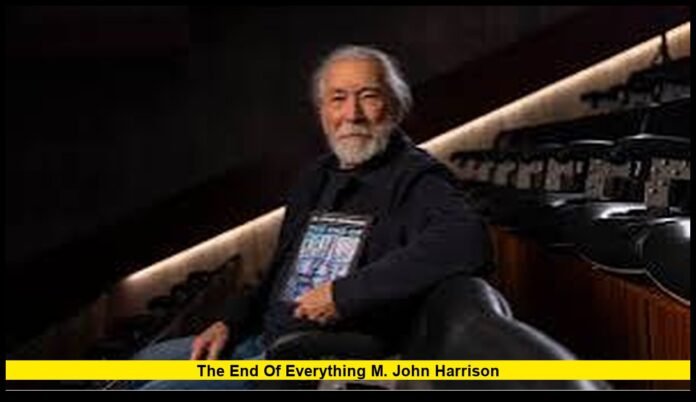

The End of Everything M. John Harrison has emerged as one of the most significant literary titles of 2026 after winning the Booker Prize on November 9. The novel brings together post-apocalyptic fiction, dark satire, unsettling mysteries, and an examination of a society struggling to understand its own collapse. Its success has introduced a wider audience to Harrison, a British author whose writing has challenged traditional boundaries between science fiction and literary fiction for decades.
Published in the United Kingdom by Serpent’s Tail, the novel imagines a version of Britain transformed by an unexplained catastrophe. Government institutions have weakened, the surrounding waters contain unfamiliar creatures, and people continue their daily routines without agreeing on what happened or how the world reached its current condition. At the center of the story is Phillip Tennent, a beachcomber whose discovery of an unusual object draws him into a situation he cannot fully comprehend.
The book’s victory at the 2026 Booker Prize represents a major milestone for Harrison and highlights the literary possibilities of speculative storytelling. Rather than relying on a conventional disaster narrative, he creates an unsettling world where ordinary behavior continues alongside extraordinary events. The result is a novel that examines uncertainty, social breakdown, technology, memory, and the human desire to find explanations when familiar systems no longer work.
Latest Update on The End of Everything M. John Harrison
The most important recent development is the novel’s victory at the 2026 Booker Prize. The award was announced at a ceremony in London on November 9, recognizing Harrison’s work from a shortlist of six books.
At 81, Harrison became the oldest author to win the Booker Prize. The result also marked a significant moment for speculative fiction because his literary career has been closely associated with science fiction and experimental writing.
The £50,000 prize recognizes the novel’s literary achievement rather than simply its commercial popularity. The judges selected it unanimously, praising its ability to address contemporary concerns through an unsettling imagined future.
The decision has placed renewed attention on Harrison’s approach to storytelling. His fiction often resists straightforward explanations, and this novel follows the same pattern. Readers encounter unusual events, conflicting interpretations, and characters who must make decisions without knowing whether their understanding of the situation is correct.
The award may encourage readers unfamiliar with Harrison’s earlier work to explore his wider bibliography. His previous books have received recognition from several literary and speculative fiction awards, demonstrating that his reputation extends well beyond this latest achievement.
The novel also represents an important moment for its UK publisher, Serpent’s Tail, an imprint of independent publisher Profile Books. Its US edition is published by Riverhead Books.
For American readers following the latest book news, the US edition became available on October 13, 2026. The hardcover edition is listed at $30 and contains 208 pages, while digital and audiobook editions are also available through the publisher’s catalog.
The Booker Prize victory is the central confirmed development surrounding the novel. Any future announcement about a screen adaptation, sequel, or related project would need separate official confirmation.
What Is The End of Everything About?
The novel takes place in a near-future version of Britain, several years after a crisis has changed society. The exact cause of the catastrophe remains unclear, and the people living through its consequences have no universally accepted explanation.
Government barely functions, the sea has become a source of strange discoveries, and familiar geographical and political assumptions have been disrupted. Although the setting suggests the aftermath of an apocalypse, life has not stopped completely.
People continue to work, search for resources, maintain relationships, and attempt to preserve ordinary routines. However, the institutions that once supported those activities have become unreliable.
Phillip Tennent makes his living collecting artifacts that wash ashore along the English Channel. His work places him between the familiar coastal landscape and the strange developments transforming it.
One day, Phillip discovers an object that behaves in ways he cannot explain. What initially appears to be a potentially valuable find begins changing and developing characteristics that make it difficult to classify as an ordinary object.
Phillip decides to take it inland, hoping to find a buyer or a practical way to deal with his discovery. His decision draws him further into a world where the boundaries between living creatures, artificial constructions, and unfamiliar forms of intelligence become increasingly uncertain.
The object becomes more than a mystery to solve. Its behavior challenges Phillip’s assumptions about the world and the ability of people to understand something that does not follow familiar rules.
The story also follows Marnie, Phillip’s 70-year-old aunt and a former artist. Her journey offers another perspective on a society in which established moral expectations and social structures have weakened.
Marnie’s actions are often direct and unsettling. After killing a teenage boy, she leaves her home and travels toward London. Her journey unfolds in an environment where violence, instability, and the absence of dependable authority have altered everyday life.
Through Phillip and Marnie, Harrison presents two different responses to a world that no longer behaves as expected. One tries to make sense of an extraordinary discovery, while the other moves through a damaged society with a determination that can be difficult to reconcile with conventional ideas about morality.
Their experiences give the novel a human focus without reducing its central mysteries to a single explanation.
Phillip Tennent and His Search for Answers
Phillip is one of the novel’s central characters, and his occupation helps establish the story’s atmosphere. As a beachcomber, he searches the shoreline for objects that the sea has carried away or returned to land.
The work requires patience, observation, and a willingness to find value in discarded materials. In the transformed world of the novel, these qualities become especially important because the coastline provides access to things that people may not understand.
Phillip’s discovery disrupts his familiar routine. The object appears to offer an opportunity, but its changing nature makes it difficult to determine whether it can be sold, controlled, or safely understood.
His response reflects a recognizable human tendency: when confronted with something unfamiliar, people often attempt to fit it into existing categories. They ask whether it is a product, a creature, a technological device, or a source of financial value.
Phillip’s attempts to classify his discovery become increasingly difficult as its behavior changes.
This part of the story also introduces questions about the relationship between curiosity and control. Finding something unusual does not mean understanding it, and possessing an object does not necessarily mean having authority over it.
Phillip’s journey therefore becomes a search for meaning as much as a practical effort to manage his discovery.
Marnie’s Journey Through a Broken Society
Marnie provides a contrasting perspective on the novel’s damaged world. As Phillip’s aunt and a former artist, she carries a personal history that differs from the experiences of younger characters attempting to navigate the new social order.
She is also living with dementia, a condition that complicates how she experiences memory and the surrounding world. Harrison does not make her character a simple symbol of helplessness. Marnie remains capable of making decisions, acting independently, and responding forcefully to situations she encounters.
Her journey toward London follows the breakdown of familiar expectations. The usual boundaries between acceptable and unacceptable behavior have become unstable, while the authority of institutions can no longer be taken for granted.
Marnie’s violence is deliberately disturbing. Her actions challenge readers to consider how people judge behavior when the social structures that normally establish rules have weakened.
The novel does not require readers to approve of her decisions. Instead, it places those decisions within a world where familiar moral and institutional frameworks no longer provide dependable guidance.
Her experiences also deepen the story’s treatment of memory. Individuals depend on personal recollection and shared history to understand their identities, relationships, and responsibilities. When memory becomes unreliable, those foundations can be harder to maintain.
This theme connects Marnie’s personal circumstances with the larger instability surrounding her. The society she inhabits has also lost parts of its shared history, leaving people uncertain about what happened and how they should interpret the present.
Understanding the Mysterious iGhetti
The iGhetti are among the most unusual elements in the novel. These mysterious entities are associated with the catastrophe that has transformed Britain, but their origins and motivations remain uncertain.
They resist straightforward classification. Characters develop competing theories about what they are and where they came from, yet none provides a definitive explanation that resolves the mystery.
Some interpretations connect them with digital technology, while others invoke unfamiliar scientific or metaphysical possibilities. Their shifting forms and apparent ability to imitate aspects of human behavior make it difficult to determine whether they should be understood as organisms, machines, or something outside those categories.
The uncertainty surrounding the iGhetti is central to Harrison’s storytelling. They are not merely obstacles that the characters must overcome. Their presence challenges the assumption that every unfamiliar event can eventually be explained through established knowledge.
The novel also explores the distinction between imitation and understanding. If an unfamiliar entity can reproduce human speech or behavior, does that mean it understands the people it imitates? How should people respond when they cannot reliably distinguish between an appearance of intelligence and something they can comprehend?
These questions resonate with contemporary discussions about artificial intelligence and automated systems. However, the iGhetti are not reducible to a single technological analogy. Their significance comes partly from the fact that the story refuses to settle on one explanation.
Their arrival also has consequences beyond individual encounters. As the unfamiliar entities appear in the wider world, established institutions struggle to respond, and the social order becomes even more unstable.
The iGhetti therefore connect the novel’s mysterious plot with its larger examination of authority, technology, and the limits of human understanding.
Major Themes Explored in The End of Everything
1. The Collapse of Social Institutions
The novel depicts a society in which government and other established systems have lost much of their ability to maintain order.
This collapse affects more than formal political structures. It changes how people obtain resources, respond to danger, form alliances, and understand their responsibilities to one another.
Harrison focuses on the period after the initial catastrophe, when people must continue living without reliable institutions. Everyday routines persist, but they no longer rest on the same assumptions.
The result is a portrait of social breakdown that feels unsettling because it does not depend entirely on spectacular destruction. The world continues functioning in fragments, making it difficult to identify a clear boundary between normal life and catastrophe.
2. The Meaning of an Apocalypse
Traditional apocalyptic fiction often emphasizes a dramatic ending, followed by a struggle for survival or the possibility of rebuilding civilization.
Harrison takes a less conventional approach. The catastrophe has already occurred, yet the characters cannot fully explain it, and its consequences continue to unfold.
The world has changed, but people still go about their lives. Some seek practical solutions, others attempt to preserve familiar habits, and many simply try to cope with circumstances they cannot control.
This creates an important question: what does the end of the world actually mean if human activity continues?
The novel suggests that an apocalypse may not produce a single, universally understood moment of closure. It may instead dismantle the assumptions that allow people to interpret their experiences as part of a stable and understandable reality.
3. Technology and Artificial Intelligence
The novel’s mysterious entities create opportunities to consider technology and the growing difficulty of understanding complex systems.
Modern technologies can perform tasks, generate language, and imitate aspects of human behavior without necessarily sharing human intentions or experiences. These developments raise questions about trust, responsibility, and the meaning of intelligence.
Harrison’s fictional world takes these uncertainties into a more unsettling setting. The characters encounter entities that do not fit their established categories, and their attempts to understand them produce more questions than answers.
The connection to artificial intelligence is a useful way to approach some of the novel’s concerns, but it should not be treated as the only interpretation. The iGhetti also serve as a broader representation of the unfamiliar and the limits of human explanation.
4. Memory and the Loss of Shared History
Memory plays an important role through Marnie’s personal circumstances and the wider society’s uncertain history.
People depend on recollection to understand who they are and how their experiences relate to the world around them. Communities also rely on shared accounts of the past to establish traditions, institutions, and collective identities.
When memory becomes unreliable, the consequences extend beyond individual confusion. Relationships can become more difficult to maintain, and shared explanations of events may break down.
The novel’s uncertain history creates a similar problem at the social level. People inhabit the consequences of a catastrophe without agreeing on its nature or meaning.
This parallel makes memory more than a secondary character detail. It becomes part of the novel’s larger examination of how individuals and communities construct a sense of reality.
5. Political Anxiety and Uncertainty
Although the story takes place in an imagined future, it reflects recognizable concerns about political instability and declining trust in established explanations.
When institutions weaken, competing interpretations can emerge without a reliable way to determine which account is correct. People may continue repeating familiar political assumptions even when the circumstances that supported them have disappeared.
Harrison uses the transformed setting to explore how people respond when the world no longer matches their expectations.
The novel does not offer a simple political solution or identify one cause for every problem. Instead, it presents a society where uncertainty affects nearly every attempt to understand events.
That approach allows the story to examine contemporary anxieties without turning into a direct account of a single political controversy.
6. Human Relationships and Moral Responsibility
Despite its unusual setting, the novel remains concerned with familiar human problems.
Phillip’s decisions and Marnie’s journey raise questions about responsibility, independence, trust, and the ways people respond to danger.
The collapse of institutions does not eliminate the need to make moral choices. Instead, it makes those choices more difficult because the consequences may be harder to predict and the usual rules may no longer command agreement.
The characters must continue interacting with others even when their environment offers little reassurance.
This human dimension prevents the story from becoming solely an exercise in speculative ideas. Its mysteries matter because they affect people attempting to live with one another in a world they cannot fully explain.
Why The End of Everything Blends Science Fiction and Literary Fiction
Science fiction frequently explores unfamiliar technologies, alternative futures, alien life, and societies that differ from our own. Literary fiction may focus more directly on characterization, language, psychological complexity, and the interpretation of human experience.
Harrison brings these traditions together.
The novel includes speculative elements, including the iGhetti, an unexplained catastrophe, and a world in which familiar institutions have weakened. Yet it does not rely on a comprehensive technical explanation to establish the rules of its fictional universe.
Instead, the setting allows Harrison to explore uncertainty, social behavior, and the limits of language.
The narrative’s shifting focus and short chapters contribute to a reading experience that can feel fragmented. Events do not always arrive with clear signals explaining their relative importance, and readers must make connections between scenes and characters.
This structure reflects the unstable world in which the story takes place. Just as the characters struggle to understand their circumstances, readers must decide how to interpret what they encounter.
The result challenges the idea that speculative fiction must provide a complete explanation for every unusual event. In Harrison’s novel, the unexplained is an essential part of the design.
M. John Harrison’s Career and Earlier Literary Achievements
M. John Harrison is a British novelist and literary critic whose career spans approximately six decades. He sold his first story in 1965 and later joined the staff of the influential British speculative fiction magazine New Worlds in 1969.
His work has crossed boundaries between science fiction, fantasy, realism, and experimental literature. Rather than following a single genre’s conventions, he has developed a distinctive style recognized for its precision, atmosphere, and willingness to challenge readers.
Among his notable novels are Climbers, The Course of the Heart, Light, Nova Swing, and The Sunken Land Begins to Rise Again.
His career has included several major literary achievements. Climbers won the Boardman Tasker Award for Mountain Literature in 1989, while Nova Swing received the Arthur C. Clarke Award in 2007. The Sunken Land Begins to Rise Again won the Goldsmiths Prize in 2020.
Harrison also served as a judge for the 2022 Booker Prize. His victory in 2026 therefore represents a new achievement for an author who has already received recognition across several literary communities.
The success of The End of Everything reflects the continuity of his approach rather than a sudden departure from his earlier work. Its combination of speculative ideas, uncertainty, and detailed prose is consistent with a career devoted to questioning familiar literary categories.
Why the 2026 Booker Prize Win Matters
The Booker Prize is one of the most prominent awards for novels written in English and published in the United Kingdom or Ireland. Its annual winner often receives increased attention from readers, booksellers, publishers, and literary critics.
Harrison’s victory is particularly notable because of his long association with speculative fiction. The result demonstrates that science fiction can compete successfully within a major literary award traditionally associated with a broad range of contemporary novels.
The win also recognizes the novel’s treatment of current concerns through an imagined setting. By depicting a society that struggles to understand its own collapse, Harrison examines questions about politics, technology, memory, and the reliability of shared explanations.
For readers, the award provides a reason to explore a novel that might otherwise have remained within the audience for experimental or genre-defying fiction.
It may also encourage renewed interest in Harrison’s earlier books, many of which have already earned critical recognition.
The award does not mean that every reader will find the novel straightforward. Its unresolved mysteries and unconventional narrative can demand patience. However, the Booker recognition places it firmly within the major literary conversations of 2026.
Publication Details and Availability in the United States
The UK edition of The End of Everything was published by Serpent’s Tail on June 18, 2026. Riverhead Books published the US edition on October 13, 2026.
The US hardcover edition is listed at $30 and contains 208 pages. Ebook and audiobook formats are also available, although prices and availability may vary by retailer.
American readers should check the edition details when comparing listings, as publication dates, formats, and page counts can differ between markets.
The novel’s Booker Prize victory may bring additional attention to its US release, particularly among readers seeking award-winning fiction or books that combine speculative storytelling with contemporary social commentary.
Who Should Read The End of Everything?
The novel may be particularly rewarding for readers who enjoy stories that raise questions rather than resolve every mystery.
Fans of literary science fiction may appreciate its unusual entities, transformed setting, and exploration of intelligence. Readers interested in dystopian fiction may be drawn to its portrayal of weakened institutions and the difficulty of maintaining everyday life after a catastrophe.
It may also appeal to readers who enjoy experimental prose, dark satire, and characters who behave in complicated or unsettling ways.
However, the book may be less suitable for readers who expect a conventional science fiction adventure with detailed explanations of its fictional technology or a clear resolution to every central mystery.
Its ambiguity is deliberate, and the reader must take an active role in interpreting events.
What Comes Next for the Novel?
Following the Booker Prize announcement, The End of Everything has an opportunity to reach readers beyond Harrison’s established audience.
The award may lead to additional book-club discussions, renewed attention from literary commentators, and increased interest in the author’s earlier work. These are possible consequences of the recognition, not confirmed future events.
As of November 10, 2026, the confirmed major development is the novel’s Booker Prize victory. No official announcement establishing a film or television adaptation or a sequel has been verified for this article.
Readers should rely on confirmed publisher or author announcements for any future developments involving adaptations or additional books.
For now, the novel’s literary recognition and publication in the United States provide the clearest reasons for its growing prominence.
Final Thoughts
The End of Everything M. John Harrison is a major literary title of 2026 because it uses an unfamiliar future to examine problems that remain recognizable in the present.
Its damaged society, mysterious entities, and uncertain history create an environment where people struggle to distinguish between what they know and what they merely assume. Through Phillip’s discovery and Marnie’s journey, Harrison explores the consequences of living without dependable explanations or stable institutions.
The novel does not provide a simple account of how the catastrophe began or what the future will bring. Instead, it asks readers to consider how people continue living when their understanding of reality becomes unreliable.
Its 2026 Booker Prize victory recognizes this distinctive approach and marks a significant moment in Harrison’s long career. For American readers interested in contemporary literature, speculative fiction, and award-winning novels that challenge conventional storytelling, the book offers a thought-provoking reading experience.
Frequently Asked Questions
Q1. What is The End of Everything by M. John Harrison?
A: The End of Everything is a post-apocalyptic speculative novel by British author M. John Harrison. It follows Phillip Tennent, a beachcomber living in a transformed Britain, whose discovery of a mysterious object leads him into a world shaped by an unexplained catastrophe.
Q2. Did The End of Everything win the 2026 Booker Prize?
A: Yes. The novel won the 2026 Booker Prize, with the result announced in London on November 9, 2026. The victory made Harrison the oldest winner in the prize’s history at 81.
Q3. Who is M. John Harrison?
A: M. John Harrison is an English novelist and literary critic known for his work across science fiction, fantasy, and literary fiction. His other notable books include Climbers, Light, Nova Swing, and The Sunken Land Begins to Rise Again.
Q4. What is the main plot of The End of Everything?
A: The story follows Phillip Tennent as he collects objects along the English Channel after a mysterious crisis has disrupted society. When he discovers a strange, changing object, he attempts to take it inland, leading to further encounters with an unfamiliar and unstable world.
Q5. What are the iGhetti in The End of Everything?
A: The iGhetti are mysterious entities associated with the catastrophe in the novel. Their origins and motives remain uncertain, and their unusual forms challenge the characters’ attempts to understand them.
Have you read The End of Everything, or are you planning to pick up the Booker Prize-winning novel? Share your thoughts in the comments and stay updated on the latest literary news.