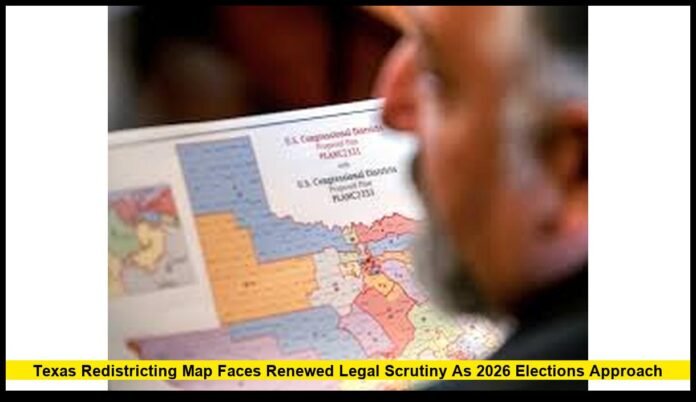

The Texas redistricting map is once again in the spotlight as federal judges weigh claims that the state’s political boundaries unfairly weaken the voices of minority voters. With the 2026 elections drawing closer, the court’s upcoming decision could shape how millions of Texans are represented for years to come.
This ongoing legal battle, now before the U.S. Court of Appeals for the Fifth Circuit, is one of the most closely watched voting rights cases in the country. The outcome could determine whether Texas must redraw its congressional and legislative districts—or whether the current maps will remain in place through the end of the decade.
How the Current Political Boundaries Came to Be
After the 2020 Census, Texas gained two new congressional seats thanks to its booming population. Most of that growth came from Latino, Black, and Asian American communities. Despite this shift, when the state’s Republican-led Legislature redrew its political lines in 2021, the new districts mostly strengthened existing GOP strongholds.
Lawmakers said the maps were based on population changes and legal redistricting principles. Critics, however, argue that the maps were drawn to favor one party while minimizing the voting power of minority communities.
Civil rights groups—including MALDEF and the NAACP Legal Defense Fund—filed lawsuits, claiming the maps violated the Voting Rights Act and the Constitution by splitting or “packing” minority voters into limited districts.
The end result was clear: Republicans expanded their congressional advantage from 23 seats to 25 out of 38, despite Texas’s growing diversity.
The Legal Showdown in 2025
The fight over the Texas redistricting map reached a new stage in November 2025, when the Fifth Circuit Court in New Orleans heard arguments from both sides.
- The state’s position: Texas Attorney General Ken Paxton’s office argues that the maps were drawn fairly and legally. Officials say political factors—not racial intent—explain the Republican advantage.
- The challengers’ view: Civil rights advocates say lawmakers intentionally diluted the power of minority voters, violating the Voting Rights Act’s protections against racial discrimination.
The court’s decision, expected in early 2026, will decide whether the maps stand or must be redrawn. If Texas loses, new district boundaries would have to be created quickly to be ready in time for the 2026 elections.
Areas at the Center of the Dispute
Several fast-growing regions of Texas have become focal points in the case:
- Dallas–Fort Worth: Minority neighborhoods were divided among several suburban districts, critics say, reducing their ability to influence elections.
- Houston: Despite explosive population growth among Latino and Black residents, the area gained no new minority-majority districts.
- South Texas: Lawmakers restructured several seats here, consolidating Republican gains from 2022. Advocacy groups argue that these changes unfairly reduced Latino voter representation.
These contested areas are critical not just for Texas politics but also for national control of Congress.
The Political Impact
The current map gives Republicans a strong advantage in both state and federal elections. Out of 38 congressional seats, 25 are considered safely Republican, while 13 lean Democratic. Before redistricting, Democrats held 13 of 36.
If the courts rule against Texas and order new maps, several seats around Houston, Dallas, and the Rio Grande Valley could become more competitive. That shift could alter the balance of power in Congress ahead of the 2026 midterms.
Texas is the second-largest state in the nation, and its delegation is one of the biggest in the House of Representatives. A change of even two or three seats could have a major impact on which party controls Washington.
What Leaders Are Saying
Governor Greg Abbott and Attorney General Ken Paxton continue to defend the redistricting process, saying Texas “followed the law and acted within its constitutional authority.”
Democratic lawmakers and civil rights advocates disagree. They argue the maps fail to reflect the population growth that came almost entirely from minority communities.
State Senator Carol Alvarado of Houston said, “These maps silence the voices of the very Texans who are fueling our growth. Fair representation shouldn’t depend on political power—it should depend on people.”
Community groups are also staying active, hosting meetings and voter education drives to explain how district lines affect local and national elections.
Key Legal Questions Before the Court
Judges on the Fifth Circuit are reviewing several key issues:
- Do the maps violate the Voting Rights Act by limiting minority voters’ ability to elect preferred candidates?
- Were race and partisanship improperly intertwined when drawing district lines?
- Should Texas be required to create additional minority-majority districts before the 2026 elections?
The answers could have lasting consequences for redistricting not only in Texas but also across the South.
Wider Implications Across the Country
Texas isn’t alone in this fight. Courts in Alabama, Georgia, and Louisiana have all ruled on similar redistricting cases this year. Those rulings have forced new maps in some states and reignited national debate over how race and partisanship influence elections.
Because Texas is so large and politically significant, its case could set an important precedent. If the court sides with Texas, other states might feel emboldened to adopt partisan maps with little oversight. If the court sides with the plaintiffs, it could lead to stronger enforcement of voting rights protections nationwide.
Texans Push for Fair Representation
Across the state, more Texans are paying attention to redistricting than ever before. Civic organizations and universities have held public forums explaining how boundary lines determine political power and funding for communities.
Surveys show that a majority of Texans support creating an independent redistricting commission to oversee future maps. However, such a reform would require legislative approval, which remains unlikely under the current political makeup.
Despite that, public awareness and activism are growing. From Houston to El Paso, residents are asking tougher questions about how political boundaries are drawn—and who benefits from them.
What Comes Next
The Fifth Circuit Court’s decision will set the next stage of this high-stakes fight. If judges find that the maps violate federal law, Texas could be forced to redraw several districts before the 2026 elections. That process would happen quickly and under close court supervision.
If the state prevails, the current boundaries will likely remain in place until the next Census in 2030. In that case, the maps will continue to define Texas politics for the next five years.
Whatever the outcome, the case is expected to head to the U.S. Supreme Court, where justices have already ruled on several redistricting disputes from other southern states.
Why It Matters
This legal battle is about more than lines on a map. It’s about representation—who has a voice, and who gets heard. As Texas grows more diverse, its political power should reflect that change. The redistricting fight highlights how the drawing of district boundaries can influence not only elections but also public policy, community investment, and local priorities.
The debate over fairness and political strategy will continue long after the court’s ruling. But one thing is certain: the outcome will help define the direction of Texas politics for years to come.
The next few months could decide how every Texan’s vote counts. Stay tuned—and share your thoughts below on what fair representation means to you.