
The competitive poker scene is growing rapidly, and understanding texas holdem terms has become a critical skill for anyone looking to play seriously in 2026. Whether you’re joining a live table, entering a tournament, or logging into an online game, knowing the language of poker helps you make faster decisions and avoid costly mistakes.
Across the United States, poker continues to attract a wider audience, from casual players to aspiring professionals. With larger tournaments, more televised events, and advanced online platforms, the level of competition has increased. Players are no longer relying on instinct alone—they are studying strategy, analyzing opponents, and mastering the terminology that defines the game.
If you want to stay ahead of the curve and play with confidence, building a strong understanding of poker vocabulary is one of the smartest moves you can make.
Start improving your game today by learning how the pros think, speak, and act at the table.
The Rising Popularity of Texas Hold’em
Texas Hold’em has cemented its position as the most popular poker format in the world. Its simple rules make it accessible to beginners, while its strategic depth keeps experienced players engaged for years.
In recent years, the game has seen renewed momentum in the U.S. thanks to a mix of live tournaments, streaming platforms, and mobile gaming apps. Poker rooms are busier, online traffic is increasing, and more players are entering competitive events than ever before.
This surge has also led to a stronger emphasis on education. Players are investing time in learning the structure of the game, understanding odds, and—most importantly—becoming fluent in the terminology used at every table.
Understanding the Basics of Texas Hold’em
Before diving into advanced strategy, it’s essential to understand how a typical hand unfolds.
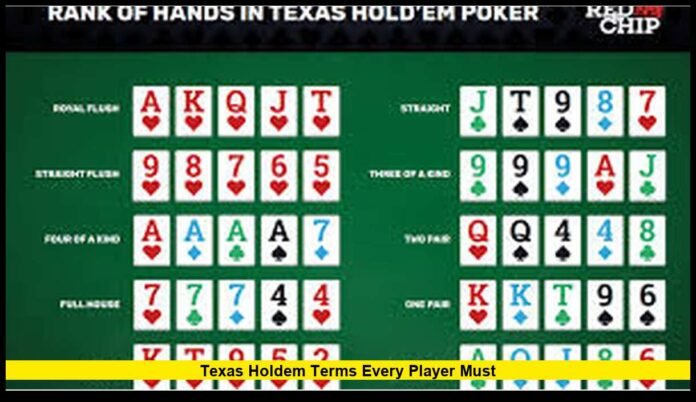
Each player is dealt two private cards known as hole cards. Five community cards are then placed face-up on the table. Players use any combination of these cards to form the best five-card hand.
The game revolves around multiple betting rounds, where players must decide whether to bet, call, raise, or fold. Every decision is influenced by position, hand strength, and the actions of other players.
This structure creates a dynamic environment where knowledge and timing matter just as much as the cards you hold.
Key Texas Hold’em Terms Every Player Should Know
Learning the core vocabulary is the foundation of becoming a better player.
Basic Table Terms
- Blinds – Mandatory bets placed before the hand begins
- Button – The dealer position that rotates clockwise after each hand
- Hole Cards – The two cards dealt face-down to each player
- Community Cards – The shared cards that all players can use
These terms appear in every hand and are essential for understanding gameplay.
Stages of the Game
- Pre-Flop – The action begins after players receive their cards
- Flop – The first three community cards are revealed
- Turn – The fourth card is added to the board
- River – The final card that completes the board
Each stage changes the strength of hands and influences betting decisions.
Common Player Actions
- Check – Passing the action without betting
- Call – Matching the current bet
- Raise – Increasing the size of the bet
- Fold – Surrendering your hand
These actions form the core of poker strategy and determine how each hand unfolds.
Advanced Poker Terms That Improve Your Strategy
Once you’re comfortable with the basics, understanding advanced terms can significantly improve your gameplay.
Strategic Concepts
- Bluff – Representing a stronger hand than you actually have
- Semi-Bluff – Betting with a hand that may improve later
- Pot Odds – Comparing the size of the pot to the cost of a call
- Implied Odds – Estimating future winnings if your hand improves
These concepts help players make more informed and profitable decisions over time.
Table Position and Its Importance
Position is one of the most important factors in Texas Hold’em.
- Early Position – Acting first, with limited information
- Middle Position – A balanced spot with moderate advantage
- Late Position – Acting last, allowing you to observe others
Players in late position often have a strategic edge because they can react to their opponents’ actions.
Player Types and Reading Opponents
Poker is not just about cards—it’s about people.
Understanding different player styles can give you a major advantage.
- Tight Players – Selective and cautious
- Loose Players – Play a wide range of hands
- Aggressive Players – Frequently bet and raise
- Passive Players – Tend to call rather than raise
By identifying these tendencies, you can adjust your strategy and exploit weaknesses.
The Role of Math in Modern Poker
Poker has become increasingly analytical, with players relying on numbers and probabilities to guide decisions.
Calculating odds helps determine whether a call is worth making. For example, if the potential reward outweighs the risk, the decision becomes mathematically sound.
This approach reduces guesswork and leads to more consistent results over time.
Technology and the Evolution of Poker Language
Technology has transformed how poker is played and studied.
Online platforms have introduced new terms and concepts that are now part of everyday poker discussions.
- Multi-Tabling – Playing several games at once
- Heads-Up Display – Tracking player statistics in real time
- Fast-Fold Formats – Quickly moving to new hands after folding
These innovations have made the game faster, more competitive, and more data-driven.
Legal Landscape and Its Impact on Poker Growth
Poker’s expansion in the U.S. is closely tied to evolving regulations. In some states, alternative business models have allowed poker rooms to operate in new ways, attracting a growing number of players.
This environment has encouraged more people to explore the game, whether for entertainment or competition. As interest continues to rise, the demand for knowledge—including terminology—has grown alongside it.
Why Mastering Poker Terms Gives You an Edge
Understanding texas holdem terms does more than improve communication—it enhances your overall performance.
Here’s how:
- You make quicker, more confident decisions
- You understand strategy discussions and training materials
- You reduce errors during gameplay
- You gain respect at the table
In competitive poker, even a small advantage can make a big difference.
Common Beginner Mistakes to Avoid
New players often struggle with the same challenges.
Misinterpreting Actions
Confusing basic moves like check and call can lead to poor decisions.
Playing Too Many Hands
Beginners often play too aggressively without proper judgment.
Ignoring Position
Failing to consider position can put you at a disadvantage.
Overvaluing Weak Hands
Holding onto weak cards too long can result in unnecessary losses.
Recognizing these mistakes early can help you improve faster.
Practical Tips to Learn Poker Terminology Faster
Improving your poker vocabulary doesn’t have to be complicated.
- Play regularly in low-pressure environments
- Watch professional games and observe decision-making
- Study hand reviews and strategy discussions
- Use apps designed for poker training
- Keep a list of new terms and review them often
The more exposure you have, the faster the terms will become second nature.
What to Expect in the Future of Poker
The poker landscape continues to evolve, and terminology will evolve with it.
Players can expect:
- Increased use of advanced analytics
- Greater integration of AI-driven tools
- New formats introducing fresh concepts
Staying informed will be essential for anyone who wants to remain competitive.
Final Thoughts
Poker is a game of skill, patience, and continuous learning. Understanding the language of the game is one of the most important steps toward becoming a better player.
From basic table terms to advanced strategy concepts, every piece of knowledge contributes to your success. As the game continues to grow in 2026, players who invest in learning and adapting will have a clear advantage.
Whether you’re just starting out or looking to refine your skills, mastering poker terminology will elevate your experience and improve your results.
Take a moment to reflect on what you’ve learned and put it into practice the next time you sit at a table.
What’s your go-to poker move or favorite term at the table? Share your thoughts and join the conversation below.