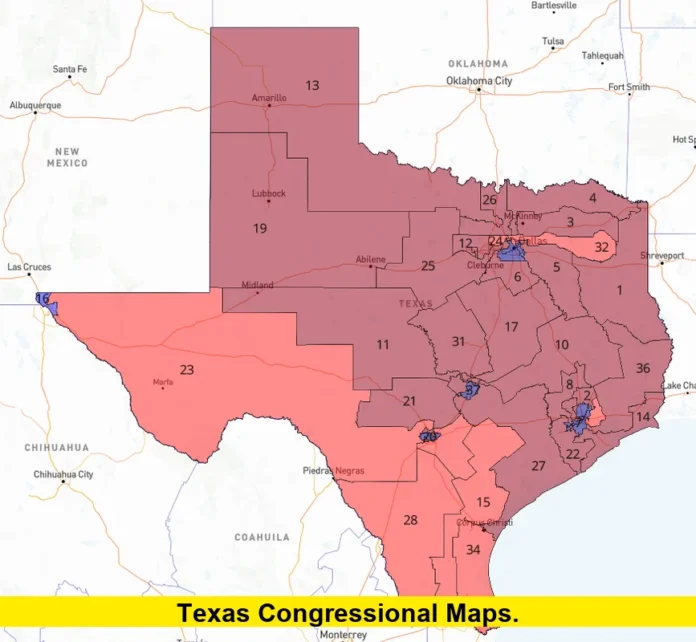

The battle over Texas congressional maps escalated sharply this week after a federal court ruled that the state cannot use the newly approved districts for the 2026 election cycle. The decision marks one of the most significant legal blows to Texas Republicans in their push for a mid-decade redistricting strategy intended to expand their influence in the U.S. House.
The ruling, handed down by a three-judge federal panel, determined that substantial evidence showed the state’s mapmaking process relied too heavily on racial considerations. As a result, the judges blocked the map from taking effect and directed Texas to prepare for upcoming elections using the congressional plan already in place since 2021 unless a higher court reverses the decision.
A Major Setback in Texas Redistricting Efforts
For months, Republican lawmakers in Texas have pushed aggressively to reconfigure district boundaries, aiming to secure additional congressional seats ahead of the 2026 midterms. The proposal, passed during a special legislative session and signed into law earlier this year, would have shifted multiple Democratic-held districts toward Republican advantage.
However, the court’s ruling interrupts that plan at a critical moment. The panel found that political motivations were not the only driving factor behind the redraw. Instead, it determined that the mapmakers relied on racial data when crafting district boundaries, crossing a constitutional line and raising serious concerns about voter dilution.
The decision immediately reshapes expectations for Texas elections. With the new map on hold, candidates and parties must now prepare under the assumption that the previous 2021 boundaries will remain in place unless the state successfully appeals.
How the Court Reached Its Decision
The court examined demographic patterns, district shapes, legislative intent, and expert analysis before concluding that race played an outsized role in the redistricting process. Although partisan motivations are allowed under federal law, district lines cannot be drawn primarily based on racial characteristics.
In its ruling, the panel stated that the evidence demonstrated a deliberate use of race when crafting several districts. Testimony and documents revealed that map drawers often referenced racial voting behaviors, population concentrations, and minority turnout patterns when adjusting boundaries.
That combination of evidence ultimately led the court to stop the map from being implemented. The judges emphasized that allowing the plan to move forward could cause significant and irreparable harm to minority voters in future elections.
Republican Strategy Now Under Question
The ruling has prompted deep discussion within Texas Republican circles over whether the mid-decade redistricting push was worth the political and legal risk. Many GOP leaders had hoped the map would provide an advantage of up to five additional U.S. House seats, strengthening national Republican efforts to expand control of the chamber.
Instead, the court’s decision has left some questioning whether the aggressive approach backfired.
Several political realities now shape the conversation:
- Mid-cycle redistricting increases scrutiny. Because Texas was not required to update its congressional map until after the 2030 Census, lawmakers faced more intense legal examination.
- Allegations of racial gerrymandering carry high legal risk. Courts historically respond forcefully to redistricting plans found to rely on race.
- The political reward may no longer match the cost. With the new map blocked, Texas returns to boundaries that do not generate the additional Republican seats the party expected.
These developments have amplified debate within GOP strategy circles and may influence other states considering similar mid-decade redistricting attempts.
Civil Rights Organizations Respond
Civil rights groups that challenged the map celebrated the ruling as a significant victory for voting rights in Texas. These organizations argued throughout the legal process that the state’s proposed configuration unfairly weakened the voting strength of Black, Latino, and other minority communities.
Advocates maintain that the court’s findings confirm what they have long alleged: the map diluted minority representation at a time when Texas’s population growth continues to be driven largely by minority residents.
With the ruling now in place, these groups are preparing to defend it through the appeals process should Texas seek further review.
Texas Officials Plan an Appeal
State leaders signaled almost immediately that they intend to appeal the decision. The case will likely advance to higher courts, including the possibility of a review by the U.S. Supreme Court.
Texas officials argue that the map reflects standard partisan redistricting practices and deny that lawmakers used race as a primary factor. Their legal team is expected to request a stay of the ruling to allow the new map to be used while appeals proceed.
The timeline for those appeals remains unclear. However, both sides acknowledge that the clock is ticking. Election administrators will need finalized district boundaries well before the 2026 candidate filing deadlines.
What the Ruling Means for the 2026 Elections
If the 2021 map stays in place, Texas voters will head into the 2026 midterms under the same district lines used in 2022 and 2024. This could have several significant effects on the state’s political landscape:
- Party advantage remains unchanged. The blocked map, which was designed to tilt certain districts toward Republicans, will not be in effect.
- Minority communities maintain existing representation levels. The concerns about minority vote dilution apply specifically to the new map, not the 2021 plan.
- Campaign strategies will stabilize. Candidates who previously prepared for drastically altered districts can now focus on the boundaries they already know.
- National implications arise. Because Texas plays a major role in determining control of the U.S. House, this ruling shapes broader national election strategies.
As uncertainty continues, campaigns, donors, and political organizations are closely watching for any movement in the appeal process.
A Pivotal Moment for Future Redistricting Battles
The controversy surrounding Texas congressional maps highlights a growing trend across the country: the rise of mid-decade redistricting efforts and the fierce legal battles that accompany them. Texas became the most high-profile example of a state choosing to redraw boundaries well before the usual post-Census cycle, and the judicial response may influence how other states handle similar proposals.
Legal experts suggest this case could establish important precedent about what courts will tolerate when it comes to the use of racial data in redistricting. Political strategists, meanwhile, view the ruling as a cautionary tale about pushing too far, too quickly, in pursuit of partisan advantage.
For now, Texas remains at the center of a national debate over voting rights, representation, and the limits of redistricting power.
Texas will continue to be a focal point in the national debate over fair representation, and readers should stay tuned as the legal process unfolds.