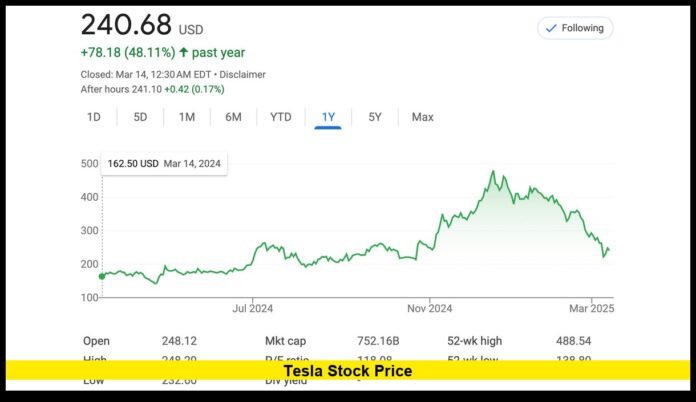

The Tesla stock price remains one of the most closely watched figures on Wall Street in 2026. As of the latest available market data on August 8, 2026, Tesla shares (NASDAQ: TSLA) are trading at around $328.58, with the stock continuing to experience significant volatility. Tesla’s market capitalization is currently about $1.16 trillion, keeping the electric vehicle and technology company among the world’s largest publicly traded businesses.
Investors continue to closely follow Tesla’s stock performance because the company’s valuation extends beyond its traditional electric vehicle business. Tesla remains heavily associated with electric vehicles, artificial intelligence, autonomous driving, robotics, and energy storage, with developments across these areas capable of influencing investor sentiment and the future direction of TSLA shares.
Recent trading has also highlighted the sensitivity of Tesla stock to broader market conditions, company-specific developments and expectations surrounding its technology and growth initiatives. As a result, investors are watching both Tesla’s financial performance and its progress in emerging businesses when assessing the outlook for the stock.
Current Tesla Stock Price Overview
The latest market data shows that Tesla (NASDAQ: TSLA) remains one of the most closely watched stocks in the U.S. market. As of August 8, 2026, Tesla shares are trading around $328.58, giving the company a market capitalization of approximately $1.16 trillion.
| Metric | Latest Data |
|---|---|
| Share Price | Around $328.58 |
| Market Capitalization | About $1.16 trillion |
| Stock Exchange | NASDAQ |
| Ticker Symbol | TSLA |
| Intraday High | About $333.72 |
| Intraday Low | About $321.16 |
Tesla stock has experienced substantial fluctuations during 2026, reflecting changing investor expectations around electric-vehicle demand, profitability, autonomous driving, artificial intelligence and the broader technology market. Recent trading has also demonstrated how quickly TSLA can move in response to company-specific developments and changing market sentiment.
Despite the volatility, Tesla remains one of the world’s largest publicly traded companies and continues to attract significant attention from investors because of its exposure to EVs, energy storage, AI and autonomous-driving technology.
Recent Trends Influencing the Tesla Stock Price
Several major developments are influencing the Tesla stock price in 2026, with investors balancing the company’s improving delivery performance against pressure on automotive profitability and Tesla’s aggressive spending on artificial intelligence, autonomous driving and robotics.
Electric Vehicle Market Changes
The global electric vehicle market continues to expand, but Tesla faces increasingly intense competition, particularly in China. Domestic manufacturers such as BYD, Xiaomi, Xpeng and Li Auto are competing with Tesla through pricing, new models and rapid product development.
Tesla’s China operations nevertheless showed signs of improvement in the latest data. China-made Tesla vehicle sales reached 93,579 units in July 2026, up 37.8% year over year, according to Reuters. However, performance across Europe remained mixed, highlighting the uneven nature of demand across major markets.
The competitive environment remains important for investors because pricing, vehicle demand, delivery volumes and profit margins can all influence expectations for Tesla’s future earnings and, consequently, its stock price.
Production and Delivery Numbers
Tesla’s latest delivery figures provide a more current picture than the previously cited 2025 total. In the second quarter of 2026, Tesla produced 451,758 vehicles and delivered 480,126 vehicles, including 467,762 Model 3 and Model Y vehicles. The company also deployed 13.5 GWh of energy-storage products during the quarter.
The Q2 delivery figure was particularly significant because it exceeded many Wall Street expectations. Tesla’s company-compiled analyst consensus had estimated approximately 406,024 deliveries for Q2 2026, although consensus figures are estimates rather than company guidance.
Investors continue to monitor quarterly production and delivery reports closely because vehicle volume remains central to Tesla’s automotive business. At the same time, recent financial results indicate that higher deliveries do not automatically translate into stronger profitability. Tesla’s second-quarter results showed pressure from lower average selling prices, reduced regulatory-credit revenue and higher spending.
Artificial Intelligence and Autonomous Driving
Tesla’s investment story increasingly extends beyond traditional electric vehicles. The company is directing substantial resources toward artificial intelligence, autonomous driving, robotaxis and robotics, areas that could potentially become important sources of future revenue.
Tesla has continued developing its Full Self-Driving (FSD) technology and robotaxi ambitions while also preparing for greater production of the Cybercab. The company has also said it expects volume production of the Cybercab and Tesla Semi during 2026.
These initiatives are attracting considerable investor attention because success in autonomous driving could give Tesla a business model that goes beyond selling vehicles. However, the timing and scale of potential commercialization remain important uncertainties.
Optimus and Robotics
Tesla’s Optimus humanoid robot program has become an increasingly important part of the company’s long-term growth strategy. Tesla is investing in the development and manufacturing infrastructure needed to move Optimus toward large-scale production, with the company planning dedicated production capacity at Gigafactory Texas.
Tesla has indicated that its initial Optimus manufacturing line is being designed with potential annual capacity of up to 1 million robots, while additional production capacity could be developed as demand and technology mature.
For Tesla shareholders, Optimus represents a potentially significant opportunity beyond the company’s traditional electric vehicle business. If Tesla can successfully commercialize humanoid robots for manufacturing, logistics and other applications, the technology could eventually create a new source of revenue. However, the program remains in an investment and development phase, meaning its eventual commercial scale, profitability and impact on the Tesla stock price remain uncertain.
Energy Storage Growth
Tesla’s energy storage business has become an increasingly important part of the company’s broader growth strategy. In the second quarter of 2026, Tesla deployed 13.5 GWh of energy-storage products, demonstrating continued demand for large-scale battery storage solutions. The company’s energy-storage portfolio includes products such as Megapack, which is designed for utility-scale energy storage projects.
Tesla’s analyst consensus published in July 2026 projected approximately 55.3 GWh of energy-storage deployments for the full year. If achieved, continued growth in this segment could help Tesla diversify its business beyond electric vehicles and create another source of revenue and profitability.
The expansion of energy storage is particularly significant as utilities, businesses and other customers increasingly seek ways to store renewable electricity and improve grid reliability. For investors, stronger growth in Tesla’s energy business could therefore provide an important counterbalance to fluctuations in vehicle demand.
Overall, the Tesla stock price in 2026 is being influenced by two broad narratives. The traditional automotive business faces competition, pricing pressure and changing consumer demand, while Tesla’s investments in artificial intelligence, autonomous driving, robotics and energy storage offer potential long-term growth opportunities. The company’s ability to turn these emerging businesses into sustainable revenue and profits will remain an important factor in how investors value Tesla shares.
Robotaxi Development and Its Impact on Tesla Shares
One of the most closely watched developments influencing the Tesla stock price is the company’s expansion into autonomous transportation. Tesla has continued developing its robotaxi strategy, with early commercial operations providing an important test of whether its self-driving technology can eventually support a large-scale autonomous ride-hailing network.
Tesla began an initial robotaxi service in Austin, Texas, in June 2025, using a limited fleet and gradually expanding the service. The company has since continued working toward broader autonomous deployment while refining its software, safety systems and operating model.
The long-term opportunity could be substantial. A successful robotaxi network could allow Tesla to generate recurring revenue from vehicles after they are produced, potentially creating a business model that extends beyond conventional automobile sales. This is one reason investors continue to place significant attention on Tesla’s autonomous-driving ambitions.
Tesla is also developing the Cybercab, a purpose-built autonomous vehicle designed for robotaxi operations. The company has indicated that Cybercab production is part of its broader effort to scale autonomous transportation and expects volume production to become an important milestone in its strategy.
However, robotaxi expansion also carries considerable uncertainty. Regulatory approvals, safety requirements, technological performance, operating costs and consumer adoption will all determine how quickly the business can scale. Consequently, the potential impact of robotaxis on the Tesla stock price depends not simply on the launch of the service, but on whether Tesla can demonstrate reliable autonomous driving and build a commercially sustainable network.
If Tesla succeeds in expanding autonomous ride services across additional markets, robotaxis could become an important component of the company’s future valuation alongside electric vehicles, energy storage, artificial intelligence and robotics.
Tesla’s Long-Term Stock Performance
Tesla has delivered an extraordinary long-term stock market performance since becoming a publicly traded company, although its history has also been marked by periods of extreme volatility.
Tesla completed its initial public offering in June 2010, giving investors their first opportunity to buy shares of the electric vehicle manufacturer on the NASDAQ. A decade later, Tesla joined the S&P 500 index in December 2020, reflecting the company’s rapid expansion and growing importance in the U.S. equity market.
Tesla has also completed multiple stock splits, including a 5-for-1 split in 2020 and a 3-for-1 split in 2022. These splits increased the number of outstanding shares while proportionally reducing the price per share, making the stock more accessible to individual investors without changing the underlying value of shareholders’ holdings.
Over the years, Tesla shares experienced dramatic increases as investors became increasingly optimistic about electric vehicles, battery technology, autonomous driving and the company’s broader technology ambitions. At the same time, the stock has experienced substantial declines during periods of weaker demand, higher interest rates, concerns about margins or changes in investor sentiment.
Tesla’s long-term history therefore illustrates both exceptional growth potential and significant investment risk. The stock can react sharply to quarterly deliveries, earnings results, new vehicle launches, autonomous-driving developments and broader market conditions. This combination of growth expectations and volatility continues to make Tesla one of the most closely followed stocks in the global financial markets.
Key Metrics Investors Watch Closely
Investors tracking the Tesla stock price typically monitor a combination of financial results, vehicle demand and progress in Tesla’s newer technology businesses. These indicators can provide clues about the company’s near-term performance as well as its longer-term growth potential.
Quarterly Vehicle Deliveries
Tesla’s quarterly vehicle production and delivery figures remain among the most closely watched metrics. Deliveries provide an important indication of global demand for Tesla’s vehicles and can influence expectations for revenue, margins and future production growth.
Investors also examine the mix of models delivered, regional performance and the relationship between production and deliveries to determine whether Tesla is successfully managing inventory and manufacturing capacity.
Autonomous Driving Progress
Advances in Tesla’s Full Self-Driving (FSD) technology remain a major potential long-term value driver. Investors closely follow software improvements, regulatory developments, autonomous-driving performance and the expansion of Tesla’s robotaxi operations.
Progress toward more capable autonomous driving could strengthen Tesla’s position as a technology company, although the commercial and regulatory path remains uncertain.
Energy Storage Expansion
Tesla’s energy storage business is becoming an increasingly important part of the company’s overall strategy. Products such as Megapack serve utility-scale and commercial customers, while continued growth in energy-storage deployments could help diversify Tesla’s revenue beyond vehicle sales.
Investors therefore watch quarterly energy-storage deployments, manufacturing capacity and demand for large-scale battery systems.
Robotaxi Deployment
The expansion of Tesla’s robotaxi operations is another major metric for investors. New service areas, fleet growth, regulatory approvals and customer adoption can provide indications of whether autonomous transportation can become a meaningful commercial business.
If Tesla successfully expands robotaxi services into additional markets, the business could potentially generate recurring revenue and influence how investors value the company. However, the pace of deployment and eventual profitability remain important uncertainties.
Overall, these indicators help investors assess whether Tesla is progressing from primarily an electric vehicle manufacturer toward a broader AI, autonomous transportation, energy and robotics company.
Tesla’s Position in the U.S. Electric Vehicle Market
Tesla continues to dominate the electric vehicle sector in the United States. Its vehicles remain among the most recognizable and widely adopted EVs in the country.
The company’s main models include:
- Model S
- Model 3
- Model X
- Model Y
These vehicles helped Tesla establish a strong brand reputation in both the automotive and technology industries.
At the same time, competition is increasing. Major automakers and emerging EV companies are expanding their electric vehicle offerings, which adds pressure to Tesla’s market share.
Even with growing competition, Tesla remains a leader in battery technology, charging infrastructure, and software integration.
What Could Move the Tesla Stock Price Next
Several developments could influence the Tesla stock price in the coming months as investors assess both the company’s core automotive business and its newer technology initiatives. Key factors include:
- Autonomous driving developments: Progress in Tesla’s Full Self-Driving technology, regulatory approvals and improvements in autonomous capabilities could affect investor expectations for future growth.
- Robotaxi expansion: The rollout of Tesla’s robotaxi service into additional locations, fleet expansion and customer adoption could provide important signals about the commercial potential of autonomous transportation. (Click here for more information)
- Global electric vehicle demand: Changes in EV demand, particularly in major markets such as the United States, China and Europe, could affect Tesla’s vehicle deliveries, pricing and profitability. ( Click Here For more Information )
- Production and delivery performance: Quarterly production and delivery figures will remain important indicators of demand and Tesla’s ability to utilize its manufacturing capacity efficiently.
- Energy storage growth: Continued expansion of Megapack and other energy-storage products could strengthen Tesla’s diversification beyond automobiles.
- AI and robotics progress: Developments involving Tesla’s artificial intelligence infrastructure and Optimus humanoid robot program could influence the company’s long-term growth narrative.
- Broader economic conditions: Interest rates, inflation, consumer spending, technology-sector valuations and overall stock-market sentiment can all affect Tesla’s share price.
Because Tesla operates across electric vehicles, energy, artificial intelligence, autonomous driving and robotics, its stock can respond to developments across several industries at once. As a result, investors are likely to watch not only Tesla’s quarterly financial results but also evidence that its newer businesses can develop into substantial and profitable sources of future growth.
Final Thoughts
The Tesla stock price remains one of the most closely watched figures in global financial markets. Tesla’s position across electric vehicles, energy storage, artificial intelligence, autonomous driving and robotics continues to attract significant investor attention.
While Tesla shares can experience substantial short-term volatility in response to earnings, deliveries, economic conditions and company-specific announcements, the company’s longer-term valuation increasingly depends on whether it can successfully turn its emerging technologies into scalable and profitable businesses.
For investors, the key will be balancing Tesla’s ambitious growth opportunities against the competitive, regulatory and financial risks that accompany them. As new developments emerge across Tesla’s automotive and technology businesses, they could continue to play an important role in determining the future direction of the Tesla stock price.
FAQs
Q: What is Tesla’s stock ticker symbol?
A: Tesla trades on the NASDAQ under the ticker symbol TSLA.
Q: What factors influence the Tesla stock price?
A: Tesla’s stock price can be affected by vehicle deliveries, earnings, profit margins, EV demand, autonomous-driving progress, robotaxi expansion, energy-storage growth, interest rates and overall market conditions.
Q: Why is Tesla stock so volatile?
A: Tesla’s valuation is influenced by expectations surrounding both its automotive business and emerging technologies such as AI, autonomous driving and robotics. Changes in those expectations can lead to significant price movements.
Q: Is Tesla involved in businesses other than electric vehicles?
A: Yes. Tesla also operates in energy storage and develops technologies related to artificial intelligence, autonomous driving and robotics.
Q: What is Tesla’s robotaxi strategy?
A: Tesla is developing an autonomous ride-hailing service that could generate recurring revenue from self-driving vehicles. The company is gradually expanding its robotaxi operations while developing the purpose-built Cybercab.
Q: Why is Tesla’s energy-storage business important?
A: Products such as Megapack allow Tesla to participate in the growing large-scale battery-storage market and diversify its business beyond vehicle sales.
Q: What Tesla metrics should investors watch?
A: Key metrics include quarterly vehicle deliveries, automotive margins, earnings, energy-storage deployments, autonomous-driving progress and robotaxi expansion.
Q: Is Tesla stock a good investment?
A: There is no universal answer. Tesla offers significant growth opportunities but also carries substantial volatility, competition, regulatory risks and valuation risks. Investors should consider their own financial circumstances and conduct independent research before investing.
What are your thoughts on Tesla’s stock performance in 2026? Share your perspective in the comments and keep following the latest Tesla stock price developments.
Disclaimer
This article is provided for informational and educational purposes only and should not be considered financial, investment, trading, or legal advice. Stock prices, market data, forecasts, analyst estimates, and company developments can change rapidly and may contain inaccuracies or delays. Past performance does not guarantee future results. Investors should conduct their own research and consider their financial goals, risk tolerance, and investment circumstances before making any investment decision. The author and publisher are not responsible for any financial losses or decisions made based on the information presented in this article.