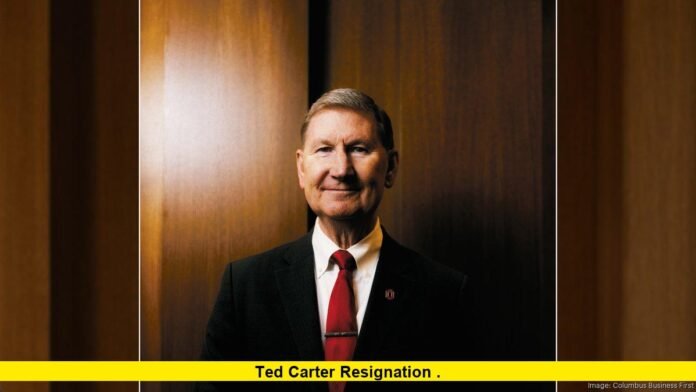

The ted carter resignation has sent shockwaves through the higher education community after the president of The Ohio State University stepped down following disclosures about a personal matter involving access to university leadership. The announcement came after the university’s board of trustees accepted Walter “Ted” Carter Jr.’s decision to resign, ending his tenure as the institution’s 17th president.
Carter had served as president since January 2024 and previously led the University of Nebraska system. His departure marks a sudden leadership change at one of the nation’s largest public universities and has quickly become one of the most talked-about developments in higher education this year.
Stay with us as this developing situation continues to unfold and the university prepares for its next leadership chapter.
Why Ted Carter Resigned
University officials stated that Carter disclosed to trustees that he had an inappropriate relationship with an individual who was seeking public resources to support a personal business. After informing the board about the situation, he offered his resignation, which the trustees accepted.
The revelation prompted a rare meeting of the board of trustees to address personnel matters. Following that discussion, the university formally announced Carter’s resignation and began preparing for a leadership transition.
In his statement, Carter acknowledged that he had made a mistake and said stepping down was a difficult but necessary decision. He also expressed gratitude for the opportunity to lead the university and praised students, faculty, and staff for their contributions to the institution.
Observers note that universities often hold leaders to strict ethical standards due to the influence presidents hold over funding decisions, strategic initiatives, and institutional partnerships. Situations involving conflicts of interest or improper relationships are typically handled with swift administrative action.
Impact on Ohio State University
The resignation comes during a period of significant growth and strategic planning for the university. During Carter’s time as president, the institution promoted a long-term strategic initiative known as the “Education for Citizenship 2035” plan, which aims to expand research activity, strengthen academic programs, and increase global engagement.
Under his leadership, the university also highlighted progress in research funding, student scholarships, and national rankings. Administrators credited the broader leadership team with helping guide those efforts over the past two years.
Despite the sudden leadership change, university officials emphasized that the institution remains focused on continuing its strategic goals and maintaining stability across academic and administrative programs.
Large public universities like Ohio State typically rely on established governance structures to ensure continuity during transitions. The board of trustees is responsible for overseeing executive leadership and will guide the next steps in selecting or appointing a new president.
Who Is Ted Carter?
Walter “Ted” Carter Jr. is a former U.S. Navy vice admiral and experienced academic administrator. Before arriving at Ohio State, he served as president of the University of Nebraska system from 2020 to 2023.
Earlier in his career, Carter spent decades in the U.S. Navy as a naval flight officer and later held senior leadership roles in military education. He also served as superintendent of the United States Naval Academy and president of the U.S. Naval War College.
His appointment to lead Ohio State was announced in 2023, and he officially began the role at the start of 2024. At the time, university officials highlighted his leadership experience, military background, and focus on expanding educational access and research initiatives.
During his tenure at Ohio State, Carter worked closely with trustees and university leaders on long-term planning initiatives designed to strengthen the institution’s national profile.
What Happens Next for Ohio State
The board of trustees will oversee the transition process while determining the university’s next leadership steps. Large universities often appoint an interim president to maintain operational continuity while a national search for a permanent leader takes place.
Ohio State’s board has indicated that more details about the transition and leadership plans will be shared in the coming days.
For students, faculty, and staff, the immediate priority remains maintaining stability across academic programs, research activities, and campus operations. Administrators emphasized that the university’s strategic initiatives and long-term projects will continue despite the leadership change.
The resignation also highlights how governance bodies at major universities respond when ethical concerns arise. Trustees play a key role in evaluating leadership conduct and ensuring institutional standards are upheld.
Ted Carter Salary
Before the resignation, Ted Carter was among the higher-paid leaders in public higher education. As president of The Ohio State University, his compensation package included a base salary reportedly around $1 million per year, along with performance incentives and additional benefits common for leaders of large research universities. Executive compensation at institutions of Ohio State’s size often reflects responsibilities that include overseeing multi-billion-dollar budgets, tens of thousands of students, and major research operations.
A Leadership Moment That Will Shape Ohio State’s Next Chapter
Leadership transitions at major universities often bring both uncertainty and opportunity. The sudden departure of a university president can influence strategic priorities, governance decisions, and campus culture.
As the university begins the process of selecting new leadership, the focus now shifts toward stability, continuity, and maintaining progress on the institution’s long-term goals.
What are your thoughts on this leadership change at Ohio State? Share your perspective and stay tuned for updates as the situation continues to develop.