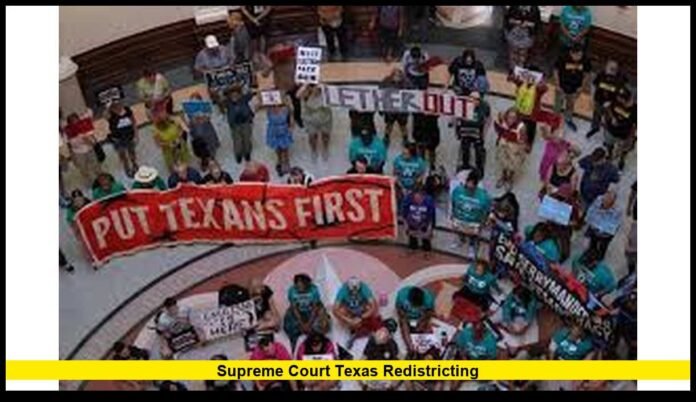

In a pivotal move, the justices on the nation’s highest court intervened in the fight over Texas’s congressional boundaries—creating immediate uncertainty, high political tension and far-reaching implications. The showdown focuses squarely on the phrase supreme court texas redistricting, and it’s reshaping how voters, officials and campaigns prepare for 2026.
The latest twist in the dispute
Texas adopted a new congressional map during a special session in 2025, aiming to reflect shifting population patterns and a political strategy that could alter the House of Representatives balance. Soon after, a federal court found that the map likely violated constitutional protections by relying on race as a predominant factor in drawing district lines and issued a preliminary injunction blocking its use in the 2026 elections. The state then appealed. Opponents argued the new layout diluted the power of Black and Hispanic voters by dismantling coalition-district protections.
In response, the Supreme Court acted via an emergency administrative stay. That stay temporarily lifts the injunction and allows Texas to move forward under the contested map for now—while the justices consider whether they will maintain it, undo it or remand the issue back to lower courts. This procedural intervention does not settle the merits of the case; it simply freezes the status quo while the high court weighs its next steps.
Why this matters now
Time is a major factor. With candidate filing deadlines, primary schedules and precinct planning deadlines looming, election administrators in Texas are working under layers of uncertainty. If the state uses the 2025 map now but is forced back to the 2021 lines later, the logistical cost and voter confusion could be high.
Campaigns on both sides also face a moving target. If the new map stands, Republicans may have the opportunity to flip or solidify an additional five seats that, under the current layout, lean their way. If the map is blocked, Democrats could maintain stronger footholds in contested districts. Either outcome will shape strategy, spending and messaging in the lead-up to the 2026 midterms.
Key legal questions at play
This confrontation revolves around several complex legal issues:
- Predominant use of race: Courts evaluate whether race, rather than politics, was the central factor in drawing lines. If race predominates, strict scrutiny applies and the plan can be struck down.
- Partisan versus racial motives: While the Supreme Court has offered limited paths to challenge purely partisan gerrymandering, race-based redistricting remains justiciable. Texas’s argument emphasizes political considerations; opponents argue race was baked in.
- Timing and Purcell principle: The “Purcell principle” cautions courts to avoid changing election rules close to an election due to disruptive effects. The question here: whether switching maps this far ahead of 2026 still triggers this risk.
- Standing and impact on voters: Plaintiffs must show they are harmed and that a remedy is feasible. The challenge in Texas hinges on claims that Black and Hispanic voters lost equal opportunity due to district redesigns.
What the timeline reveals
Let’s break down the sequence of events so far:
| Date | Event |
|---|---|
| Mid-2025 | Texas Legislature enacts new congressional map during special session. |
| Nov. 18, 2025 | Federal three-judge panel issues injunction blocking the map, finding evidence of racial gerrymandering. |
| Nov. 21–22, 2025 | Supreme Court issues administrative stay restoring the map’s use temporarily. |
| Coming weeks | Justices decide whether to extend the stay, hear full briefing, or send the case back. |
Because components of this fight hinge on timing (candidate filings, primary schedules, ballot preparation), each development has immediate administrative ripple effects.
Political and electoral implications
From a practical standpoint:
- If the contested map holds, Republicans could gain up to five additional House seats from Texas, shifting national balance in Congress.
- If the map fails, voters in several metro and suburban districts may find themselves shifted back into older configurations, influencing campaign strategy and media outreach.
- Minority communities are watching closely — the outcome could affect future coalition districts and how much influence they have in upcoming elections.
- Other states are monitoring this case as a precedent. How the court treats mid-decade redistricting, coalition districts and race versus partisan motive could echo elsewhere.
Local election officials and civic groups face significant work: altering precinct assignments, mailing new notices, educating voters and fielding questions about which district boundaries apply. The sooner clarity arrives, the better for administration.
Voices and reactions from the frontrunners
The state of Texas, under its governor and legislative leadership, emphasized that the new map reflects conservative voting patterns and population change—not race. Officials framed the legal fight as partisan in nature, not racial.
Opponents, including civil-rights organizations, argue that the map dismantles majority-minority and coalition districts intentionally, reducing the ability of Black and Hispanic voters to elect candidates of their choice. They view the judicial intervention as a defense of equal protection and voting rights.
High court watchers also note that the justices may weigh national implications — whether to allow a map so close to the election cycle when major change may ensue, and how precedent set here might restrict or enable future redistricting waves.
What to watch next
- Will the Supreme Court issue a full stay, extend the existing stay, or allow the lower-court injunction to kick in?
- Will the case be heard on an expedited basis? If so, how quickly will briefing and argument proceed?
- How will election administrators handle candidate filings, precinct planning and ballots in the meantime?
- What is the reaction of voters in districts affected by redrawn lines or potential reversion to older maps?
- Will this decision spur other states to attempt mid-decade redraws or push back against coalition districts?
Potential scenarios and their outcomes
Here are three plausible paths:
- Map stands: The high court allows Texas’s 2025 map to be used in full. Elections proceed under the new boundaries, Republicans gain advantage, and coalition-district protections shift.
- Map overturned: The court allows the injunction to remain. Texas must revert to 2021 lines. Affected voters may face changed districts, campaigns retool, and Republicans lose expected gains.
- Hybrid/remand: The court sends parts of the case back for fact-finding or orders partial modifications, leaving some boundaries intact while others are redrawn. This triggers further revisions and administrative churn.
Each scenario carries significant electoral and legal disruption. The deadline pressures make swift resolution more than academic.
Why this matters for voters across Texas
If you live in Texas and plan to vote in 2026:
- Your congressional district might change—not just once, but possibly twice—depending on the court’s decision.
- Campaigns in your area may shift focus, message and candidate lineup based on new boundaries.
- Local election offices may send notices, change polling-places or update ballot language in response to evolving maps.
- Communities of color may see changes in how they are grouped and represented, which influences local representation and resources.
- For national watchers, Texas is becoming a battleground not only for seats, but for the rules of redistricting going forward.
As the high court weighs its next move in this high-stakes redistricting conflict, all sides brace for impact: legal, political and administrative. The outcome will influence who holds power in Congress, how Texas allocates representation, and how future maps are drawn across the country.
Let us know how this fight over Texas’s congressional boundaries affects your community or what outcome you expect—share your thoughts or stay tuned for further updates.