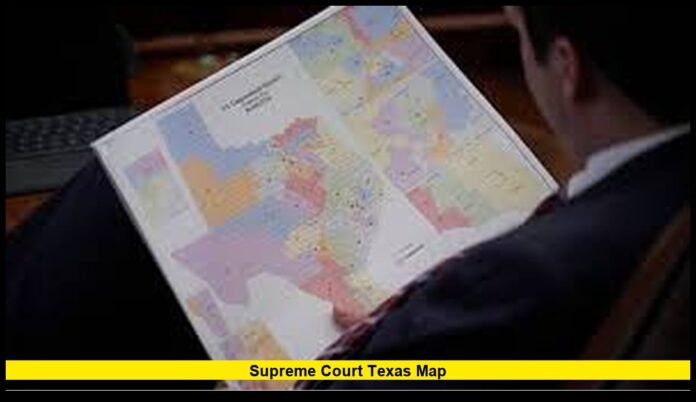

The Supreme Court Texas map ruling has become one of the most consequential election developments heading into the 2026 cycle, as the nation’s highest court has allowed the state to move forward with a contested congressional map while legal challenges continue. The order, issued in early December 2025, reinstated a map that had been blocked by a lower federal court and set the stage for a high-stakes political battle across one of the country’s fastest-growing states. With the decision now in place, lawmakers, election officials and voters are preparing for significant changes that will influence representation for millions of Texans.
A pivotal moment in the national redistricting landscape
The Court’s action cleared an immediate roadblock for Texas election administrators, who now must prepare ballots, adjust precinct information and finalize candidate filings under the reinstated lines. The ruling arrived after months of legal tension surrounding whether the map unlawfully diluted minority voting power in several metropolitan areas. By restoring the districts for the 2026 cycle, the Court ensured that Texas voters will see different boundaries than those used in previous elections.
This shift is notable because Texas continues to experience some of the fastest population growth in the United States, particularly among Black, Hispanic and Asian communities. As these demographics expand, battles over district design have grown more intense, with both major parties treating each map as a strategic battleground that shapes the state’s long-term political balance.
Why the map was initially blocked
Earlier in 2025, a federal panel in El Paso ruled that the new boundaries likely violated constitutional protections by using race as a predominant factor in shaping several districts. The panel pointed to patterns that suggested minority neighborhoods had been divided in ways that weakened their ability to elect candidates of their choosing. The judges temporarily stopped Texas from implementing the map, directing the Legislature to revisit the contested districts.
That order came after the candidate filing period had already opened for the 2026 cycle. Local election officials warned that requiring a redrawn map so late in the process would disrupt ballot preparation and risk widespread voter confusion. With primary elections only months away, the timing of the injunction became a central issue in the appeal that followed.
How the Supreme Court intervened
The Supreme Court issued a brief order that restored the map while the lawsuit continues. Though the Court did not provide a full opinion, the majority signaled that the lower court acted too close to an active election schedule. The justices emphasized the need for stability and consistency for both voters and election administrators, especially when procedural deadlines have already begun.
The Court’s liberal justices dissented, warning that reinstating the contested map could leave minority communities without adequate representation. Their opposition underscored the deep ideological divide surrounding redistricting and the ongoing clash between legal interpretations of race, partisanship and constitutional boundaries.
How the reinstated map alters political dynamics
The new lines create an electoral landscape that favors Republicans in several districts, particularly in fast-growing suburban areas. Analysts reviewing the plan believe that Republicans could gain multiple additional seats in the U.S. House as a result of the boundary shifts. These potential gains stem from strategic rearrangements in the Dallas–Fort Worth region, the Houston metropolitan area and parts of the Rio Grande Valley.
In some districts, minority communities that previously formed significant voting blocs now find themselves spread across several districts, reducing their political cohesion. Critics argue that this change undermines decades of progress in ensuring fair representation for historically underrepresented communities. Supporters counter that the Legislature followed constitutional requirements and population trends, noting that rapid growth has transformed Texas’ political map.
Reactions from state leaders and advocates
Texas Republican leaders celebrated the Supreme Court’s decision. They described the reinstated boundaries as a constitutional reflection of the state’s evolving population and said the ruling helps avoid unnecessary disruptions to the election schedule. They also emphasized that the map ensures continuity for voters who rely on stable district lines when evaluating candidates.
Democratic lawmakers and voting rights advocates condemned the decision. They argued that the map fractures communities that share socioeconomic and cultural ties, weakening their collective influence in Washington. Many have pledged to continue fighting the case through the appeals process, saying they believe the courts will eventually strike down the disputed districts.
Impact on voters heading into the 2026 elections
Millions of Texans will find themselves in newly drawn districts when they cast their ballots in 2026. Counties across the state have already begun the administrative work required to update precinct boundaries, revise voter registration databases and prepare new ballot layouts. Election officials say voters can expect updated district assignments early in the new year, giving residents time to understand how the changes affect their representation.
These adjustments will be especially significant in suburban regions, where rapid population spikes have transformed neighborhoods and shifted demographic balances. In these areas, slight changes to district lines can reshape electoral outcomes, making early voter education essential.
Campaigns recalibrate for the new terrain
Candidates for the U.S. House are now reassessing strategies as they prepare to campaign under the reinstated boundaries. Incumbents may face new challengers or new constituencies, while first-time candidates may find fresh opportunities in districts with shifting political landscapes. Fundraising plans, messaging strategies and grassroots outreach efforts are already adapting to account for demographic and geographic changes.
Political strategists from both parties expect Texas to host several closely watched races in 2026, particularly in districts where the margins have historically been narrow. Campaigns are also expected to invest heavily in voter turnout operations, recognizing that unfamiliar district lines often require additional education efforts.
Legal journey ahead
While the Supreme Court’s order allows the map to stand for now, the legal challenge remains active. The appeals process will continue throughout 2026, and the case could eventually return to the Supreme Court for a full review. If the courts ultimately determine that the map violates constitutional protections, Texas lawmakers may be required to revisit multiple districts before future elections.
This ongoing legal battle reflects a broader national trend in which redistricting disputes increasingly shape political power. As population patterns shift and partisan competition intensifies, courts have become central referees in determining how far state legislatures can go when drawing district lines.
A broader signal to other states
Texas is not alone in facing contentious redistricting fights. Several states have seen similar disputes, with courts examining whether lawmakers relied too heavily on race or partisanship when designing congressional or legislative districts. The Texas ruling may influence how judges in other states evaluate timing issues and election disruptions when assessing requests for emergency relief.
Legal observers note that the Supreme Court’s emphasis on maintaining election stability could guide how other jurisdictions handle late-stage challenges. This approach could make it harder for opponents to block maps once voter registration, ballot design or candidate filing processes have begun.
The civic importance of understanding districting
Redistricting shapes the foundation of democratic representation. District boundaries determine whose voices are amplified and how equitably communities are represented in Congress. For Texans, the reinstated map will govern how the state’s diverse population is organized politically during a pivotal election cycle.
Community groups across the state are launching education campaigns to help voters understand their district changes. These efforts include informational mailers, public forums and digital tools designed to help residents identify their elected representatives. With the 2026 elections approaching, voter awareness will play a crucial role in ensuring that participation remains strong despite shifting political boundaries.
Looking ahead to a high-stakes election season
With the map now authorized for use, attention turns to the 2026 primary and general elections. Both national parties are expected to pour resources into Texas, viewing the state as a key battleground that could influence control of the U.S. House.
The reinstated boundaries have transformed the political calculus in several regions, setting up contests that will test the strength of incumbents and the appeal of emerging candidates. As campaigns intensify, voter engagement efforts will remain essential to help Texans navigate a changing electoral landscape.
The Supreme Court’s ruling marks the beginning of a new chapter in the state’s ongoing redistricting debate. The legal questions surrounding the map will continue to unfold, but for now, the lines are set, and Texas is preparing for a consequential election cycle that will shape representation for years to come.