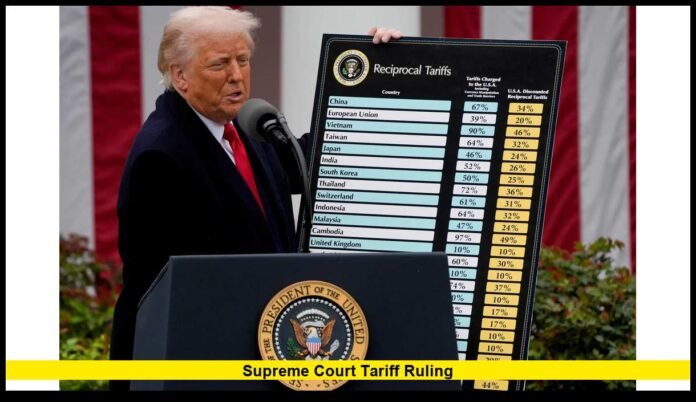

The supreme court tariff ruling remains one of the most closely watched legal decisions in the United States as of today, with the nation’s highest court still weighing the fate of sweeping import duties imposed under presidential emergency authority. The outcome will determine whether the executive branch can continue using national emergency laws to levy broad tariffs or whether such power rests solely with Congress under the Constitution.
The case has drawn intense attention from businesses, lawmakers, and legal experts because it goes beyond trade. It touches the core of how the U.S. government balances power between its branches and how future presidents may respond to economic and security challenges.
Background of the Legal Challenge
The dispute began after the federal government imposed wide-ranging tariffs on imported goods by invoking emergency economic powers. The administration argued that long-standing trade imbalances, supply-chain vulnerabilities, and national security concerns justified immediate action without waiting for congressional approval.
Under this authority, tariffs were placed across multiple categories:
- General import duties affecting consumer goods
- Higher reciprocal tariffs on select trading partners
- Sector-specific levies targeting metals, technology components, and industrial materials
A coalition of states, business groups, and importers challenged these actions in federal court. They argued that the Constitution gives Congress the exclusive authority to set tariffs and that emergency economic statutes were never intended to support permanent, economy-wide trade taxes.
Lower courts sided with the challengers, ruling that the president exceeded statutory authority. The federal government appealed, bringing the issue before the Supreme Court.
Key Constitutional Questions Before the Court
The supreme court tariff ruling will answer several fundamental legal questions:
- Scope of Emergency Powers
Can a president use national emergency laws to impose broad tariffs that affect the entire economy? - Separation of Powers
Does allowing such authority undermine Congress’s constitutional role in regulating trade and taxation? - Limits on Executive Discretion
How far can the executive branch go in defining what qualifies as an economic emergency? - Precedent for Future Administrations
Will future presidents be able to rely on the same legal pathway to reshape trade policy without legislative approval?
These questions place the case among the most significant constitutional trade disputes in decades.
Current Status of the Supreme Court Tariff Ruling
As of today, the Supreme Court has not yet issued its final opinion. Oral arguments have concluded, and the case remains under active deliberation.
Several factors explain the delay:
- The case involves complex constitutional interpretation.
- It affects multiple federal statutes and decades of trade law.
- The potential financial consequences are enormous.
- The ruling will set binding precedent for future emergency actions.
Until the decision is released, the tariffs remain legally in effect, and uncertainty continues across markets and industries.
Impact on the U.S. Economy
Import Costs and Consumer Prices
Tariffs directly influence the cost of imported goods. Businesses that rely on foreign suppliers have faced higher input costs, which in many cases have been passed on to consumers through increased prices on everyday products, including:
- Electronics
- Household appliances
- Vehicles and auto parts
- Construction materials
- Clothing and footwear
The supreme court tariff ruling could either lock these cost structures in place or open the door to major price adjustments.
Corporate Planning and Investment
Uncertainty over the legal future of tariffs has affected corporate decision-making. Many companies have delayed:
- Long-term supply contracts
- Factory expansion plans
- Cross-border investment
- Pricing strategies
A clear ruling would allow firms to plan with greater confidence, regardless of which side prevails.
Potential Outcomes and Their Consequences
If the Tariffs Are Invalidated
A ruling against the government would mean that the emergency statute does not authorize broad import duties. Possible effects include:
- Suspension of the challenged tariffs
- Administrative processes to handle refund claims
- Repricing of imported goods
- Renegotiation of supplier contracts
- Renewed congressional involvement in tariff legislation
Such a decision would reinforce the principle that trade taxes require explicit legislative approval.
If the Tariffs Are Upheld
If the Court finds that the emergency law allows such action:
- The existing tariff framework would remain in force
- Executive authority over trade policy would be strengthened
- Future presidents could use similar legal tools
- Congress might face pressure to revise emergency statutes
- Trade negotiations could increasingly rely on unilateral leverage
This outcome would mark a major shift in how economic emergencies are interpreted under federal law.
Business Sector Response
Large and small businesses alike have been preparing for both scenarios.
Retail and Consumer Goods
Retailers have:
- Adjusted sourcing strategies
- Diversified supplier locations
- Built larger inventories
- Modeled pricing under different tariff assumptions
Manufacturing and Industrial Firms
Manufacturers have:
- Shifted parts production domestically where feasible
- Explored near-shoring options
- Delayed capital investments tied to import costs
- Reviewed compliance and customs procedures
Technology Sector
Technology companies, heavily reliant on global supply chains, are watching closely because tariffs affect:
- Semiconductor components
- Data hardware
- Network equipment
- Consumer electronics
Political Implications
The supreme court tariff ruling carries major political significance.
Supporters of strong executive authority argue that presidents must be able to act quickly when economic threats emerge, without waiting for lengthy legislative processes.
Opponents counter that:
- Emergency powers should be temporary and narrowly defined
- Broad tariff authority risks bypassing democratic oversight
- Congress’s constitutional role must remain central
The ruling could influence future debates over national security, trade sanctions, and economic policy tools.
Congressional Response and Possible Legislative Action
Regardless of the outcome, lawmakers are expected to reassess the legal framework governing emergency economic powers.
Potential legislative responses include:
- Clarifying limits on emergency trade authority
- Requiring congressional approval for long-term tariffs
- Establishing sunset clauses on emergency measures
- Enhancing oversight of executive economic actions
Such steps would aim to prevent prolonged legal ambiguity in future administrations.
International Trade Relations
The ruling will also affect how the United States is viewed by its trading partners.
A decision restricting emergency tariff authority could:
- Restore confidence in rules-based trade
- Encourage multilateral negotiations
- Reduce uncertainty in global markets
A decision affirming broad presidential power could:
- Increase the use of unilateral trade measures
- Shift negotiating dynamics
- Prompt other nations to reassess their own trade defense laws
Legal Precedent and Future Cases
The supreme court tariff ruling will become a cornerstone reference for future cases involving:
- National emergency declarations
- Economic sanctions
- Trade restrictions
- Executive authority limits
- Congressional oversight powers
Law schools, courts, and policymakers will study the decision for years as a guide to interpreting economic emergency statutes.
What Comes Next
Once the Supreme Court releases its decision:
- Federal agencies will implement compliance measures
- Businesses will revise cost structures
- Importers may pursue refunds or adjustments
- Lawmakers may propose statutory reforms
- International partners will respond diplomatically
The legal clarity will end months of uncertainty but open a new chapter in U.S. trade governance.
Why This Ruling Will Shape the Future of U.S. Trade
The supreme court tariff ruling is not simply about import taxes. It is about defining the boundaries of presidential authority, protecting constitutional checks and balances, and determining how the United States responds to economic threats in a globalized world.
Whether the Court limits or affirms the use of emergency powers, its decision will influence:
- How quickly future presidents can act
- How Congress exercises its trade authority
- How businesses plan global operations
- How consumers experience price stability
- How the U.S. negotiates on the world stage
The ruling will stand as a landmark in modern constitutional and trade law.
As the nation awaits the final word from the Supreme Court, the impact of this decision is set to reach far beyond the courtroom, shaping U.S. economic policy and executive power for years to come. Join the conversation and stay alert for the moment the ruling is released.