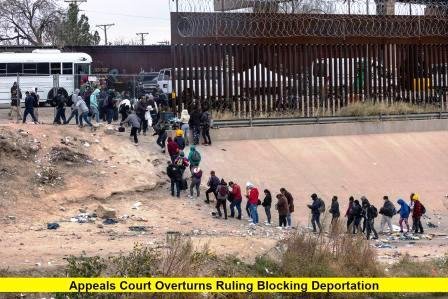

The phrase supreme court overturns has once again taken center stage in the United States legal and political landscape. In the most recent development, a federal appeals court has overturned a lower court’s decision that had blocked the deportation of nearly half a million migrants. This ruling, issued just days ago, could have sweeping consequences for families, communities, and immigration policy nationwide.
The case revolves around the humanitarian parole program that was established under the Biden administration, granting temporary legal protection and work authorization to migrants from Cuba, Haiti, Nicaragua, and Venezuela. With the appeals court decision, those protections are now under threat, and the government has been cleared to begin revoking the status of an estimated 430,000 to 530,000 individuals.
What Led to the Decision
Earlier this year, the administration announced the termination of the CHNV parole program, arguing that it placed a strain on resources and lacked strong legal footing. Migrants who entered through this program were granted two years of parole status, allowing them to live and work in the United States legally.
In response, immigrant rights groups and several state attorneys challenged the decision, leading a district court judge to temporarily block the government from canceling the program. That injunction gave migrants relief for a short time, ensuring that their parole would not be revoked until further review.
However, the appeals court has now overturned that injunction, ruling that the federal government has broad authority to end parole programs when deemed necessary. This reversal has opened the door for the administration to move forward with large-scale deportations.
Immediate Impact on Migrants
The overturning of the injunction means that hundreds of thousands of migrants could soon face deportation proceedings. Many of them had established lives during their parole period—finding jobs, enrolling their children in schools, and building community ties.
The implications are enormous:
- Work Authorization Loss: Migrants who held valid work permits may no longer be able to continue their employment.
- Risk of Deportation: Families could be forced into removal proceedings, even if their parole period was still active.
- Community Disruption: Local economies and neighborhoods that relied on these workers could face sudden instability.
For many migrants, this decision represents not just a legal setback but a potential life-altering event that could separate families and uproot children who have begun adapting to life in the United States.
Reactions From Both Sides
The decision has sparked heated responses across the political spectrum.
- Supporters of the ruling argue that humanitarian parole was always intended as a temporary measure and should not be used as a backdoor pathway to permanent residency. They emphasize that the federal government must maintain control over immigration policies and resources, particularly when border numbers are high.
- Critics of the ruling contend that terminating protections for so many people at once is both inhumane and destabilizing. They stress that many parolees have complied with U.S. laws, contributed economically, and relied on the promise of their parole status when planning their lives.
Advocacy groups have vowed to continue fighting in court, insisting that due process rights must be upheld. They argue that each individual case deserves proper evaluation rather than blanket termination.
Broader Legal and Political Context
The appeals court decision highlights the tension between judicial oversight and executive authority in immigration matters. The phrase supreme court overturns has often symbolized pivotal turning points in U.S. law, and many observers believe this case could eventually make its way to the highest court in the nation.
The ruling also underscores the fragility of temporary immigration programs. Unlike permanent legal protections, humanitarian parole is discretionary. This means that even when granted, it does not guarantee long-term stability. Migrants under such programs often find themselves in a state of uncertainty, dependent on the policies of whichever administration is in power.
Humanitarian Concerns
Human rights organizations are raising alarms about the humanitarian consequences of the decision. Deporting hundreds of thousands of migrants could exacerbate crises in countries already facing political turmoil, economic instability, or violence.
- Cuba continues to struggle with severe economic shortages and political repression.
- Haiti is facing worsening gang violence and governance challenges.
- Nicaragua remains under authoritarian rule with limited freedoms.
- Venezuela is still grappling with hyperinflation, poverty, and mass displacement.
Sending migrants back to these conditions could create further instability in the region and fuel additional waves of migration toward the U.S. border.
What Comes Next
Although the appeals court ruling paves the way for deportations, the situation is far from settled. Immigration advocates are preparing new legal challenges, and some cases may soon be escalated to the Supreme Court. If that happens, the phrase supreme court overturns could again dominate headlines, as the highest court decides the fate of hundreds of thousands of people.
In the meantime, the Department of Homeland Security is expected to begin reviewing parole cases and initiating removal proceedings. Officials have indicated that the process may take time, as resources must be allocated to handle such a large number of cases.
Key Takeaways
- A federal appeals court overturned a lower court’s block on deportations tied to the CHNV parole program.
- Between 430,000 and 530,000 migrants could lose legal status and face deportation.
- The ruling highlights the discretionary nature of humanitarian parole and the power of executive decision-making.
- Advocacy groups are preparing further legal challenges, potentially setting the stage for another major Supreme Court battle.
The legal and human impact of this ruling cannot be overstated. Families are now living in uncertainty, while the government prepares to enforce one of the largest deportation efforts in recent history. Whether the case stops here or escalates further, the phrase supreme court overturns will remain tied to the ongoing debate over immigration policy and the future of those who came to the United States seeking safety and opportunity.
For now, the nation watches as the courts, policymakers, and communities grapple with the consequences of this monumental decision. Share your thoughts below—how do you believe this ruling will affect the future of immigration in America?