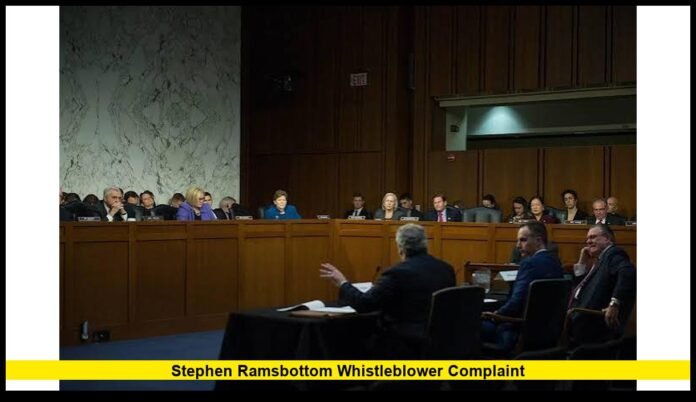

The Stephen Ramsbottom Whistleblower complaint has intensified scrutiny of U.S. military leadership following an Iranian drone attack that killed six American service members at Port Shuaiba in Kuwait. Army Reserve Maj. Stephen Ramsbottom, who survived the March 1, 2026, strike, has formally raised concerns with congressional leaders about the military’s preparation, protective equipment and decisions that placed American personnel at the vulnerable installation.
Ramsbottom alleges that commanders received warnings about the possibility of an Iranian attack but failed to provide adequate protection against one-way attack drones. He also questions why additional counter-drone equipment never reached the facility and why medical resources were insufficient to handle a large-scale emergency. His allegations have become a major focus of public attention following a November 15 60 Minutes investigation featuring interviews with the Army officer and other people connected to the attack.
The disclosure has brought renewed attention to the circumstances surrounding the deaths of six soldiers, the treatment of wounded personnel and the responsibility of military commanders to protect troops during overseas operations. It has also prompted calls for congressional oversight and greater transparency from the Department of Defense.
Stephen Ramsbottom Whistleblower Complaint Draws Congressional Attention
Maj. Stephen Ramsbottom submitted his whistleblower disclosure to the House and Senate Armed Services Committees on November 13, 2026. The filing challenges decisions made before the Iranian drone attack and asks lawmakers to examine whether military leaders adequately addressed known security concerns.
Ramsbottom served with the 103rd Expeditionary Sustainment Command, an Army Reserve organization responsible for coordinating logistical support for American forces. His position as deputy chief of operations gave him direct involvement in operational planning and awareness of concerns surrounding the installation.
In his account, the problem was not simply that an enemy drone managed to penetrate military defenses. He argues that the command post lacked protection specifically designed to address the aerial threat and that personnel had raised concerns before the attack.
Ramsbottom described the incident as a failure of planning and leadership. He also acknowledged that responsibility for operational preparedness extended through multiple levels of the military organization.
The complaint matters because it moves the allegations beyond interviews and public criticism into a formal congressional oversight process. Lawmakers can now seek additional records, question military officials and examine the decisions that shaped the deployment.
The allegations, however, remain allegations. A complete public determination of individual responsibility has not yet emerged.
Who Is Army Major Stephen Ramsbottom?
Stephen Ramsbottom is a U.S. Army Reserve officer who served in the 103rd Expeditionary Sustainment Command during its deployment to Kuwait.
His responsibilities included operational duties connected to the unit’s mission. The command supported military logistics in the Middle East, making its personnel important to the movement and coordination of supplies and other operational requirements.
Ramsbottom was inside the Port Shuaiba operations center when the Iranian drone struck on March 1. He survived the explosion but sustained injuries and later became one of the service members speaking publicly about the circumstances surrounding the incident.
His firsthand experience has made his account particularly relevant to the investigation. Unlike someone relying exclusively on documents or secondhand reports, Ramsbottom was present at the facility and participated in discussions about its operational conditions.
He has described concerns about the building’s protective capabilities, the availability of medical assistance and the absence of dedicated defenses against one-way attack drones.
His decision to file a whistleblower disclosure also places attention on the protections available to military personnel who raise concerns about operational decisions.
The case is not simply about one officer’s criticism of his superiors. It involves questions about whether military organizations have effective procedures for recognizing, evaluating and addressing warnings from personnel working in potentially dangerous environments.
What Happened at Port Shuaiba on March 1, 2026?
The incident at the center of the complaint occurred at Port Shuaiba, a Kuwaiti port facility used by American military personnel.
On March 1, an Iranian one-way attack drone struck a U.S. Army tactical operations center at the installation. The attack killed six American service members and wounded more than 20 others.
The strike took place during the opening phase of the U.S.-Israeli military campaign against Iran, known as Operation Epic Fury.
The six service members who died were:
- Master Sgt. Nicole M. Amor
- Sgt. Declan J. Coady
- Maj. Cody A. Khork
- Master Sgt. Noah L. Tietjens
- Maj. Jeffrey R. O’Brien
- Chief Warrant Officer Robert M. Marzan
The attack destroyed the operations center and created an immediate emergency involving multiple casualties.
Survivors described a chaotic scene involving damaged structures, smoke, fire and injured personnel. Soldiers and available medical responders had to assist wounded colleagues while dealing with the destruction caused by the explosion.
The deaths made the Port Shuaiba strike one of the most consequential attacks against American military personnel during the conflict.
For the survivors and families of those killed, the central concern has increasingly shifted from the attack itself to the decisions made before it occurred.
Lack of Dedicated Counter-Drone Protection
One of the principal allegations in the Stephen Ramsbottom Whistleblower complaint concerns the absence of dedicated protection against one-way attack drones.
Ramsbottom says the facility had protective arrangements intended to address certain conventional threats but lacked adequate measures specifically designed to stop aerial attacks.
This distinction is important because modern drone warfare presents different challenges from traditional ground-based threats.
Small, relatively inexpensive unmanned aircraft can approach military installations and strike buildings, vehicles and personnel. One-way attack drones are designed to reach a target and detonate rather than return to their launch point.
Military installations therefore need to consider detection systems, interception capabilities, warning procedures and protective structures when evaluating potential drone threats.
Ramsbottom said personnel had discussed obtaining a counter-drone system in the week before the attack. He recalled that a senior noncommissioned officer indicated that the equipment would be sent to Port Shuaiba.
However, Ramsbottom said the system never arrived. He also said he did not know whether the equipment had actually been ordered or formally requested.
The complaint raises a broader question about whether commanders had the necessary resources to address the threat they faced.
Determining what equipment was available, what requests were submitted and why particular decisions were made will be important to any independent assessment.
Warnings About Iran’s Potential Target List
Another important part of the disclosure concerns intelligence warnings before the March 1 attack.
Ramsbottom told 60 Minutes that he had seen intelligence reporting that identified Port Shuaiba as a potential Iranian target.
Other soldiers interviewed during the CBS investigation also said they had seen intelligence indicating that the port appeared on a target list.
These accounts have increased scrutiny of how military intelligence reached commanders and whether the information influenced decisions about troop placement.
The existence of a threat assessment does not automatically establish that an attack will occur. Intelligence reports require interpretation, and military leaders must evaluate the likelihood, timing and potential consequences of different threats.
Nevertheless, warnings about a particular installation can influence decisions involving fortifications, air defenses, personnel movements and emergency planning.
Ramsbottom says his concerns were not adequately addressed despite discussions with senior leadership.
Investigators will need to establish which officials received the relevant intelligence, what assessments they made and whether additional protective measures were considered or rejected.
Medical Preparedness Became Another Major Concern
The whistleblower allegations also focus on the medical resources available at Port Shuaiba.
Ramsbottom said the installation had no physician, no fixed medical aid station and only one ambulance when the attack occurred.
These limitations became particularly significant after the drone strike produced numerous casualties.
Tanner Carson, a civilian medic who regularly worked at the port, also described concerns about the available medical resources. He said the facility lacked the staffing, equipment and transportation needed to manage a mass-casualty incident.
Carson’s account raised questions about whether the medical arrangements were appropriate for the number of soldiers assigned to the location.
Emergency planning at a military installation involves more than having basic first-aid equipment available. Personnel need access to trained responders, medical supplies, transportation and procedures for moving critically injured people to hospitals.
When multiple people suffer serious injuries simultaneously, limited resources can create additional difficulties.
The complaint therefore places medical readiness alongside physical security as an important part of the investigation.
Lawmakers and military investigators will need to examine what resources were requested, what supplies were provided and whether any requests were denied.
Why Military Leaders Selected Port Shuaiba
The decision to position American personnel at Port Shuaiba is another major issue surrounding the case.
According to earlier reporting, the Army moved members of the 103rd Sustainment Command from Camp Arifjan to the port as the conflict with Iran approached.
The relocation formed part of broader military efforts to distribute personnel across different locations in the region.
However, surviving soldiers and other reporting have raised concerns about whether Port Shuaiba offered sufficient protection against the threats facing American personnel.
Alternative locations, including facilities in Saudi Arabia, were reportedly considered during deployment planning.
The Washington Post’s reporting described disagreements and concerns surrounding the decision to use the port despite its potential vulnerabilities.
Military officials have defended the selection process, stating that Port Shuaiba was chosen in accordance with operational plans. Army Central also maintained that the facility had protective arrangements and sufficient bunker space for assigned personnel.
This disagreement makes the location decision an important area for further examination.
Investigators must consider the operational reasons for choosing the port, the information available to commanders and the practical alternatives considered at the time.
The fact that another location was available would not automatically establish that it offered greater protection. The relevant question is whether military leaders made an appropriately informed decision based on the risks and mission requirements.
Pentagon Response and Questions About Military Readiness
The allegations have placed previous Pentagon statements about the installation under renewed scrutiny.
Following the March attack, Defense Secretary Pete Hegseth described the targeted operations center as fortified.
Pentagon spokesperson Sean Parnell also previously defended the protective arrangements, pointing to the facility’s six-foot walls and broader regional security measures.
Army Central separately maintained that Port Shuaiba and the surrounding area had layered defenses against drones and incoming missiles.
These statements contrast with Ramsbottom’s description of the facility and the concerns raised by other surviving personnel.
The difference highlights the importance of distinguishing between the existence of regional air defenses and the specific protection available at the location that was struck.
A military installation may operate within a broader defensive network while still facing vulnerabilities involving individual buildings, warning systems or the availability of immediate protection.
The Pentagon has not publicly provided a comprehensive response addressing every allegation in the new whistleblower disclosure.
A complete assessment will require access to classified intelligence, operational records and the relevant military investigations.
Congressional Oversight and Calls for Accountability
The complaint has attracted attention from lawmakers seeking answers about the circumstances surrounding the attack.
Sen. Richard Blumenthal has called for a classified briefing from Defense Secretary Pete Hegseth. He has also sought information about the force protection assessments conducted for Port Shuaiba.
His request reflects concern about whether the Department of Defense adequately evaluated the risks before assigning personnel to the facility.
The issue has also attracted attention from other members of Congress. In July, Democratic lawmakers announced an investigation into the attack, raising concerns about the objectivity and completeness of the military’s internal review.
The 2026 defense legislation also established a specific reporting requirement concerning Port Shuaiba.
Under Section 6023, the Department of Defense Inspector General must submit a report to congressional defense committees within 180 days of the legislation’s enactment.
The required review covers several important areas:
- The reasons for moving members of the 103rd Sustainment Command to Port Shuaiba.
- Medical supplies provided to the unit and whether supply requests were denied.
- Physical security measures at the installation.
- A timeline of the March 1 attack.
- Medical treatment provided to wounded service members, including assessments involving traumatic brain injuries.
- Whether public statements from the Department of Defense were consistent with information available to the department.
The legislation requires an unclassified report, although a classified annex may accompany it.
This reporting requirement could provide lawmakers and the public with a more comprehensive understanding of the decisions and circumstances surrounding the incident.
Army Investigation and the Remaining Unanswered Issues
The Army completed an internal investigation into the March attack earlier in 2026. Families of the deceased service members received briefings about its findings in July.
However, the investigation’s full findings have not been released publicly.
Earlier reporting indicated that the internal review did not assign fault or address punitive action. Army Central also described a separate classified investigation examining intelligence warnings and defensive capabilities.
The existence of these investigations is important because it means the military has already examined parts of the incident.
However, the new whistleblower disclosure raises questions that lawmakers and independent investigators may examine separately.
These include whether commanders adequately responded to warnings, whether the facility had sufficient protection and whether the medical response met the needs of wounded personnel.
The Inspector General’s reporting requirement also provides a mechanism for examining the consistency of official public statements with the information available to the Department of Defense.
No public finding has established that a particular commander is responsible for the deaths. Any conclusion about individual misconduct or negligence would require evidence and an appropriate investigative process.
What the Complaint Could Mean for Future U.S. Military Operations
The Port Shuaiba incident has implications for American military readiness beyond Kuwait.
Drone warfare has become an increasingly important consideration in modern conflicts. Military planners must prepare for threats that can emerge from relatively inexpensive unmanned systems and reach facilities that may not have been designed to withstand aerial attacks.
The allegations also highlight the importance of listening to personnel who identify potential vulnerabilities.
Command structures need reliable processes for receiving warnings, evaluating equipment requests and communicating decisions to those responsible for carrying out operations.
Medical readiness is equally important. A military facility’s emergency arrangements must reflect the number of personnel present and the potential severity of an attack.
The outcome of the Ramsbottom disclosure may therefore influence future discussions about:
- Counter-drone technology and installation security.
- Intelligence sharing and threat assessment.
- Deployment locations and operational risk management.
- Emergency medical staffing and mass-casualty preparation.
- Whistleblower protections and military leadership accountability.
These issues are particularly relevant as the U.S. military continues adapting to changing threats in the Middle East and other overseas operating environments.
Latest Stephen Ramsbottom Whistleblower Complaint Developments
As of November 16, 2026, the most significant development is Ramsbottom’s formal submission to the House and Senate Armed Services Committees on November 13.
His November 15 television interview brought additional public attention to the allegations, including questions about drone defenses, intelligence warnings and emergency medical capabilities.
Sen. Richard Blumenthal has called for a classified briefing and additional information from the Pentagon.
Meanwhile, the Army’s earlier investigation remains an important part of the record, although its complete findings have not been made publicly available.
The Department of Defense Inspector General’s reporting requirement creates another avenue for examining the attack and its aftermath.
There is no confirmed public announcement establishing that the new complaint has resulted in disciplinary action against military officials. There is also no publicly released final determination resolving all of Ramsbottom’s allegations.
The next important developments will involve congressional oversight, the Defense Department’s response and the findings required under the 2026 defense legislation.
Final Thoughts
The Stephen Ramsbottom Whistleblower complaint has brought significant attention to the decisions made before the March 1 Iranian drone attack at Port Shuaiba. The deaths of six American service members and the injuries suffered by more than 20 others have made questions about military preparedness especially important.
Ramsbottom’s allegations focus on counter-drone protection, intelligence warnings, deployment decisions and the availability of emergency medical resources. His account, together with testimony from other survivors and civilian medical personnel, has increased pressure on military leadership to provide a clearer explanation of what happened.
At the same time, the allegations must be evaluated through a transparent investigative process rather than treated as established conclusions. The Army’s internal findings, congressional oversight and the Inspector General’s review will be important in determining whether military procedures were followed and what changes may be necessary.
For the families of the six fallen service members and the survivors of the attack, obtaining accurate answers remains central to the search for accountability.
Share your thoughts in the comments and follow our latest coverage for verified updates on the Stephen Ramsbottom whistleblower case and the investigation into Port Shuaiba.