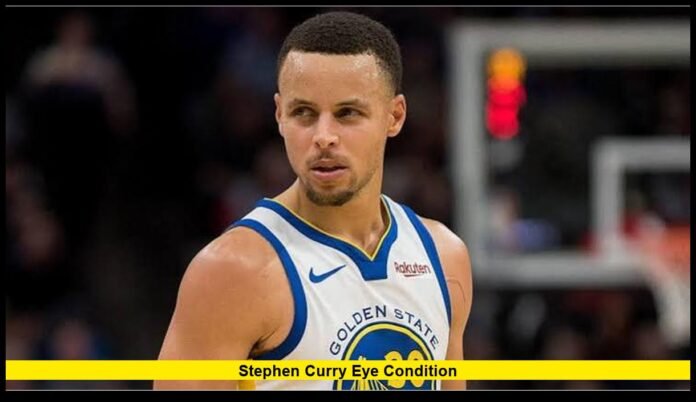

Stephen Curry eye condition has received renewed attention after the Golden State Warriors star shared new details about his long-standing struggle with keratoconus. Curry recently explained that he spent years playing basketball while dealing with blurred and distorted vision without fully realizing how much his eyesight had changed. He eventually received a diagnosis, began using contact lenses and now has regular eye examinations to monitor his condition.
Curry, 38, recently discussed the experience while promoting a new awareness campaign focused on keratoconus. He said Warriors general manager Bob Myers noticed him squinting during a televised game in 2018 and encouraged him to have his eyes examined.
That recommendation ultimately led Curry to an optometrist, where doctors diagnosed him with keratoconus. The condition affects the cornea and can cause blurred, distorted vision as the cornea changes shape.
Curry has since adapted to wearing contact lenses during basketball games. He also says he gets his eyes checked every six months and has worked with eye-care professionals on a treatment plan that has eased concerns about the future of his vision.
What Eye Condition Does Stephen Curry Have?
Curry has keratoconus, a corneal condition that can progressively change the shape of the eye’s clear front surface.
The cornea normally has a smooth, rounded shape. It helps focus light entering the eye so that images appear clear.
With keratoconus, the cornea can become thinner and develop an increasingly irregular, cone-like shape. That change can interfere with normal focusing and produce blurred or distorted images.
Curry recently described his experience in personal terms. He said he had become accustomed to seeing things differently and did not initially recognize his vision as abnormal.
For years, he compensated by squinting.
That habit became so familiar that he considered it part of normal life rather than a sign that something might be wrong.
His diagnosis changed that understanding.
Curry now knows that the blurred and distorted images he experienced were connected to keratoconus.
How Stephen Curry Discovered His Eye Problem
Curry’s recent account traces the discovery of his condition to 2018.
At the time, Golden State Warriors general manager Bob Myers was watching Curry during a road game broadcast.
Myers noticed that Curry was squinting heavily while sitting on the bench.
The behavior caught Myers’ attention because Curry appeared to be struggling to see clearly.
After the game, Myers contacted Curry and suggested that he have his eyes checked.
Curry initially thought the examination would show nothing significant.
Instead, the optometrist diagnosed him with keratoconus.
The diagnosis gave Curry an explanation for the visual problems he had experienced for years.
It also introduced him to the possibility that the condition could progress over time.
That realization eventually led him to take his eye care more seriously.
What Curry Says His Vision Was Like Before Diagnosis
Curry has described his vision before diagnosis as blurry and distorted.
The unusual part was that he did not always perceive those problems as symptoms.
He had gradually adapted to them.
Instead of immediately recognizing that his vision needed medical attention, Curry simply squinted when he needed additional clarity.
He continued playing basketball at the highest professional level.
He also continued to shoot, pass and read the court despite not having the visual clarity he has today.
Curry recently joked that he could have called a future memoir “The Whole Time I Couldn’t See.”
The comment reflects how different his perception of his eyesight became after receiving proper correction.
He now understands that he was compensating for impaired vision rather than seeing normally.
How Contact Lenses Changed Curry’s Vision
Contact lenses became an important part of Curry’s approach to managing his eyesight.
After his diagnosis, he started using contacts to improve his vision.
Curry has described the change as dramatic.
He previously had to squint to see clearly. With the right contact lenses, he could see the court and the basket with greater clarity.
The adjustment took time.
Curry explained that finding the right fit and prescription mattered because the lenses needed to remain stable while he played basketball.
That requirement is particularly important for a professional athlete.
An NBA player constantly changes direction, jumps, runs and makes rapid movements. A lens that does not remain properly positioned can interfere with clear vision.
Curry eventually became comfortable with the process.
He now describes himself as highly experienced at putting in his contacts.
Why Vision Matters So Much for Stephen Curry
Curry’s career depends heavily on visual precision.
Basketball requires players to process information quickly.
A player needs to see the basket, teammates, defenders and the ball while moving around the court.
For Curry, long-distance shooting adds another visual demand.
He frequently attempts shots from well beyond the three-point line. Clear vision helps him identify the target and judge the position of the basket.
Curry has not claimed that contacts suddenly created his shooting ability.
Instead, he has described improved vision as providing clarity and peace of mind.
He has said that seeing more clearly gives him additional confidence because he no longer needs to wonder whether blurred vision is affecting his performance.
That distinction matters.
Curry had already established himself as an elite shooter before he corrected the vision problem.
The contacts helped address his eyesight rather than create his basketball skills.
Did Keratoconus Affect Curry’s Basketball Career?
Curry continued competing professionally despite the condition.
He won NBA championships and built his reputation as one of basketball’s most accomplished shooters while dealing with impaired vision.
His recent comments reveal that he did not fully appreciate the extent of the problem at the time.
He had adapted to blurry and distorted images.
That adaptation allowed him to continue performing, but it did not mean his eyesight was normal.
Once he began wearing contacts, Curry noticed the difference.
He described the improved clarity as transformative.
The experience also changed his attitude toward eye care.
He now monitors his vision regularly and encourages people to seek professional attention when they notice persistent symptoms.
What Is Keratoconus?
Keratoconus is a condition involving the cornea.
The cornea sits at the front of the eye and plays a major role in focusing light.
When the cornea changes shape, the eye may no longer focus light normally.
That can result in:
- Blurry vision
- Distorted images
- Ghosting around objects
- Increased sensitivity to light
- Difficulty seeing clearly at night
- Frequent changes in vision correction
- Problems with visual sharpness
Symptoms can vary significantly.
One person may experience mild visual changes, while another may develop substantial distortion.
The condition can also affect the two eyes differently.
Keratoconus is considered progressive because the cornea can continue changing shape over time in some patients.
That does not mean every person experiences rapid progression.
Monitoring remains important because doctors can track changes and determine whether additional treatment is necessary.
Why Curry Now Gets Regular Eye Examinations
Curry has said he gets his eyes checked every six months.
That schedule allows his eye-care professionals to monitor his condition.
Regular examinations can help identify changes in corneal shape and vision.
They also give doctors an opportunity to determine whether a patient’s current vision correction remains effective.
Curry’s approach is very different from the period before his diagnosis.
Earlier in his life, he had become comfortable with squinting and blurry vision.
Now, he understands that changes in eyesight deserve attention.
His recent public comments emphasize the importance of having conversations with eye-care professionals when symptoms appear.
Curry’s New Keratoconus Awareness Campaign
On September 23, 2026, Curry joined Glaukos in launching “Could it be KC?”, an awareness and education campaign focused on keratoconus.
The campaign aims to improve recognition of the condition and encourage earlier detection.
Curry is sharing his personal experience as part of the initiative.
The campaign focuses particularly on helping families recognize possible warning signs and understand the importance of regular eye care.
The initiative also includes educational resources.
As part of the launch, Curry is scheduled to participate in an eye-health event for students in Oakland, California.
He is also expected to read a new picture book inspired by his experience with keratoconus.
The campaign plans additional activities in 2027.
Curry’s involvement gives the condition a highly visible public advocate who can speak from personal experience.
Why Early Detection Matters
Keratoconus can progress differently among individuals.
Some people may experience gradual changes that remain manageable for years.
Others can experience more significant progression.
Early recognition gives eye-care professionals an opportunity to monitor the cornea and determine an appropriate treatment strategy.
That is particularly important for children, teenagers and young adults because keratoconus can progress during younger years.
Curry’s story illustrates one challenge with diagnosis.
He had already adapted to his symptoms.
Because squinting had become normal, he did not immediately recognize it as a reason to seek medical attention.
It took someone else noticing the behavior to prompt an examination.
That experience is now part of the message behind his awareness work.
What Symptoms Can Indicate Keratoconus?
Curry’s experience involved squinting, blurred vision and distorted images.
Those symptoms can occur with many different eye conditions, so they do not automatically indicate keratoconus.
Still, persistent changes in vision warrant an examination by an eye-care professional.
Potential warning signs associated with keratoconus can include:
- Increasingly blurry vision
- Distorted images
- Frequent prescription changes
- Difficulty seeing at night
- Halos around lights
- Increased sensitivity to light
- Difficulty obtaining clear vision with ordinary glasses
People experiencing these symptoms should not attempt to diagnose themselves.
An eye-care professional can perform appropriate examinations and determine the cause.
Curry’s own diagnosis came after an eye examination rather than from the symptoms alone.
How Contact Lenses Can Help With Keratoconus
Contact lenses can provide clearer vision for people whose corneas have become irregular.
Specialized lenses can help compensate for an uneven corneal surface.
Curry has discussed the importance of finding the correct lens fit and prescription.
For an athlete, stability is particularly important.
A lens must remain properly positioned while the wearer moves.
Curry spent time adjusting to contacts before incorporating them into his basketball routine.
Today, putting them in has become part of his normal routine.
His experience demonstrates that vision correction can require an adjustment period, particularly when someone has spent years adapting to an untreated or underrecognized visual problem.
Has Stephen Curry Had Eye Surgery?
There is no current public confirmation that Curry has undergone a corneal transplant or another major eye surgery for keratoconus.
His recent comments focus on contact lenses, regular eye examinations and a treatment plan developed with eye-care professionals.
That distinction is important because keratoconus treatment varies according to the individual.
Some patients manage their vision with glasses or contact lenses.
Doctors may recommend other treatments when they identify progression.
One procedure used to strengthen the cornea is corneal cross-linking.
However, Curry has not publicly stated that he underwent that procedure.
Therefore, there is no factual basis for saying that he has had a specific surgical treatment unless he or his medical team confirms it.
What Is Corneal Cross-Linking?
Corneal cross-linking is a treatment used to strengthen the cornea.
Doctors can use the procedure when keratoconus is progressing.
The treatment uses riboflavin, commonly known as vitamin B2, together with ultraviolet light.
The goal is to strengthen bonds within the corneal tissue and slow or stop further progression.
Cross-linking differs from contact lenses.
Contact lenses primarily improve vision by helping compensate for the irregular shape of the cornea.
Cross-linking aims to address the structural weakness of the cornea.
Whether a patient needs cross-linking depends on clinical findings.
Curry’s current public comments do not confirm that he has undergone this procedure.
Does Keratoconus Have a Cure?
There is no simple cure that restores every affected cornea to its original condition.
However, treatments can help manage the condition and, in appropriate cases, slow progression.
Vision correction remains an important part of management.
Patients may use glasses or specialized contact lenses depending on the shape of the cornea and the severity of their visual problems.
Doctors can also consider procedures such as corneal cross-linking when appropriate.
Advanced cases can require more complex treatment.
The right approach depends on the individual patient’s eyes.
Curry’s current experience shows that he has been able to manage his vision successfully with contact lenses, monitoring and professional eye care.
Curry’s Current Approach to Eye Care
Curry now treats his eye health as an ongoing responsibility.
He gets his eyes checked every six months.
He wears contact lenses that allow him to see more clearly.
He also works with eye-care professionals on a treatment plan.
Curry has said that the plan has helped reduce his anxiety about where the condition could go.
That is particularly meaningful because he learned that keratoconus can progress.
Rather than ignoring the issue, he now monitors it regularly.
His current approach allows him to continue his basketball career while keeping his vision under professional observation.
Did Contacts Improve Curry’s Shooting?
Curry has previously connected the introduction of contact lenses with an improvement in his shooting.
In 2019, he said the world seemed to open up after he began wearing contacts.
His comments at the time came after a period when his shooting numbers had dipped.
However, basketball performance depends on many factors.
It would be inaccurate to attribute a change in shooting performance entirely to improved eyesight.
Curry’s own recent comments focus more on clarity and confidence than on claiming that contacts directly increased his shooting percentage.
He says clearer vision gives him more energy because he knows he can see the basket and the court properly.
That distinction keeps the focus on what he personally experienced rather than assigning a specific statistical effect to his eye treatment.
Curry’s Experience Before and After Diagnosis
Curry’s experience can be viewed in two distinct periods.
Before diagnosis, he had learned to compensate for blurred and distorted vision.
Squinting became normal.
He continued playing basketball and competing at the highest level.
After diagnosis, he began using contact lenses and monitoring his eyes regularly.
The difference gave him a clearer understanding of how much he had been compensating.
He now has a routine for managing his condition.
That includes regular examinations and contact lenses.
His experience also encouraged him to speak publicly about keratoconus.
Stephen Curry Wants People to Get Their Eyes Checked
Curry’s current awareness work focuses on encouraging people to pay attention to their vision.
He has urged people who notice symptoms to seek professional advice and discuss their concerns with eye doctors.
His personal experience provides a straightforward example.
He did not initially realize that his squinting represented an eye problem.
Someone else noticed it.
An eye examination eventually identified keratoconus.
Curry now wants other people to avoid dismissing similar warning signs.
His message does not suggest that every person with blurry vision has keratoconus.
Instead, it emphasizes the value of professional evaluation when vision changes persist.
Stephen Curry Eye Condition: Current Status
As of September 23, 2026, Curry continues to manage keratoconus.
He uses contact lenses to improve his vision and receives eye examinations every six months.
He has also worked with eye-care professionals on a treatment plan that he says has reduced his concerns about the condition’s progression.
There is no current public report indicating that Curry has experienced a new serious complication involving his eyesight.
His latest comments focus on his long-term experience and his decision to use that experience to increase awareness of keratoconus.
The launch of the “Could it be KC?” campaign marks the latest public development.
Curry is now using his platform to encourage greater awareness, earlier recognition and regular eye care.
Key Facts About Stephen Curry’s Eyesight
| Detail | Current information |
|---|---|
| Eye condition | Keratoconus |
| Primary affected structure | Cornea |
| Vision problems | Blurred and distorted images |
| Diagnosis discussed publicly | 2019 |
| Discovery period described by Curry | 2018 |
| How the issue was noticed | Bob Myers noticed Curry squinting |
| Vision correction | Contact lenses |
| Eye examinations | Every six months |
| Current public status | Managing the condition |
| 2026 development | Curry launched a keratoconus awareness campaign with Glaukos |
The Latest Update on Stephen Curry’s Eye Condition
The latest information gives a clearer picture of Curry’s experience with keratoconus.
The Warriors star spent years playing basketball while dealing with blurred and distorted vision. He did not initially recognize the problem because he had adapted to it.
Bob Myers noticed Curry squinting during a televised game in 2018 and encouraged him to get his eyes checked.
The examination led to a diagnosis of keratoconus.
Curry subsequently began using contact lenses and developed a routine for managing his vision.
Today, he receives eye examinations every six months and works with eye-care professionals on his treatment plan.
His latest public effort goes beyond his personal care. On September 23, 2026, he joined Glaukos to launch the “Could it be KC?” campaign, which aims to increase awareness of keratoconus and encourage earlier recognition of the condition.
Curry’s story highlights how easily persistent vision problems can become part of someone’s routine. His experience also shows why changes such as repeated squinting, blurry vision or distorted images deserve attention from an eye-care professional.
Stay tuned for confirmed updates on Stephen Curry’s eyesight and share your thoughts about his keratoconus journey in the comments.