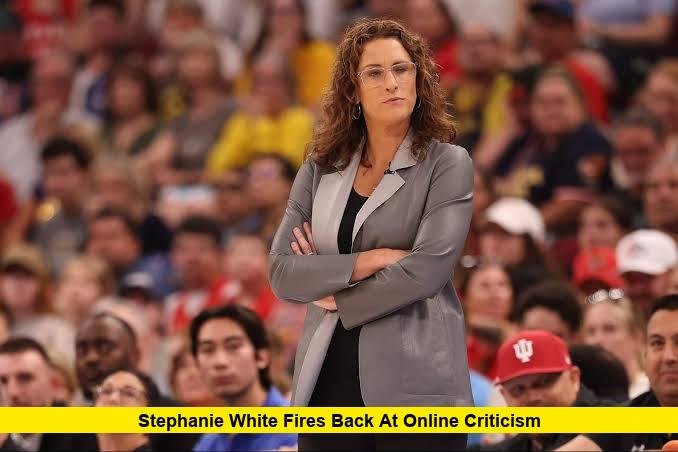

Indiana Fever coach Stephanie White fires back at online criticism in one of the most dramatic press conference moments of the 2026 WNBA season, delivering an impassioned, unscripted statement on Tuesday, August 11, 2026, that ended with the now-viral line, “Everybody else can go to hell.” The outburst came just before the Fever’s matchup against the New York Liberty and marked a striking departure from White’s usually composed public demeanor, as she chose to address a wave of backlash head-on rather than take questions from reporters.
What Happened at the Press Conference
Ahead of Indiana’s game on August 11, 2026, White skipped her usual pregame media Q&A and instead read a prepared statement to the assembled press. Over roughly two and a half minutes, she defended her coaching staff, her players, and her own leadership while condemning what she described as the toxic online discourse surrounding the Fever and the broader WNBA. White pounded the table as she spoke, telling reporters that “the hate, the fear-mongering, the divisiveness, the stuff that’s trying to hijack our league will not win.”
She continued by insisting that the team remains unified despite the outside noise. “It won’t win. We are united. We are connected. We will not be divided,” White said. “Every day, these women put their a** on the line. Every day. When they go low, we go high. Love will win! Grace will win! Humility will win, and kindness will win.” She closed the statement with the line that immediately spread across social media: “I stand by them. I will always stand by them. Everybody else can go to hell.” White then left the podium without taking any questions from the media.
The Controversy That Sparked the Backlash
The fiery statement did not emerge from nowhere. It followed days of intense criticism directed at White after Chicago Sky guard DiJonai Carrington was ejected for a flagrant foul on Fever guard Sophie Cunningham during a game the previous Saturday. Carrington struck Cunningham across the face and neck area while Cunningham was in mid-air, and officials assessed a Flagrant 2 foul, resulting in Carrington’s ejection.
In her initial postgame comments on Saturday, White did not sound especially critical of the play. She said she believed the officials made the correct call but added that she did not think Carrington intended to hit Cunningham near the head and neck. White also noted that Carrington, whom she had coached for two seasons with the Connecticut Sun, “is gonna play her butt off” and that “nobody’s gonna go walking in for a layup” against her. Those remarks were widely interpreted by fans and commentators as White downplaying the severity of the foul or appearing to side with Carrington over her own player, and criticism intensified quickly across social media platforms.
The backlash grew significant enough that Indiana Lieutenant Governor Micah Beckwith weighed in publicly, writing on social media that the Fever should consider parting ways with White, arguing that no coach should appear to defend an opposing player who committed a flagrant foul on one of their own. That comment from a sitting state official added political weight to what had already become one of the most talked-about storylines of the WNBA season.
By Tuesday, White explained that her original comments came before she had seen a replay of the incident. She said she went straight into her Saturday press conference without having watched the foul multiple times and that once she reviewed the footage more closely, her opinion shifted. She revised her characterization of the foul, calling it “egregious” during her Tuesday statement, a notable change in tone from her initial remarks.
Public and Player Reaction
The Fever organization moved quickly to back its head coach. Team president Kelly Krauskopf issued a statement shortly after White’s press conference expressing support for her leadership. Krauskopf praised White for keeping the team focused and united for a second consecutive playoff push while operating under intense public scrutiny, adding that White has “the full support of leadership.”
Fever star Caitlin Clark also spoke out in support of her coach following the team’s win over the Liberty. Clark said fans booing White before the game “made me a little sick” and emphasized that the locker room remains united behind their coach regardless of outside noise. She recalled an emotional moment from the previous season when she was injured and comforted by White, saying, “I bawled in Steph’s arms,” and added that people outside the organization often draw conclusions about situations “they think they know a lot of things” about but “are just blatantly wrong.”
Cunningham, the player at the center of the incident, also defended White after the game, saying the team has “each other’s backs” and that “coach loves us.” She noted that White had not seen the replay of the foul in real time when she made her initial comments. Cunningham has separately been at the center of her own controversy in recent weeks tied to comments she made about transgender athletes, adding another layer to what has already been a turbulent stretch for the Fever both on and off the court.
Reaction across sports media and social platforms has been mixed. Some observers praised White for standing firmly behind her players and pushing back against what she characterized as manufactured outrage. Others noted that much of her statement focused on defending herself rather than directly addressing the concerns players and fans initially raised about her softer response to the Carrington foul. Commentary from outlets covering the moment pointed out that White’s passionate defense, while emotionally resonant, arrived several days after the incident and largely centered on her own position rather than the specific criticism of her Saturday remarks.
Stephanie White’s Career Background
White’s connection to the Fever organization runs deep, and her basketball résumé is one of the most accomplished in the league. Born June 20, 1977, in Danville, Illinois, and raised in West Lebanon, Indiana, White played college basketball at Purdue, where she led the Boilermakers to the 1999 NCAA national championship and earned the Wade Trophy as the nation’s top female player.
She was drafted in the second round of the 1999 WNBA Draft by the Charlotte Sting and played five seasons in the league, four of them with the Indiana Fever, before retiring as a player in 2004. She quickly transitioned into coaching, holding assistant roles at Ball State, Kansas State, Toledo, and the Chicago Sky before returning to the Fever as an assistant coach from 2011 to 2014, a stretch that included Indiana’s first WNBA championship in 2012.
White was promoted to Fever head coach for the 2015 and 2016 seasons, leading the team to the WNBA Finals in her first year at the helm. She went on to coach college basketball at Vanderbilt from 2016 to 2021 before taking over as head coach of the Connecticut Sun in 2023. During her two seasons in Connecticut, White compiled a 55-25 record, led the Sun to back-to-back semifinal appearances, and won both WNBA Coach of the Year and Associated Press Coach of the Year honors in 2023.
Indiana brought White back home in November 2024 to lead the Fever into a new era built around Caitlin Clark. In her first season back, White guided the Fever to a 24-20 record and the team’s first trip to the semifinals in a decade, though the run ended in overtime of Game 5 against the Las Vegas Aces. During the 2026 offseason, White also served as an assistant coach for the USA Basketball team during FIBA World Cup qualifying, helping the program finish 5-0, and continued her long-running work as a college basketball analyst for ESPN.
Latest Updates
As of this week, White remains the Fever’s head coach with no indication from the organization of any change in that status, and Krauskopf’s statement of support suggests the front office is standing firmly behind her amid the criticism. The Fever defeated the Liberty 106-92 on the night of White’s statement, with Clark and Cunningham both playing significant roles in the win. There is no official confirmation of any disciplinary action from the WNBA league office related to either the Carrington foul or White’s public comments, and any further developments, including potential league review of the flagrant foul incident, may unfold in the coming days as the Fever continue their push toward the playoffs.
The episode has become part of a broader narrative around tension and scrutiny in the WNBA this season, with several high-profile incidents involving physical play, player conduct, and public commentary drawing national attention. White’s comments, whether viewed as an authentic defense of her team or an incomplete response to legitimate criticism, have added another chapter to that ongoing storyline.
Final Thoughts
Stephanie White’s decision to publicly confront her critics reflects both the pressure surrounding one of the WNBA’s most visible franchises and the increasingly personal nature of scrutiny facing coaches and players in the social media era. Her track record, including a Coach of the Year award, multiple playoff runs, and deep ties to the Fever organization, has earned her considerable goodwill among players and team leadership, as reflected in the immediate support from Clark, Cunningham, and Krauskopf. At the same time, the criticism she faced highlights how quickly public perception can shift when a coach’s comments are seen as insufficiently protective of their own players.
Whether White’s fiery statement quiets the criticism or fuels further debate may become clearer as the Fever continue their playoff push over the coming weeks. What is clear is that the moment has resonated widely, turning a pregame press conference into one of the most discussed events of the WNBA season and reinforcing just how closely every word from Fever coaches and players is being watched right now.
Stay tuned for more updates on this developing story, and share your thoughts on Stephanie White’s response in the comments below.