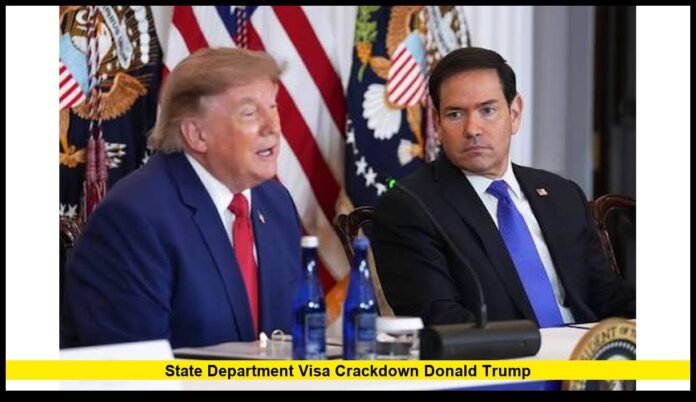

The State department visa crackdown donald trump administration has taken a broader approach to U.S. visa screening in 2026, combining tighter applicant vetting, online-presence checks, country-specific restrictions and continued review of people who already hold visas.
The latest development came into effect October 1, when the Department of State added I, TN and TD applicants to its online-presence review. The policy requires applicants in those categories to make their social-media profiles public or open for government review.
The change comes as the administration continues to increase scrutiny across the U.S. visa system. The State Department says it uses available information when evaluating applicants for inadmissibility, national-security concerns, public-safety issues and compliance with the requested visa category.
The department has also reported more than 250,000 visa revocations since President Donald Trump took office. The latest figure was reported at the end of September and represents an increase from the more than 175,000 revocations reported by the department in August.
These developments do not represent one single rule affecting every foreign traveler. The requirements vary according to visa category, nationality, purpose of travel and individual circumstances.
Why U.S. Visa Screening Has Become More Intensive
The State Department has increasingly emphasized that visa decisions involve security and eligibility considerations.
A person seeking a U.S. visa must establish eligibility for the specific category requested. The department also evaluates whether the applicant intends to follow the conditions associated with admission.
The current screening approach can involve information beyond the documents submitted with a visa application.
For covered applicants, that now includes online-presence review. The department says it may use available information during screening and vetting to identify people who could be inadmissible or pose national-security or public-safety concerns.
The policy has developed in stages during 2026.
Earlier in the year, online review already covered student, exchange visitor, temporary worker and several other visa categories. The September announcement added three additional classifications beginning October 1.
That progression is one of the clearest indicators of how the administration has changed visa processing.
October 1 Social-Media Screening Covers Three More Visa Categories
The October 1 change specifically affects three nonimmigrant classifications.
I visas cover foreign media representatives. TN visas cover qualifying professionals under the United States-Mexico-Canada Agreement. TD visas cover eligible dependents of TN professionals.
Applicants in all three categories are instructed to make their social-media profiles public or open.
The department says the measure is intended to support its vetting process. It forms part of the broader online-presence review already used for other visa classifications.
The requirement is significant for professionals who may not previously have expected social-media information to form part of their visa screening.
It also means that applicants need to understand the information they provide during the visa process and ensure that their application accurately reflects their circumstances.
Other Visa Categories Already Subject to Online Review
The October change did not create online screening from scratch.
The State Department had already extended online-presence review to numerous categories during earlier stages of 2026.
The covered classifications include:
- F-1 and F-2 student visas
- M-1 and M-2 vocational student visas
- J-1 and J-2 exchange visitor visas
- H-1B visas
- Certain H-4 dependent visas
- H-3 and certain H-4 visas
- K-1, K-2 and K-3 visas
- Q visas
- R-1 and R-2 religious-worker visas
- S, T and U visas
- Certain A-3, C-3 and G-5 categories
The March 2026 State Department announcement instructed applicants in the covered classifications to adjust privacy settings on social-media profiles to “public” or “open.”
The department later added I, TN and TD applicants to the system.
This means the online review now reaches a wider group of students, workers, exchange visitors, professionals, journalists and other temporary visa applicants.
More Than 250,000 Visa Revocations Reported
The other major development is the number of visas the State Department says it has revoked.
By September 30, the department had reported more than 250,000 visa revocations since Trump returned to office.
The department has associated the revocations with a range of issues, including criminal conduct, fraud, immigration violations, birth-tourism activity and national-security concerns.
The figure is an overall number.
It should not be interpreted as meaning that every person whose visa was revoked faced the same allegation or the same type of immigration problem.
The administration has used multiple sources of information in its visa enforcement effort. Law-enforcement information can become relevant when a visa holder has contact with authorities.
The department’s earlier August figure exceeded 175,000 revocations.
The increase to more than 250,000 by the end of September shows how quickly the total has grown during the administration’s continuing enforcement campaign.
Criminal Cases Are Central to the Revocation Effort
Criminal conduct has been a major part of the State Department’s reported visa cancellations.
The department previously said many revocations followed law-enforcement encounters.
Reported categories have included assault, driving under the influence, theft and drug-related offenses.
Other cases have involved more serious allegations, including sexual assault, child abuse, fraud and embezzlement.
Visa revocation and criminal prosecution are separate matters.
A visa cancellation does not by itself establish that every person involved was convicted of an offense. The government’s immigration action and any criminal case can follow different legal processes.
That distinction matters when interpreting the overall revocation figure.
The department’s broader point is that visa eligibility can change after a visa has already been issued.
A Visa Can Be Revoked After Approval
One of the most important issues for foreign nationals is the difference between receiving a visa and keeping it valid.
Visa issuance does not permanently remove the government’s ability to review eligibility.
A person who receives a visa remains subject to U.S. immigration law and the terms associated with that visa.
When new information raises eligibility concerns, the government can take action.
The large number of revocations reported in 2026 demonstrates that post-issuance enforcement has become a major feature of the administration’s immigration strategy.
Foreign nationals therefore cannot assume that an older visa remains unaffected simply because it was originally approved.
Birth Tourism Remains Outside Visitor Visa Rules
Birth tourism has also received significant attention under the current administration.
The State Department’s existing visitor-visa guidance states that birth tourism is not a permissible purpose for a B-1/B-2 visitor visa.
The department defines birth tourism as travel to the United States primarily to give birth so that the child obtains U.S. citizenship.
That rule is distinct from a general prohibition on pregnant travelers.
A pregnant person may travel to the United States for a permissible purpose when the requirements for the applicable visa are met.
The issue arises when giving birth in the United States to obtain citizenship for the child is the primary purpose of the trip.
The State Department’s visitor-visa rules also prohibit other activities that require different classifications, including employment and regular academic study.
Visa Fraud Is Another Major Enforcement Concern
The administration’s visa policies also place strong emphasis on accurate information.
Applicants must provide truthful information about their travel plans, personal circumstances and eligibility.
Misrepresentation can create serious immigration consequences.
The current screening system gives consular officers access to information that can be used to evaluate whether the applicant’s stated purpose of travel is consistent with the requested visa.
This is particularly important when an applicant’s public information appears inconsistent with the information provided during the visa process.
The October social-media screening requirement increases the role of publicly available online information for applicants in the covered categories.
Country-Based Visa Restrictions Remain Part of the System
Another part of the Trump administration’s visa policy involves restrictions based on nationality.
Presidential proclamations have imposed full or partial visa restrictions on nationals of designated countries.
Those restrictions are not identical for every country.
Depending on the applicable rules, restrictions can affect immigrant visas, visitor visas, student visas, exchange visas or other categories.
There are also specified exceptions under the applicable presidential proclamations.
As a result, nationality alone does not always determine the final outcome. The specific visa category and the applicant’s circumstances remain relevant.
Applicants from countries affected by restrictions must therefore review the current State Department instructions before making travel plans.
Visa Bonds Add a Financial Requirement for Some Visitors
The State Department also maintains a visa-bond program covering nationals of designated countries.
Under the current guidance, eligible B-1/B-2 applicants from listed countries who otherwise qualify for the visa must post a bond.
The listed bond amounts are $5,000, $10,000 or $15,000.
The amount is determined during the visa process. Applicants are directed to use the government’s required procedures rather than third-party services.
The current State Department list contains dozens of countries, including Algeria, Angola, Bangladesh, Cambodia, Ethiopia, Georgia, Nigeria, Senegal, Tanzania, Uganda, Venezuela and Zambia, among others.
The bond requirement does not automatically mean that every citizen of a listed country is barred from receiving a visitor visa.
Instead, qualifying applicants can face the additional financial requirement when the policy applies.
Where Nonimmigrant Visa Applicants Should Apply
The State Department also changed its instructions concerning the location of visa interviews.
Since July 2026, nonimmigrant applicants generally should schedule interviews at a U.S. embassy or consulate in their country of nationality or residence.
Applicants from countries without routine U.S. nonimmigrant visa operations must use designated processing posts unless another applicable arrangement covers them.
The department warns that applicants who apply outside their country of nationality or residence, when not otherwise covered by an exception or designated location, may face longer waits and greater difficulty qualifying.
Fees paid for applications made at an inappropriate location are also not necessarily refundable or transferable.
This change matters to applicants who previously considered applying at a U.S. consulate in another country because of shorter appointment queues.
Visa Services in Africa Have Also Been Reorganized
The State Department has been changing how some visa services operate in Africa.
Beginning August 1, 2026, routine visa services in certain African countries were realigned to regional hubs.
The department said the change was intended to promote more consistent security screening, vetting and adjudication while using government resources more efficiently.
Applicants affected by the realignment are directed toward designated processing locations.
The change is operational rather than a universal suspension of visa services across Africa.
Applicants need to check the designated location for their nationality or residence before scheduling an appointment.
Immigrant Visa Policies Have Also Changed
The administration’s visa changes extend beyond temporary visitors and workers.
The State Department temporarily paused immigrant visa issuance for nationals of 75 countries beginning January 21, 2026.
That pause is no longer in effect.
The department states that, as of August 21, 2026, the pause ended following a federal court order in CLINIC et al. v. Rubio.
This development is important because it shows that immigration rules can change through litigation as well as through executive and administrative action.
Applicants should therefore rely on current State Department information instead of assuming that an earlier restriction remains active.
Diversity Visa Issuance Is Also Paused
Another current development concerns the Diversity Visa program.
The State Department says that, as of August 28, 2026, the earlier court-related pause of diversity visa issuance was no longer in effect.
The department then announced that it had paused all diversity visa issuances while it reviewed screening and vetting procedures for the program.
Applicants can continue certain parts of the process, including submitting applications and attending interviews, but the department says diversity visas are not being issued during the current pause.
The State Department also states that the pause does not revoke existing valid diversity or other visas.
This is another example of why applicants must distinguish between a pause in new visa issuance and cancellation of an already issued visa.
What U.S. Visa Applicants Should Check Before Traveling
The current visa environment requires applicants to pay attention to several separate requirements.
Before applying or traveling, applicants should verify:
- The correct visa category for the intended activity
- Whether their nationality is affected by current restrictions
- Whether a visa bond applies
- Where they are required to attend an interview
- Whether their visa category requires online-presence screening
- Whether their intended activities comply with the visa
- Whether their documents and application information are accurate
- Whether current embassy or consulate instructions have changed
The State Department’s visa system is organized around the purpose of travel.
A person seeking employment generally needs a different classification from a tourist.
A foreign journalist requires a different category from a student.
A professional entering under the USMCA framework follows different rules from a family-based immigrant applicant.
A Visa Does Not Guarantee Admission
Another important distinction concerns the role of the visa itself.
The State Department explains that foreign citizens generally need a visa to travel to the United States when they are not eligible for visa-free travel.
However, having a visa does not itself guarantee admission at the border.
Visa issuance occurs through the State Department and U.S. embassies and consulates abroad.
Once a traveler arrives in the United States, the Department of Homeland Security has jurisdiction over immigration matters.
This division is important when discussing the administration’s visa crackdown.
A visa decision and a decision to admit someone at a U.S. port of entry are separate stages of the immigration process.
What the Latest Numbers Show
The current developments can be summarized through several major figures and dates.
| Development | Current 2026 status |
|---|---|
| Visa revocations | More than 250,000 reported since Trump took office |
| Earlier revocation figure | More than 175,000 reported in August |
| Online screening | Expanded to I, TN and TD applicants October 1 |
| Visa-bond amounts | $5,000, $10,000 or $15,000 when applicable |
| Nonimmigrant interview location | Generally country of nationality or residence |
| 75-country immigrant visa pause | No longer in effect as of August 21 |
| Diversity visa issuance | Currently paused under State Department guidance |
| Birth tourism | Not permissible as the primary purpose of a visitor visa |
The figures describe different parts of the U.S. visa system and should not be combined into one measure.
The 250,000-plus figure concerns visa revocations.
The visa-bond amounts concern certain B-1/B-2 applicants.
The 75-country figure concerned an immigrant visa issuance pause that has since ended.
The Diversity Visa pause involves a separate immigrant visa program.
What Makes the 2026 Visa Crackdown Different
The current enforcement strategy stands out because it operates across several stages of the visa process.
The government is scrutinizing applicants before visa issuance.
It is also reviewing online information for covered categories.
Existing visa holders can face action when later information affects their eligibility.
Country-specific restrictions create additional requirements for some nationalities.
Visa bonds add financial conditions for certain visitor-visa applicants.
At the same time, federal court decisions continue to affect the implementation of some immigration policies.
These separate developments form the current State Department visa crackdown Donald Trump has pursued during 2026.
The system is not based on one universal rule.
Instead, applicants face different requirements depending on the reason they want to travel, their nationality, their visa category and their individual circumstances.
Latest Outlook for U.S. Visa Applicants
The State Department’s latest announcements show that visa screening remains an active area of immigration policy under President Donald Trump.
The October 1 addition of I, TN and TD applicants to online-presence review is one of the newest changes.
The reported total of more than 250,000 visa revocations is another major indicator of the scale of post-issuance enforcement.
Other current measures include country-specific restrictions, visa bonds, new interview-location rules and additional screening of immigrant and Diversity Visa applicants.
For foreign nationals, the practical effect depends on the exact visa involved.
A rule affecting a student may not apply to a tourist.
A restriction affecting a particular nationality may not apply to every visa category.
A pause affecting new immigrant visa issuance may not revoke an existing visa.
That distinction is essential when assessing any individual case.
The most reliable information comes from the current requirements for the specific visa category, nationality and U.S. consular post involved.
What do you think about the latest U.S. visa changes under the Trump administration? Share your thoughts below and stay informed about confirmed developments.