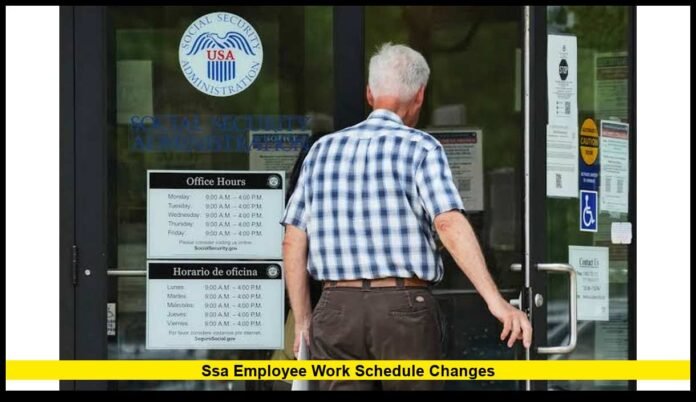

SSA employee work schedule changes remain an important issue for Social Security Administration employees as the agency prepares to end alternative work schedules beginning November 16, 2026. The announced policy would require employees who currently use compressed workweeks, including 4/10 and 5/4/9 schedules, to transition to a standard five-day workweek. The decision has also prompted a labor dispute, with the American Federation of Government Employees challenging the agency’s move. As of October 10, 2026, the central issue is how SSA will implement the change and whether the union’s grievance will affect the planned transition.
The policy could reshape the weekly routines of employees who currently rely on a scheduled weekday off. It also raises questions about staffing coverage, workplace agreements, employee morale, and the practical steps workers must take before the transition date.
SSA’s stated goal is to maintain more consistent staffing throughout the workweek. However, the announced policy and its potential operational effects are separate matters. Employees should focus on confirmed instructions and avoid treating unverified claims about future changes as established facts.
What Is the Latest SSA Work Schedule Update?
The Social Security Administration plans to discontinue alternative work schedules across the agency starting November 16, 2026. Under the announced arrangement, employees will move to a standard five-day workweek rather than completing their regular hours over fewer days.
The policy became a major workforce issue after SSA communicated its decision to employees in early October. The announcement identified compressed schedules as a concern because employees who take scheduled days off can leave their teams with fewer workers available on particular weekdays.
The transition date gives affected employees time to prepare for the change. Employees using compressed schedules should review internal instructions and confirm how management will assign their new working hours.
The central points of the announcement are:
- SSA plans to end alternative work schedules beginning November 16, 2026.
- Employees using 4/10 schedules will need to transition to a five-day workweek.
- Employees using 5/4/9 schedules will also be affected.
- Friday, November 13, is the final scheduled day for existing compressed arrangements under the announced transition.
- AFGE has challenged the decision through a national grievance.
These details describe the announced policy. They do not establish that every employee will work identical hours or that every individual employment arrangement will change in precisely the same way.
For employees, the most important immediate step is to confirm their individual schedule with their supervisor or human resources representative.
Which SSA Employee Work Schedules Will End?
The new policy targets alternative work schedules that allow employees to complete their regular weekly hours in fewer than five working days. Two common arrangements are central to the announcement: the 4/10 schedule and the 5/4/9 schedule.
Understanding these arrangements helps explain why the transition matters to affected workers.
How the 4/10 Schedule Works
A 4/10 schedule allows an employee to work four days per week, with 10 hours of work each day. An employee who completes four 10-hour days reaches 40 hours without working a fifth regular day.
This arrangement can give employees an additional weekday off while preserving their scheduled weekly hours. Some workers use that day for family responsibilities, appointments, or other personal commitments.
Under SSA’s announced policy, employees using this arrangement will need to move to a five-day workweek. They should not assume they can continue their existing four-day schedule after the transition date unless official instructions provide an applicable exception.
How the 5/4/9 Schedule Works
The 5/4/9 schedule distributes working hours differently across a two-week pay period. Employees generally work eight nine-hour days and one eight-hour day, receiving one scheduled day off during the cycle.
This arrangement provides a regular weekday off without reducing the employee’s scheduled hours across the pay period.
The announced SSA policy also covers this compressed schedule. Employees who depend on the arrangement will need to prepare for five-day weekly attendance under the new rules.
Comparison of the Existing and Planned Schedules
| Schedule | Typical arrangement | Announced direction |
|---|---|---|
| 4/10 | Four 10-hour workdays per week | Transition to five days |
| 5/4/9 | Eight nine-hour days and one eight-hour day across two weeks | Transition to five days |
| Standard workweek | Five working days each week | Becomes the required arrangement under the policy |
The distinction matters because the policy changes how employees distribute their work across the week. It does not, by itself, announce a change to the total number of scheduled weekly hours, employee pay rates, or Social Security benefit amounts.
Why Is SSA Ending Alternative Work Schedules?
SSA says it wants employees available throughout the regular workweek. Agency leadership has identified reduced staffing on certain weekdays as a concern associated with compressed schedules.
When employees have different scheduled days off, a team may have fewer workers available on a particular day. Managers must then organize assignments and maintain coverage with the employees who are present.
SSA’s decision reflects its preference for a more consistent five-day staffing pattern. The agency expects the change to help managers maintain employee availability across the workweek.
Several operational considerations explain the significance of that approach.
More consistent employee availability: A five-day structure gives managers a common weekly attendance pattern to work with. Employees can coordinate their assignments around a more consistent schedule.
Coordination between departments: SSA employees perform different duties across field offices, telephone operations, and administrative units. A shared five-day structure may make it easier to coordinate work that involves several teams.
Public service responsibilities: The agency handles Social Security applications, benefit questions, claims processing, and other administrative work. Staffing availability is one factor that can affect its ability to manage these responsibilities.
Workforce planning: Managers must assign duties, schedule meetings, and distribute workloads. A consistent attendance pattern may simplify some of these tasks.
These considerations explain the agency’s stated rationale. They do not prove that the change will automatically improve customer service, shorten processing times, or eliminate staffing problems.
Those outcomes will depend on how SSA implements the policy and how employees and managers adapt to the new arrangements.
When Will the New SSA Workweek Begin?
The announced transition date is Monday, November 16, 2026. Employees who currently use compressed schedules should prepare for the change before that date.
The timeline provides several important reference points.
- October 5, 2026: SSA communicates its decision to employees.
- October 6, 2026: Reporting brings wider attention to the planned policy change and the union’s response.
- November 13, 2026: Existing compressed schedules are scheduled to end under the announced transition.
- November 16, 2026: The standard five-day workweek is scheduled to begin.
Employees should use this timeline to prepare, but they should also follow any subsequent instructions from SSA management.
The transition date does not determine every employee’s daily start time, departure time, or local reporting arrangements. Supervisors and human resources representatives remain the appropriate contacts for those details.
Workers should also distinguish between the announced implementation plan and the unresolved labor dispute. A grievance may challenge a policy, but filing one does not automatically cancel the announced start date.
How Will the Changes Affect SSA Employees?
The practical effects will vary depending on an employee’s current schedule, job responsibilities, and personal circumstances.
For workers who have relied on a regular weekday off, the transition may require substantial planning. Their existing routines may depend on having that day available for appointments, childcare, transportation, or family commitments.
Employees who already work five days a week may experience fewer direct changes. However, they should still read any new instructions that apply to their unit.
Childcare and Family Responsibilities
Some employees organize childcare around a compressed workweek. Losing a regular weekday off may require changes to pickup arrangements, appointments, or other responsibilities.
Workers should review their schedules as soon as management provides confirmed details. Early planning can help them identify conflicts before the new arrangement begins.
Commuting and Transportation
Employees who currently travel to the workplace four days a week may need to account for an additional regular commute day. The effect will depend on travel distance, transportation options, and local circumstances.
This change may also affect employees who coordinate transportation with family members or share commuting arrangements with colleagues.
Daily Working Hours
A five-day schedule does not necessarily mean every employee will receive the same daily hours as another employee. Work requirements, approved schedules, and management instructions may determine individual reporting times.
Employees should obtain written confirmation of their assigned schedule rather than rely on assumptions based on a colleague’s arrangement.
Employee Morale and Retention
The removal of compressed schedules has also raised concerns about employee satisfaction. Workers who value alternative schedules may view the change as a loss of flexibility.
The effect on retention remains uncertain. It would be inaccurate to claim that the policy will necessarily cause employees to leave or that it will have no effect on morale.
The actual outcome will depend on employee responses and the broader workplace conditions surrounding implementation.
AFGE Challenges the SSA Work Schedule Policy
The American Federation of Government Employees has opposed SSA’s decision and filed a national grievance.
The union represents employees within the agency and argues that alternative work schedules have long been part of negotiated workplace arrangements. It has raised concerns about the relationship between the announced policy and existing labor agreement provisions.
AFGE’s position is that SSA should not eliminate these arrangements without addressing its contractual obligations. Union representatives have also questioned whether ending compressed schedules is necessary to resolve staffing concerns.
The dispute places workplace agreements at the center of the issue. Federal agencies must consider the rules that govern their relationships with bargaining-unit employees when making changes that affect working conditions.
However, the existence of a grievance does not establish that the agency has violated the law or that the union will prevail. Those questions depend on the applicable agreements, relevant procedures, and the outcome of the dispute.
Has AFGE Stopped the November 16 Deadline?
As of October 10, 2026, the available reported information does not confirm that SSA has withdrawn the announced policy or that a final decision has blocked implementation.
Employees should therefore avoid assuming that the grievance has automatically suspended the transition.
They should monitor official workplace communications and union updates for verified information about the dispute. Any change to the implementation date should be based on a confirmed announcement rather than an unverified online claim.
Does the Policy Also Change Telework Rules?
The alternative work schedule announcement concerns when employees work across the week. Telework and remote work concern where employees perform their duties.
These are separate workplace arrangements, and the distinction is important.
An employee may have a five-day workweek while also having a separate, approved arrangement governing the location of work. The compressed schedule policy alone does not answer every question about telework eligibility or remote work.
SSA previously addressed telework separately through its return-to-office policy. Employees should not treat that earlier policy as proof of additional changes beyond the current announcement.
Workers who have telework agreements, approved accommodations, or other individual arrangements should consult the relevant documentation and official agency guidance. They should ask human resources to clarify how the new scheduling rules interact with their circumstances.
The safest approach is to rely on the specific instructions that apply to each arrangement rather than assume one policy automatically cancels another.
What Should SSA Employees Do Before the Transition?
Employees can take several practical steps to prepare for the announced five-day workweek.
Review official communications. Read all relevant instructions from management and human resources. Confirm whether the policy applies to your current schedule.
Contact your supervisor. Ask for your new working days, daily hours, and reporting requirements. Do not assume the new schedule will match another employee’s hours.
Reorganize personal commitments. If you currently use a weekday off for childcare, transportation, or appointments, begin reviewing alternatives.
Consult your union representative. Bargaining-unit employees who have questions about the national grievance or their labor agreement should seek guidance from AFGE.
Clarify individual arrangements. If you have an approved accommodation or another formal scheduling agreement, request specific guidance through the appropriate agency process.
Keep written records. Save official communications that explain your assigned hours and any subsequent changes. Written instructions can help prevent misunderstandings during the transition.
These steps will not determine the outcome of the labor dispute, but they can help employees prepare for the announced policy while awaiting further information.
Could the Five-Day Workweek Improve Social Security Services?
SSA’s stated objective is to improve staffing availability throughout the week. The agency believes that ending compressed schedules will help employees remain available on days when some workers previously had scheduled days off.
That objective is understandable from a workforce planning perspective. Consistent staffing can help managers coordinate assignments and distribute work across the week.
However, the impact on public service remains to be demonstrated. Service performance depends on several factors, including staffing levels, workload, training, technology, and the distribution of employees across different functions.
AFGE has raised concerns that removing scheduling flexibility could affect employee morale and retention. If employees respond negatively, that could create additional workforce challenges. However, the outcome is not yet established.
The policy should therefore be evaluated on the basis of measurable results rather than assumptions. Future evidence about staffing coverage, employee retention, and service performance would help establish whether the change achieves its stated objectives.
What Remains Uncertain About the Policy?
Although SSA has announced its intention to end alternative work schedules, several practical and procedural questions remain important.
The outcome of the grievance: The available information does not establish a final resolution of AFGE’s challenge.
Individual reporting hours: The policy establishes a five-day workweek, but employees must obtain their specific daily schedules from management.
Individual employment arrangements: The announcement does not explain every possible interaction with accommodations or other approved workplace arrangements.
The effect on staffing and services: SSA expects more consistent staffing, but the actual operational results remain to be measured.
Further implementation instructions: Additional guidance may clarify how managers will apply the policy across different work units.
These distinctions are essential for employees seeking accurate information. An announced policy establishes the agency’s current plan, while implementation details and labor disputes may require further clarification.
Frequently Asked Questions
When do SSA employee work schedule changes begin?
The announced transition date is November 16, 2026. Existing compressed schedules are scheduled to end after November 13, subject to any subsequent official changes.
Which schedules will SSA discontinue?
The announcement covers alternative work schedules, including the 4/10 arrangement and the 5/4/9 compressed schedule.
Why is SSA ending compressed schedules?
SSA says the arrangements can leave offices with fewer employees available on certain weekdays. The agency wants more consistent staffing throughout the five-day workweek.
Has AFGE challenged the decision?
Yes. AFGE has filed a national grievance and argues that the decision conflicts with provisions governing negotiated working conditions.
Will every employee have the same daily hours?
Not necessarily. A standard five-day workweek does not establish identical start and finish times for every position. Employees should confirm their individual schedules with management.
Does the policy automatically end telework?
The announcement focuses on alternative work schedules. Employees should consult separate telework agreements and official guidance for information about their work location.
Will the schedule change affect Social Security benefits?
The policy concerns SSA employee working arrangements. It does not announce a change to retirement benefits, Social Security Disability Insurance, or Supplemental Security Income payment amounts.
Can employees continue using their existing compressed schedules after November 13?
The announced policy schedules the transition to a five-day workweek for November 16. Employees should follow official instructions and check for any confirmed changes before relying on an exception.
Final Update on SSA Employee Work Schedule Changes
The Social Security Administration plans to end alternative work schedules beginning November 16, 2026, moving affected employees toward a standard five-day workweek. The change directly affects workers who currently use compressed arrangements such as 4/10 and 5/4/9 schedules.
SSA says the decision will support more consistent staffing throughout the week. AFGE has challenged the policy through a national grievance, raising concerns about negotiated workplace agreements and the consequences for employees. As of October 10, the available information does not confirm a reversal of the announced plan or a final resolution of the dispute.
Employees should prepare for the scheduled transition, confirm their individual working hours, and rely on official updates for any changes to the implementation plan.
What is your view on SSA’s planned five-day workweek? Share your thoughts in the comments and keep following verified updates as the policy develops.