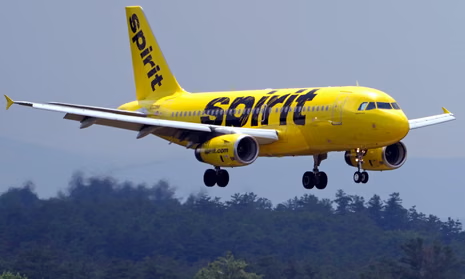

Travelers checking fares for summer trips got a jolt this week when news broke about fresh pressure on one of the country’s biggest budget carriers. The latest twist in Spirit Airlines’ long-running financial drama centers on whether the airline can push through its restructuring or face a more drastic outcome.
Spirit Airlines continues to operate flights across the United States, the Caribbean, and Latin America while its parent company, Spirit Aviation Holdings, works through Chapter 11 bankruptcy proceedings that began in August 2025. This marks the second time in under a year the carrier has sought court protection to reorganize its debts.
Have Spirit’s recent route cuts or fare changes affected your travel plans? Drop your experiences in the comments below and let fellow readers know what you’ve seen firsthand.
The situation escalated rapidly in recent days. Surging jet fuel prices, driven by geopolitical tensions including the U.S. involvement in the Middle East and disruptions around the Strait of Hormuz, have squeezed the airline’s slim margins at a critical moment. Reports indicate the carrier now faces a heightened risk of liquidation, with any decision potentially coming as soon as this week. Talks with creditors remain active, and the airline has not halted operations.
Background on Spirit’s Repeated Bankruptcy Filings
Spirit Airlines built its reputation as an ultra-low-cost leader by packing planes with passengers willing to pay extra for bags, seats, and snacks. That model delivered strong growth for years, making it a major player in leisure-heavy markets like Florida, Las Vegas, and Orlando. But external shocks exposed its vulnerabilities.
The first major blow came when federal regulators blocked a proposed merger with JetBlue in early 2024. Without that combination, Spirit lacked the scale and financial cushion to weather rising costs and softer demand for leisure travel. The carrier filed for Chapter 11 protection in November 2024, completed a quick restructuring, and emerged in March 2025 with less debt and fresh financing.
Yet losses mounted again. By August 2025, Spirit filed for bankruptcy a second time, citing dwindling cash reserves and ongoing operational challenges. Management moved fast to cut unprofitable routes, furlough staff, and reject leases on dozens of aircraft. The goal was simple: shrink to a sustainable size and stop burning cash.
Restructuring Plan Designed to Create a Leaner Carrier
Under the February 2026 agreement with key lenders and noteholders, Spirit outlined a clear path forward. Debt and lease obligations would drop dramatically from roughly $7.4 billion before the latest filing to about $2 billion post-emergence. The fleet would shrink to between 76 and 80 aircraft by the third quarter of 2026—roughly one-third of its pre-bankruptcy size.
Executives planned to focus on high-performing routes, improve aircraft utilization, and maintain the core low-fare appeal while adding some premium options. The company filed a formal restructuring support agreement and plan of reorganization on March 13, 2026, with court approval targeted for late spring or early summer.
These steps represented a serious attempt to preserve jobs, honor existing tickets, and keep the airline flying as an independent carrier. Spirit even recalled some furloughed pilots and flight attendants and sold off planes to generate cash. The strategy aimed to position the airline as a nimbler competitor in a market dominated by larger legacy carriers and other low-cost players.
Fuel Price Surge Creates New Headwinds
Jet fuel costs have spiked sharply in recent weeks. Global supply disruptions tied to conflict in the Middle East have driven prices higher across the board, hitting budget carriers especially hard. Spirit’s business model depends on filling seats at rock-bottom fares, leaving little room to absorb sudden cost increases without raising prices or cutting capacity further.
Management had already flagged fuel volatility as a key risk in court filings. Now, those concerns have moved from theoretical to immediate. The airline continues to fly its current schedule, but the added financial strain has forced fresh discussions with creditors about the viability of the existing exit plan.
Unique Explanation: Chapter 11 Versus Liquidation in the Airline World
It helps to understand the two paths available in bankruptcy court. Chapter 11 gives a company breathing room to reorganize—negotiate with creditors, reject expensive leases, and keep operating while it fixes its balance sheet. Passengers can still book and fly, employees stay on payroll, and the brand lives on.
Liquidation, by contrast, typically shifts to Chapter 7. Assets get sold off piece by piece—planes, gates, spare parts, even the brand name. Operations stop abruptly. Ticket holders may face refunds or rebooking on other carriers, but the process often leaves travelers scrambling. Employees lose jobs quickly, and communities served by the airline lose service overnight.
Spirit has fought to stay in Chapter 11 territory precisely because liquidation would erase years of investment and disrupt millions of travelers who rely on its affordable fares to visit family, take beach vacations, or reach secondary cities. The current talks center on whether the numbers still add up under today’s higher fuel environment or whether creditors see greater value in an orderly wind-down.
Real-World Example: How Competitors Prepare for Sudden Airline Exits
When smaller carriers have faced shutdowns in the past, larger airlines quickly adjust schedules and offer rescue fares to stranded passengers. During previous periods of industry stress, competitors have added flights to popular Spirit routes in Florida and the Caribbean, sometimes at discounted rates to capture displaced customers. This pattern shows how the market can absorb capacity loss—but it also highlights the risk of higher average fares once aggressive low-cost pressure eases.
Spirit’s heavy presence in leisure markets means any sudden reduction in service would ripple through airports like Fort Lauderdale, Orlando, and Tampa. Travelers who book months in advance could see last-minute changes or need to switch carriers, potentially paying more for the same trip.
Deep Analysis: Why Ultra-Low-Cost Carriers Face Unique Pressures
The ultra-low-cost model pioneered by Spirit thrives when fuel stays cheap and demand stays high. Remove either factor and the math turns ugly fast. Fixed costs like aircraft leases and crew salaries remain high even when planes fly half-empty. Variable costs like fuel swing wildly with global events.
Spirit’s repeated bankruptcies illustrate a broader truth about the U.S. airline industry: consolidation and scale increasingly favor bigger players. Legacy carriers enjoy diversified revenue streams, hedging programs for fuel, and stronger balance sheets. Other low-cost rivals have also grown through mergers or careful expansion. Spirit, by staying independent and ultra-focused on the lowest fares, bet big on volume over margin. That bet worked until external shocks piled up.
Geopolitical events now compound the challenge. The current fuel spike is not just a line item—it directly threatens the thin profitability needed to support the restructured operation. Creditors weighing liquidation versus continued support must balance short-term pain against long-term recovery potential in a volatile energy market.
Impact on Passengers, Employees, and the Broader Travel Industry
For passengers, the immediate effect remains minimal because Spirit keeps flying. Booked tickets stay valid, and the airline continues to honor its schedule. Yet uncertainty creates anxiety. Families planning summer travel wonder whether fares will rise or routes will vanish. Business travelers who use Spirit for quick, cheap connections face similar questions.
Employees have already weathered multiple rounds of furloughs and recalls. A successful restructuring could stabilize jobs at a smaller scale. Liquidation would bring rapid layoffs and uncertainty for thousands of workers in Dania Beach headquarters and across the network.
On the industry side, the loss of Spirit’s capacity would tighten supply in key leisure markets. Analysts have long warned that reduced competition from ultra-low-cost carriers tends to push fares upward across the board. Routes that Spirit pioneered—smaller cities to warm-weather destinations—could see service gaps filled by higher-priced options.
What This Means for the Future of Budget Air Travel
Spirit’s story reflects larger forces reshaping American aviation. Post-pandemic recovery brought strong leisure demand but also inflation in labor, fuel, and maintenance. Regulatory decisions on mergers have limited consolidation options for struggling players. Meanwhile, global events continue to inject volatility into energy markets.
The carrier’s attempt to right-size through bankruptcy shows resilience. Management has demonstrated willingness to make tough calls—selling planes, trimming the network, and seeking creditor support. Whether those efforts succeed under current fuel conditions will play out in the coming days.
Travelers who value affordable options hope for a positive resolution that keeps Spirit in the skies. The airline’s yellow planes have democratized air travel for millions, connecting people who might otherwise drive or skip trips altogether.
Spirit Airlines Liquidation remains a phrase no one in the industry wants to hear become reality, yet the current fuel-driven pressures have brought it back into focus. The coming week could prove decisive as the company and its creditors weigh the numbers one more time.
What’s your take on how budget airlines are navigating these fuel and economic challenges? Share your thoughts in the comments and stay tuned for the latest developments.