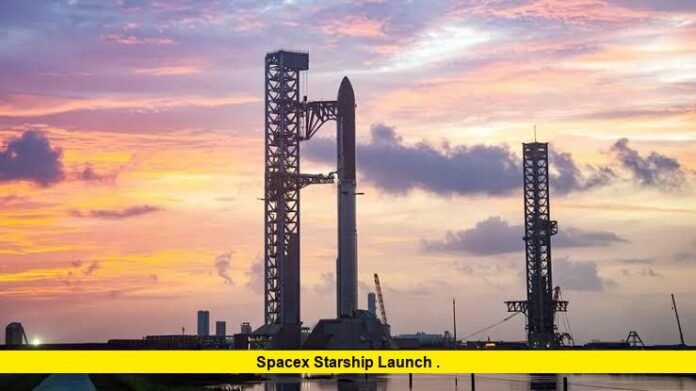

The spacex starship launch is scheduled for September 28, 2026, as SpaceX prepares to send Starship into orbit for the first time and deploy 26 next-generation Starlink V3 satellites. The launch is planned from SpaceX’s Starbase facility in South Texas during a 75-minute window beginning at 8:15 a.m. EDT, or 7:15 a.m. CDT. The Federal Aviation Administration has authorized the Flight 14 launch and reentry operations.
The mission, designated Starship Flight 14 and also identified as Starlink Group 31-1, represents a major change from the first 13 integrated Starship-Super Heavy flights. Those missions followed suborbital trajectories. Flight 14 is designed to attempt orbital insertion, operate in space for several hours and deploy functional Starlink V3 spacecraft.
SpaceX Starship Launch Schedule and Current Status
SpaceX has set the launch window for Monday, September 28. The 75-minute window is scheduled to open at 8:15 a.m. EDT and close at 9:30 a.m. EDT.
For viewers across the United States, the planned window is:
- Eastern Time: 8:15–9:30 a.m. EDT
- Central Time: 7:15–8:30 a.m. CDT
- Mountain Time: 6:15–7:30 a.m. MDT
- Pacific Time: 5:15–6:30 a.m. PDT
The rocket is standing at Pad 2 at Starbase, Texas. The vehicle consists of Super Heavy booster B21 and Starship upper stage S41. SpaceX does not plan to recover either stage during this mission.
The FAA issued its Flight 14 authorization on September 26, clearing the mission for launch and reentry operations. That approval removed a major regulatory requirement that had remained in the way of the orbital attempt.
What Makes Flight 14 Different
Flight 14 is the 14th integrated launch of Starship and Super Heavy, but it is the first mission designed to actually reach orbit.
SpaceX has used earlier flights to test increasingly advanced versions of the vehicle. The company has now reached the point where Starship will attempt to transition from a suborbital test program into an orbital launch system.
The rocket stands approximately 407 feet tall, making Starship-Super Heavy one of the largest launch vehicles ever developed. The Flight 14 mission will test not only the rocket’s ascent but also its ability to restart an engine in space, achieve orbit, deploy satellites and perform a controlled return.
SpaceX will monitor the vehicle during its initial flight and coast phase. If Starship remains healthy, the upper stage is expected to perform an orbital insertion burn roughly 25 minutes after liftoff.
26 Starlink V3 Satellites Are Riding on Starship
One of the biggest objectives of Flight 14 is the deployment of 26 Starlink V3 satellites.
The satellites represent the next generation of SpaceX’s Starlink hardware. Rather than carrying another conventional Starlink batch on Falcon 9, SpaceX is using Starship to demonstrate the larger launch capacity available from its next-generation rocket.
SpaceX previously flew 20 V3 Starlink satellites during Flight 13. Those spacecraft were used for testing and did not enter permanent operational orbit. The Flight 14 satellites are intended for orbital deployment and integration into the Starlink network.
The 26 satellites will not all be released simultaneously. Spaceflight Now reports that the deployment sequence is expected to last about 30 minutes, with the spacecraft released at roughly one-minute intervals.
Three of the satellites also carry imaging capabilities designed to capture views of Starship’s heat-shield tiles during the mission.
That additional hardware gives SpaceX another way to collect information about the spacecraft while it is operating in orbit.
How the Starship Flight 14 Mission Will Work
The mission begins with the ignition of Super Heavy’s engines and liftoff from Starbase.
After the booster completes its portion of the ascent, Starship will separate and continue toward space using its own engines. The vehicle will initially follow a trajectory similar to previous Starship flights.
The critical difference comes later.
If the vehicle and its systems are performing properly, Starship will ignite one of its sea-level Raptor engines to change its trajectory and enter orbit. SpaceX plans an orbital insertion burn roughly 25 minutes after liftoff.
Once in orbit, Starship is planned to circle Earth approximately six times. The mission profile calls for an orbital altitude of about 171 miles.
The Starlink deployment follows the orbital insertion. Spaceflight Now reports that the 26 satellites are expected to begin deployment roughly 34 minutes after liftoff, with the sequence continuing for approximately half an hour.
After completing its orbital objectives, Starship will perform a deorbit maneuver. The spacecraft is then expected to reenter the atmosphere and make a controlled splashdown in the Pacific Ocean west of South America.
Why Starship Will Not Be Caught on Flight 14
SpaceX has demonstrated considerable progress with Starship’s launch and landing systems, but Flight 14 has a different priority.
The company will not attempt to catch either the Super Heavy booster or Starship with the launch tower during this mission. Both stages are planned to end their flights in the ocean.
That approach allows SpaceX to concentrate on the orbital portion of the mission.
The upper stage is expected to spend several hours collecting flight data before its planned reentry. The mission is expected to last close to 10 hours from liftoff through splashdown.
The decision also separates Flight 14 from the recovery demonstrations that have been central to earlier Starship testing.
SpaceX has indicated that future missions will continue advancing recovery capabilities. The results from Flight 14 will provide additional information before the company attempts more ambitious recovery operations.
Starship Flight 13 Set the Stage
The upcoming mission follows Starship’s 13th flight test on July 24, 2026.
Flight 13 was significant because it involved the Starship and Super Heavy V3 vehicles and included the first flight test involving the next-generation Starlink V3 satellites. SpaceX reported that the mission successfully completed its major ascent sequence before the vehicle ultimately ended its flight in the Indian Ocean.
The experience from that flight has informed preparations for Flight 14.
For the new mission, SpaceX is moving beyond a demonstration of satellite deployment in a suborbital environment. The objective now is to place Starship into orbit and release operational satellites.
Starship’s Orbital Insertion Is a Key Test
Reaching orbit is the central technical milestone for Flight 14.
Previous Starship flights were intentionally placed on trajectories that did not require orbital insertion. Flight 14 changes that profile.
The vehicle must first complete its ascent and stage separation. It then needs to maintain the necessary conditions during the coast phase before restarting an engine to alter its trajectory.
SpaceX’s mission plan calls for an orbital insertion burn lasting about 19 seconds. If successful, the maneuver would place Starship into an orbit around Earth.
That sequence creates several important test points in a single flight.
Engine performance, guidance, thermal protection, communications, payload deployment and orbital operations will all be evaluated during the mission.
Starship’s Heat Shield Will Also Be Closely Monitored
The heat shield is another important focus of the mission.
Starship must withstand the intense thermal environment created during atmospheric reentry. Flight 14 will give SpaceX an extended opportunity to observe the spacecraft and evaluate its thermal protection system.
Three Starlink V3 satellites are equipped with additional imaging capabilities intended to provide views of Starship’s heat-shield tiles.
Those observations could give engineers useful information before the spacecraft begins future recovery attempts. The mission therefore combines an orbital launch demonstration with additional testing of Starship’s ability to survive the conditions associated with returning from space.
What Happens to the Starlink V3 Satellites After Deployment
The 26 Starlink V3 spacecraft are intended to become part of SpaceX’s broadband satellite network after deployment.
Their release marks an important transition for the Starlink program because SpaceX is beginning to use its next-generation Starship system to launch larger batches of next-generation satellites.
The first Flight 14 batch is intentionally limited to 26 spacecraft. SpaceX has indicated that future Starship missions could carry substantially more V3 satellites. Spaceflight Now reports that the company has previously discussed the possibility of carrying as many as 60 V3 satellites on future missions.
This difference highlights one of the reasons SpaceX is developing Starship for Starlink. A larger launch vehicle can potentially place more capable satellites into orbit in a single mission.
What U.S. Viewers Should Know About the Launch
For viewers in the United States, the launch is currently scheduled for the morning of September 28.
The primary window begins at 8:15 a.m. EDT. Because launch operations can change during countdown activities, viewers should check SpaceX’s live mission coverage for the latest countdown status.
The official launch target is a window rather than a guaranteed second-by-second liftoff time. Weather, technical checks and other operational considerations can affect the timing.
The mission’s importance also means that the launch will be closely watched by the commercial space industry. A successful orbital attempt would provide SpaceX with critical flight data for future Starship missions.
SpaceX Starship Launch: Key Mission Facts
| Mission detail | Current information |
|---|---|
| Mission | Starship Flight 14 |
| Alternate mission name | Starlink Group 31-1 |
| Launch date | September 28, 2026 |
| Launch site | Starbase, Texas |
| Launch pad | Pad 2 |
| Launch vehicle | Starship-Super Heavy |
| Booster | Super Heavy B21 |
| Upper stage | Ship 41 |
| Payload | 26 Starlink V3 satellites |
| Launch window | 8:15–9:30 a.m. EDT |
| Planned orbit | About 171 miles |
| Planned orbital duration | About six Earth orbits |
| Recovery plan | Ocean splashdowns |
| Mission duration | About 10 hours |
What Comes Next After Flight 14
Flight 14 is designed to provide SpaceX with data for the next phase of Starship development.
A successful mission would give engineers information about orbital operations, satellite deployment, vehicle performance and reentry. Even if individual objectives are not completed, the flight is structured to gather information across multiple phases.
The results will also influence the preparation of subsequent Starship flights.
For now, the immediate focus remains on Flight 14 and its attempt to place Starship into orbit for the first time.
The combination of a first orbital attempt and the first operational deployment of Starlink V3 satellites makes the September 28 mission one of the most significant Starship tests to date.
The next major milestone is now just hours away, with Starship preparing to attempt orbit and deploy its first operational V3 Starlink satellites—share your thoughts and stay tuned for the latest launch developments.