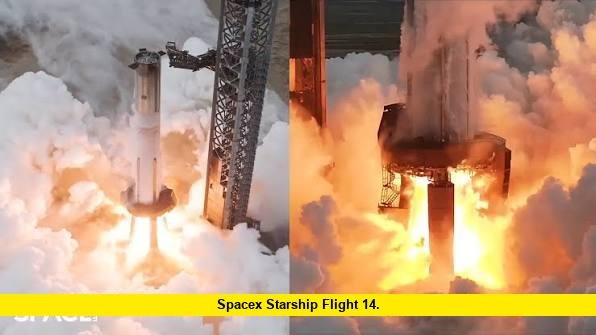

SpaceX Starship Flight 14 is moving closer to launch after the company completed major engine testing on both vehicles assigned to the mission, including a full-duration static fire of Booster 21 on August 28, 2026.
The upcoming mission will use Booster 21 as the Super Heavy first stage and Ship 41 as the upper-stage spacecraft. Both vehicles are part of SpaceX’s Starship V3 development effort. The latest testing marks an important step toward the next integrated flight test from Starbase, Texas.
SpaceX has not announced an official launch date or launch time for Flight 14. Current launch tracking information places the mission in September 2026, but the exact date remains subject to change.
Latest Starship Flight 14 Status
The most important developments in the Flight 14 campaign are now centered on the two flight vehicles and their prelaunch testing.
- Booster: Booster 21
- Ship: Ship 41
- Launch site: Starbase, Texas
- Launch pad: Orbital Launch Pad 2
- Vehicle generation: Starship V3
- Launch timing: No official date or time announced by SpaceX
- Current target: September 2026 based on current launch trackers
- Mission status: Prelaunch testing and preparations
SpaceX completed Ship 41’s major static-fire campaign before moving attention to Booster 21. On August 21, the company confirmed that Ship 41 completed a full-duration, 60-second static fire using all six of its Raptor engines.
The next major step came on August 28. SpaceX reported that Booster 21 completed a full-duration static fire with all 33 engines. That test involved the massive Super Heavy first stage that will power the beginning of Flight 14.
Booster 21 Completes Full-Duration Static Fire
Booster 21’s latest test is one of the clearest signs that Flight 14 preparations have entered an advanced stage.
SpaceX conducted the full-duration static fire on August 28 at Starbase. The company described it as a 33-engine static fire for the Super Heavy booster preparing for Flight 14.
During a static fire, the rocket remains secured to the ground while its engines ignite. Engineers can then evaluate the propulsion system and associated hardware without sending the vehicle into flight.
For Booster 21, firing all 33 engines provides a major opportunity to evaluate the complete first-stage propulsion system before an actual launch.
The successful test followed Booster 21’s move to the launch pad earlier in the week. SpaceX had already completed preparations that included installing the booster’s Raptor engines and conducting earlier vehicle testing.
The August 28 test therefore represents a significant transition from vehicle preparation to launch-campaign operations.
Ship 41 Also Completed Its Major Engine Test
The upper stage for Flight 14, Ship 41, has also passed an important preflight milestone.
SpaceX confirmed on August 21 that Ship 41 completed a full-duration, 60-second static fire with all six Raptor engines. The company specifically identified the spacecraft as the Starship being prepared for its fourteenth flight test.
Ship 41 had also undergone an earlier single-engine test associated with its planned flight operations. Those tests allowed engineers to evaluate the spacecraft’s propulsion system before the larger six-engine firing.
The six-engine static fire was especially significant because it tested Ship 41’s complete Raptor propulsion configuration while the spacecraft remained on the ground.
With Ship 41’s major static-fire work completed and Booster 21 now having completed its own full-duration test, both primary flight vehicles have moved through important propulsion milestones.
Why the Two Static Fires Matter
A Starship mission depends on the performance of both stages.
The Super Heavy booster must generate the thrust required to lift the enormous vehicle away from Starbase. After separation, the Ship upper stage must continue the mission independently.
Testing the stages separately gives SpaceX the opportunity to examine their propulsion systems before combining them into a complete flight vehicle.
For Flight 14, the testing sequence has therefore provided several key checkpoints:
- Ship 41 completed its single-engine propulsion test.
- Ship 41 completed a 60-second, six-engine static fire.
- Booster 21 moved to the launch pad.
- Booster 21 completed its full-duration, 33-engine static fire.
- The campaign can now progress toward final launch preparations and vehicle integration.
These steps do not guarantee a launch date. SpaceX still needs to review test data and complete the remaining preparations required for an actual flight.
Flight 14 Is Expected to Be Starship’s First Orbital Mission
One of the biggest reasons Flight 14 is attracting attention is the planned mission profile.
Current launch-tracking information identifies Flight 14 as the expected first orbital flight of Starship. The mission will use the V3 configuration and is listed as the third flight of the V3 development hardware.
That makes the mission different from the earlier Starship test flights.
The previous flight campaign provided SpaceX with valuable information about propulsion, flight control, atmospheric reentry and vehicle survival. Flight 14 is intended to push the system into a more demanding mission profile.
However, the exact orbital objectives and final flight plan remain subject to official mission updates.
Current launch trackers list Flight 14 for September 2026, but SpaceX has not publicly confirmed a specific launch day or launch time.
That distinction is important because Starship test schedules can change as engineers analyze test results and complete regulatory and operational preparations.
The Flight 13 Results Are Important to Flight 14
The development of Flight 14 follows the results of Flight 13, which produced a major milestone for Starship.
Flight 13 launched on July 24, 2026, and its Ship 40 upper stage survived atmospheric reentry and splashed down intact in the Indian Ocean near Christmas Island. That represented a significant change from earlier Starship tests in which the upper stages did not survive the complete mission sequence.
SpaceX later sent engineers to inspect Ship 40 in the water.
The team collected heat-shield samples and examined the spacecraft after its reentry. SpaceX said the inspection provided information about how the vehicle handled reentry and would help guide improvements on future vehicles.
Ship 40 was subsequently loaded onto a large transport vessel for its journey back toward Texas.
Those activities matter to Flight 14 because SpaceX can use the information from the previous flight when preparing the next Starship vehicles.
Ship 41 and Booster 21 Form the Flight 14 Pair
The hardware assigned to the mission is now clearly identified.
Booster 21 will serve as the first stage. It is designed to provide the initial thrust needed to launch the Starship stack from Starbase.
Ship 41 will serve as the upper stage. It contains six Raptor engines and is the spacecraft that will continue into the mission after separation from the Super Heavy booster.
Both vehicles belong to SpaceX’s V3 Starship development configuration.
Current launch databases identify the pair as the hardware assigned to Flight 14.
The completion of their individual static fires is therefore an important step toward assembling and preparing the complete launch vehicle.
No Official Flight 14 Launch Date Yet
Despite the rapid pace of recent testing, there is still no officially announced SpaceX launch date for Flight 14.
Several launch-tracking services currently place the mission in September. One current tracker lists Flight 14 as NET September 2026, meaning no earlier than September.
Other tracking information has pointed to a later September target, but those dates should not be treated as confirmed SpaceX launch commitments.
The difference between a projected date and an official launch date is particularly important for a developmental test program.
SpaceX may need additional time for:
- Post-test data analysis
- Vehicle inspections
- Final integration
- Ground-system preparations
- Regulatory and range coordination
- Weather assessment
- Final launch readiness reviews
Until SpaceX announces a specific date and time, September should be treated as the current expected timeframe rather than a guaranteed launch schedule.
What Happens Before the Launch
The next phase will focus on bringing the two tested vehicles together and completing the final preparations for flight.
The Starship stack must be assembled at the launch site before engineers can conduct final checks of the complete vehicle.
Launch preparations also involve the ground infrastructure surrounding Orbital Launch Pad 2. Propellant systems, communications equipment, flight computers, range coordination and other launch-support systems must all be ready before liftoff.
The completion of Booster 21’s full-duration static fire removes one major testing milestone from the immediate campaign.
Ship 41’s successful six-engine static fire similarly provides SpaceX with a completed propulsion test on the upper stage.
The remaining work will determine how quickly SpaceX can progress toward an integrated flight attempt.
What Makes Flight 14 Significant
Flight 14 represents a major test for the next stage of Starship development.
The mission is expected to be the first orbital flight attempt for the Starship system. That means SpaceX will be testing the vehicle under conditions that extend beyond the earlier suborbital flight profiles.
The mission will also provide another opportunity to evaluate the V3 hardware after the lessons gathered from previous flights.
For SpaceX, the objective is not simply to launch another rocket. The broader development effort depends on repeatedly testing the vehicle, analyzing the results and applying those lessons to later hardware.
The successful survival of Ship 40 during Flight 13 gave engineers new data on reentry and the heat shield. Flight 14 can build on that experience while testing a newer vehicle combination.
Current Flight 14 Checklist
As of August 30, the campaign can be summarized simply:
| Milestone | Current status |
|---|---|
| Ship 41 identified for Flight 14 | Completed |
| Booster 21 identified for Flight 14 | Completed |
| Ship 41 propulsion testing | Major static-fire testing completed |
| Ship 41 six-engine static fire | Completed |
| Booster 21 launch-pad campaign | Completed/underway |
| Booster 21 33-engine static fire | Completed |
| Full vehicle stack | Final preparations pending |
| Official launch date | Not announced |
| Current expected timeframe | September 2026 |
| Launch location | Starbase, Texas |
The table reflects the latest publicly available information rather than an official SpaceX launch schedule. Current tracking services continue to show the mission as a September flight.
What to Watch Next
The most important developments will now come from the final stages of the prelaunch campaign.
A confirmed stacking operation would be a major visual milestone because it would show Booster 21 and Ship 41 being brought together as the complete Flight 14 vehicle.
Another key development will be the publication of an official launch date and time.
SpaceX will also need to complete the final operational and regulatory steps before attempting the mission.
For now, the successful static fire of Booster 21 is the newest major propulsion milestone. Combined with Ship 41’s earlier six-engine test, it leaves the Flight 14 hardware substantially farther along than it was just a few weeks ago.
The mission nevertheless remains a developmental test flight. Until SpaceX formally announces the launch schedule, reports of specific launch dates should be treated as targets rather than confirmed commitments.
Bottom Line
SpaceX has made clear progress toward its next major Starship test. Ship 41 has completed a full-duration six-engine static fire, while Booster 21 has now completed a full-duration 33-engine static fire at Starbase.
The two vehicles are the hardware designated for Flight 14, which current tracking sources expect to take place in September 2026. SpaceX, however, has not yet published a definitive launch date or time.
The next major milestone will be the transition from individual vehicle testing to final integrated launch preparations. If those operations proceed successfully, Flight 14 will move closer to becoming Starship’s first orbital test mission.
Stay tuned for the next confirmed Starship update as SpaceX moves Flight 14 toward its launch attempt.