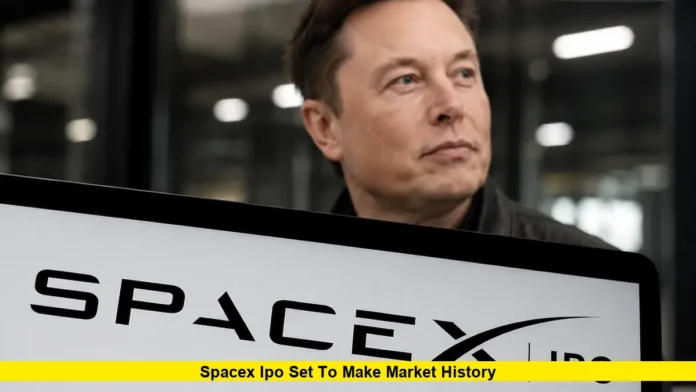

The financial world is holding its breath. Elon Musk’s Space Exploration Technologies Corp. — better known as SpaceX — is days away from what could be the most consequential stock market debut in history. With a target valuation of $1.75 trillion and investor demand already blowing past expectations, the SpaceX IPO is no longer just a headline — it is a generational market event.
What Is the SpaceX IPO and Why Does It Matter?
SpaceX, founded by Elon Musk in 2002, is the world’s leading private aerospace and satellite communications company. For years, it remained firmly private, resisting the pull of public markets. That era is ending. On June 8, 2026, SpaceX officially announced plans to list on the Nasdaq under the ticker symbol SPCX, with share pricing expected after market close on June 11 and the first trading day targeted for June 12, 2026.
This is not just another tech IPO. If SpaceX lists at its target valuation, it will surpass Saudi Aramco’s $29 billion raise in 2019 to become the largest initial public offering in the history of global financial markets. At a $1.75 trillion valuation, SpaceX would also become the most valuable company ever to go public on a U.S. exchange — exceeding the market cap of most existing publicly traded giants.
SpaceX IPO: The Key Numbers You Need to Know
Understanding the scale of this offering starts with the headline figures:
- IPO Share Price: $135 per share
- Shares Offered: Approximately 555.6 – 556.6 million shares
- Target Raise: $75 billion
- Target Valuation: $1.75 trillion
- Stock Exchange: Nasdaq
- Ticker Symbol: SPCX
- Expected Listing Date: June 12, 2026
- Investor Demand Reported: $150 billion — double the initial $75 billion target
The sheer magnitude of investor appetite tells the story. As of June 7, 2026, demand for SpaceX shares had reached a staggering $150 billion, representing more than double what the company initially aimed to raise, signaling one of the most enthusiastic pre-IPO responses Wall Street has ever recorded.
SpaceX’s Three Business Segments Explained
One reason this IPO is so complex — and so compelling — is that SpaceX is not a single-line business. After its landmark acquisition of xAI earlier this year, SpaceX now operates across three distinct reporting segments:
Space (Rockets and Launch Services)
The Space segment encompasses SpaceX’s flagship Falcon 9 rocket, the Falcon Heavy, Dragon spacecraft missions for NASA, and the next-generation Starship system. In 2025, this segment generated $4 billion in revenue. However, it also carried a $657 million operating loss, largely driven by the $3 billion invested in Starship research and development — the company’s bet on its next frontier.
SpaceX completed 134 launches in 2024, more than all other launch providers worldwide combined. No competitor — including United Launch Alliance, Blue Origin, or Rocket Lab — comes close to matching this launch cadence.
Connectivity (Starlink Satellite Internet)
Starlink is the engine powering SpaceX’s valuation story. The satellite internet network reached 10.3 million subscribers in Q1 2026, having grown from 5 million in Q1 2025 — a subscriber base that more than doubled in a single year. The constellation currently operates approximately 7,000 satellites in low-Earth orbit, making it the largest satellite network in history.
In 2025, the Connectivity segment generated $11.4 billion in revenue — roughly 61% of the company’s total — and remains the only profitable segment, posting $4.4 billion in operating profit. Starlink revenue is projected to reach between $15.9 billion and $24 billion in 2026, with military applications through the Starshield program representing a fast-growing revenue line.
AI (xAI, Grok, X, and Space-Based Computing)
In February 2026, SpaceX completed an all-stock acquisition of Elon Musk’s artificial intelligence company xAI in a deal that valued the combined entity at $1.25 trillion. The AI segment now includes the Grok large language model, the social media platform X (formerly Twitter), and a rapidly expanding AI data center infrastructure.
The Colossus 1 data center secured a landmark deal with Anthropic worth $1.25 billion per month through May 2029 — a contract worth approximately $40 billion over its life. In its S-1 filing, SpaceX revealed ambitions to deploy orbital AI compute satellites as early as 2028, which would link space-based computing power directly to Starlink’s global connectivity network.
The AI segment generated $3.2 billion in revenue, but it currently burns an estimated $1 billion per month on compute infrastructure — a fact that has contributed to the company’s net losses.
SpaceX’s Financial Picture: Growth Meets Losses
The IPO filing reveals a company at a fascinating financial crossroads. In 2024, SpaceX was profitable with a $791 million net income. However, the xAI merger in early 2026 dramatically changed the income statement. In 2025, after integrating xAI, the company posted a $4.94 billion net loss. In Q1 2026 alone, the net loss was $4.28 billion.
Total 2025 revenue for the combined company exceeded $18.5 billion, while the company’s total long-term debt as of March 31, 2026 stood at $29.1 billion.
It is important to understand the strategic logic here. The losses are largely deliberate — each segment funds the next frontier. Starlink’s profitability subsidizes Starship development. xAI’s burn rate is framed as the cost of building the infrastructure for space-based AI. Whether investors accept this narrative at $1.75 trillion is the central question hanging over the IPO.
Morningstar analysts have publicly warned that SpaceX is “significantly overvalued” at the IPO target, suggesting the stock may trade down post-listing and offer better entry points later. Meanwhile, GF Score data assigns the company an 88/100, suggesting strong long-term return potential for patient investors.
The Retail Investor Revolution: 30% Allocation Is Unprecedented
One of the most unusual aspects of this IPO is SpaceX’s apparent commitment to retail investors. In most large public offerings, individual investors receive just 5% to 10% of share allocations, with the bulk going to institutional funds and hedge funds. SpaceX is reportedly planning to allocate up to 30% of IPO shares to retail investors — at least three times the industry norm.
In a further sign of its commitment to individual investors, SpaceX plans to host a dedicated retail investor event on June 11 — the day shares are priced — inviting 1,500 individual investors, including participants from the U.S., U.K., EU, Australia, Canada, Japan, and South Korea. This kind of global retail-facing event is essentially unprecedented for a deal of this magnitude.
How the Roadshow Unfolded Faster Than Expected
The path to the June 12 listing accelerated significantly. SpaceX confidentially filed its IPO paperwork with the U.S. Securities and Exchange Commission (SEC) in April 2026. The formal roadshow launched on June 4, 2026 — ahead of the originally anticipated week-of-June-8 start — driven by a faster-than-expected SEC review.
Investor response during the roadshow has been described as exceptional. With demand reaching $150 billion against a $75 billion raise target, underwriters are dealing with a massively oversubscribed book — a situation that typically supports strong first-day trading performance, though it also raises questions about pricing discipline.
Elon Musk’s Historic Dual Trillion-Dollar Company Moment
When SpaceX lists, Elon Musk will achieve something no CEO has done before: he will simultaneously helm two separate trillion-dollar publicly traded companies. Tesla (TSLA) is the other. Musk owns approximately 42% of SpaceX, making him the largest individual stakeholder in what will be the world’s most valuable IPO.
This dual leadership dynamic is also listed as a risk factor. SpaceX’s own S-1 filing acknowledges concentration risk around Musk — his involvement in multiple ventures, government advisory roles through DOGE, and ongoing legal battles (including a recent high-profile defeat in a lawsuit against OpenAI) all represent variables that could affect investor confidence.
The Bull Case: Why Investors Are Excited
The investment thesis for SpaceX at these levels rests on several compelling pillars:
Monopolistic Launch Position: SpaceX’s reusable rocket technology has created an essentially unassailable lead in the commercial launch market. No competitor operates at anything close to SpaceX’s cadence or cost structure.
Starlink’s Exponential Growth: With 10.3 million subscribers and growing, and revenue projections of up to $24 billion in 2026, Starlink represents one of the fastest-growing connectivity businesses ever built.
Space-Based AI Infrastructure: The xAI merger and plans for orbital data centers represent a genuinely new asset class — space-based compute — that no other company is positioned to build at scale.
Starship’s Commercial Potential: Once fully operational, Starship is designed for mass satellite deployment, crewed lunar and Mars missions, and point-to-point Earth transport — opening revenue streams that don’t yet exist.
The Bear Case: Key Risks to Watch
No investment of this magnitude comes without significant risk. Analysts and skeptics have highlighted several concerns:
Extreme Valuation Multiple: At $1.75 trillion, SpaceX is being priced at roughly 90 to 110 times trailing revenue — a multiple that prices in near-perfect execution across multiple complex business lines simultaneously.
xAI Burn Rate: The $1 billion monthly cash burn from xAI is a significant drag. Multiple xAI co-founders have already departed, and the Anthropic data center deal, while enormous, can be terminated with 90 days’ notice.
Starship Development Risk: Starship’s commercial viability remains unproven. Significant delays in certification and deployment could undercut the long-term valuation thesis.
Regulatory and Antitrust Scrutiny: As SpaceX grows across multiple strategically critical sectors — defense, internet infrastructure, AI — regulatory oversight is likely to intensify globally.
CEO Concentration Risk: Musk’s attention and time are spread across SpaceX, Tesla, X/xAI, and his government advisory role. Any distraction or reputational event could move the stock significantly.
Ways to Gain Exposure to SpaceX
For investors who want exposure to SpaceX beyond the June 12 IPO listing, several indirect routes currently exist:
- Alphabet (GOOG/GOOGL): Invested $900 million in SpaceX in 2015; owns approximately 7% of the company.
- Baron Partners Fund (BPTRX): A mutual fund with roughly 33% of its portfolio in SpaceX — one of the heaviest weightings of any publicly accessible fund.
- Cambria ERShares Private Investments ETF (XOVR): Holds SpaceX exposure through a special-purpose vehicle.
Once SPCX begins trading on June 12, shares will be accessible through any standard brokerage account.
What This IPO Means for the Broader Market
The SpaceX IPO is more than a single company going public. It is a signal event for several converging trends:
The commercial space industry is maturing into a legitimate asset class. The convergence of AI and space infrastructure is being institutionalized through corporate structure for the first time. And the retail investor empowerment movement — accelerated by platforms like Robinhood and the meme stock era — is finding its most sophisticated expression yet in SpaceX’s unusual 30% retail allocation strategy.
For the IPO market itself, a successful SpaceX debut could unlock a wave of major listings. OpenAI and Anthropic have both been reported as exploring public offerings — and a SpaceX blockbuster could provide the confidence catalyst the market needs.
Timeline: SpaceX IPO Key Dates
| Date | Event |
|---|---|
| April 1, 2026 | SpaceX confidentially files S-1 with SEC |
| February 2026 | SpaceX acquires xAI in all-stock merger |
| June 4, 2026 | Investor roadshow launches (accelerated from original timeline) |
| June 7, 2026 | Investor demand reported at $150 billion |
| June 8, 2026 | Roadshow week begins; IPO officially announced |
| June 11, 2026 | Share pricing after market close; retail investor event |
| June 12, 2026 | SpaceX (SPCX) begins trading on Nasdaq |
Final Thoughts
The SpaceX IPO is a once-in-a-generation financial event. Whether investors view it as the entry point to a transformational company or an overpriced spectacle, there is no neutral ground. The numbers are staggering, the ambition is genuine, and the stakes — for SpaceX, for Elon Musk, and for the global investment community — could not be higher.
What happens on June 12 will be watched not just on Wall Street, but in boardrooms, living rooms, and mission control rooms around the world.
Will you be investing in SpaceX on Day 1, or watching from the sidelines? Drop your thoughts in the comments below — and bookmark this page for live updates as SPCX makes its Nasdaq debut on June 12!
Disclaimer: This article is intended for informational and educational purposes only and does not constitute financial, investment, or legal advice. The information presented is based on publicly available reports, news sources, and SpaceX’s S-1 filing as of June 8, 2026. IPO timelines, valuations, and share prices are subject to change. Investing in IPOs carries significant risk, including the potential loss of principal. Always conduct your own due diligence and consult a qualified financial advisor before making any investment decisions. The author and publisher hold no responsibility for any financial decisions made based on the contents of this article.