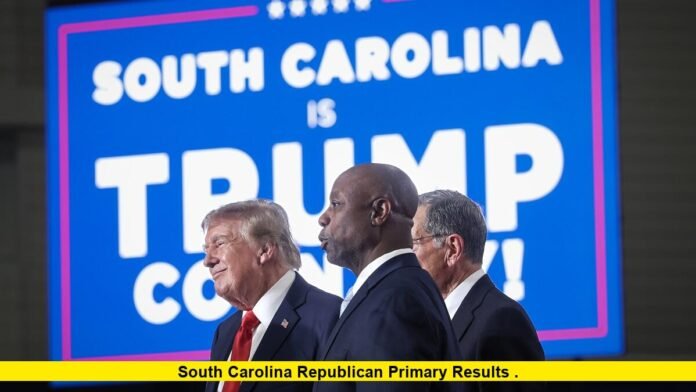

South Carolina Republican primary results are once again drawing national attention as voters decide who will carry the GOP banner into November’s U.S. Senate election. On August 25, 2026, Republicans across the Palmetto State returned to the polls for a special primary runoff, choosing between appointed Senator Darline Graham and U.S. Representative Ralph Norman. The contest, triggered by the sudden death of longtime Senator Lindsey Graham, has become one of the most closely watched races of the 2026 midterm cycle, largely because President Donald Trump staked his political capital on the outcome.
Why South Carolina Held a Special Senate Runoff
The special election process began after Senator Lindsey Graham died on July 11, 2026, following a sudden illness that his office later attributed to a tear in his aorta. Graham, who had represented South Carolina in the Senate since 2003, had just weeks earlier won his own Republican primary for a fifth term. His unexpected death forced state officials to move quickly under South Carolina’s compressed special election timeline.
Governor Henry McMaster appointed Graham’s sister, Darline Graham Nordone, to serve out the remainder of her brother’s term, which runs through January 2027. She is believed to be the first sibling appointed to a Senate seat under these circumstances in the state’s history. Almost immediately after her swearing-in, Darline Graham announced she would run for the full six-year term, entering a crowded Republican field that ultimately included ten candidates.
Among those candidates were U.S. Representative Ralph Norman of the 5th Congressional District, U.S. Representative Russell Fry of the 7th Congressional District, and former Governor Mark Sanford, who was attempting a political comeback. The August 11, 2026, special primary narrowed that field considerably. Darline Graham finished first with roughly 33 percent of the vote, while Norman came in second with about 25 percent, edging out Fry for the runoff spot. Since no candidate cleared the 50 percent threshold required under South Carolina law, the top two finishers advanced to an August 25 runoff.
Trump’s Endorsement and the Stakes of the Runoff
President Trump endorsed Darline Graham early in the race, framing her candidacy as a continuation of her brother’s legacy and his own alliance with the late senator. Trump’s backing extended beyond a simple statement of support. He traveled to South Carolina to campaign alongside Graham ahead of the runoff, a move that underscored how much importance his political operation placed on securing the seat for his preferred candidate.
Political observers noted that this runoff carried extra significance because Trump’s endorsement record in South Carolina’s 2026 primary season had already been mixed. Earlier in the year, Lieutenant Governor Pamela Evette held a narrow lead in the gubernatorial primary but ultimately lost the runoff decisively to Attorney General Alan Wilson. That outcome raised questions about how reliably a Trump endorsement could translate into runoff victories in a state where Republican voters have shown a willingness to back candidates outside the president’s preferred lane.
Norman, for his part, campaigned as a proven conservative with a legislative record, arguing that voters should judge candidates by what they have accomplished in office rather than by endorsements alone. He also emphasized his frustration with congressional gridlock, telling supporters that the Senate too often fails to advance strong conservative legislation. Both candidates publicly stated they would remain allies of the president regardless of the runoff’s outcome, reflecting how central Trump remains to South Carolina Republican politics even when he is not the one on the ballot.
What the Primary Results Show So Far
Turnout in the August 11 special primary was relatively low, with just over 11 percent of registered voters participating, a common pattern in off-cycle special elections. Darline Graham performed strongest across most of the state, while Norman led in Upstate counties, and Fry carried the Grand Strand region that overlaps with his congressional district.
As the August 25 runoff proceeded, polls closed at 7 p.m. Eastern time, with any voters already in line still permitted to cast ballots. South Carolina law requires an automatic recount if the margin between the top two finishers is 1 percent or less of the total vote, a threshold that election officials and news organizations were monitoring closely given how competitive the race appeared heading into runoff day.
As of this writing, there is no official confirmation of a final winner in the runoff. Vote counting was ongoing, and organizations such as the Associated Press had not yet declared a result, consistent with their standard practice of waiting until the outcome is mathematically clear before making a call. Readers should treat any early reports of a winner with caution until state election officials and major news outlets confirm certified results.
The Path to November
Whichever candidate wins the Republican nomination will face Democratic nominee Dr. Annie Andrews in the November 3, 2026, general election. South Carolina has not elected a Democrat to the U.S. Senate since 1998 and has not won this particular seat since 1960, making the state a reliable Republican stronghold. Trump carried South Carolina by 18 percentage points in the 2024 presidential election, and Lindsey Graham won his final Senate reelection in 2020 with 54 percent of the vote.
Despite that historical advantage, Democrats have shown renewed interest in South Carolina this cycle. The party recently selected the state to host its first presidential nominating contest for the 2028 election cycle, a decision that has raised the broader political profile of South Carolina races heading into the midterms. Andrews, a pediatrician who has run for federal office in South Carolina before, is expected to campaign heavily on healthcare access and affordability as she looks to make the general election more competitive than recent history might suggest.
Public Interest and National Implications
National interest in the South Carolina Senate runoff has been unusually high for a special primary, driven in large part by the storyline around Trump’s endorsement power. Political analysts and reporters covering the race have framed it as a barometer for how much sway the president holds over South Carolina’s Republican electorate following the earlier gubernatorial primary result. A Graham victory would likely be presented as validation of Trump’s continued dominance within the party, while a Norman win would fuel discussion about the limits of presidential endorsements in contested runoff settings.
Beyond the endorsement angle, the race has drawn attention because of its personal and emotional dimensions. Darline Graham has spoken publicly about the difficulty of campaigning so soon after her brother’s death, telling reporters after the primary that she believed he was watching over her campaign. Her lack of prior elected experience has also been a recurring theme in coverage, with supporters framing her as an authentic outsider and critics questioning her readiness for a full Senate term.
Federal oversight has also factored into public interest surrounding the runoff. The U.S. Department of Justice confirmed it was monitoring the election in Charleston County as part of standard federal election observation procedures, though no significant issues were reported during voting.
Final Thoughts
The South Carolina Republican primary results from this runoff cycle reflect a state party still working through the aftershocks of Lindsey Graham’s sudden death, while also serving as a real-time test of Donald Trump’s influence over Republican primary voters. Darline Graham entered the runoff with the advantage of the president’s endorsement and a personal connection to her brother’s legacy, while Ralph Norman leaned on his legislative record and appeals to party unity. With official results still being finalized, the coming days should bring clarity on which candidate will represent Republicans against Annie Andrews in November. Given South Carolina’s strong Republican lean, the party’s nominee will enter the general election as a clear favorite, but the closeness of this runoff has already reshaped conversations about Trump’s endorsement power heading into the broader 2026 midterm elections.
Stay tuned and check back for the latest confirmed results, and feel free to share your thoughts on how this runoff could shape the November election.