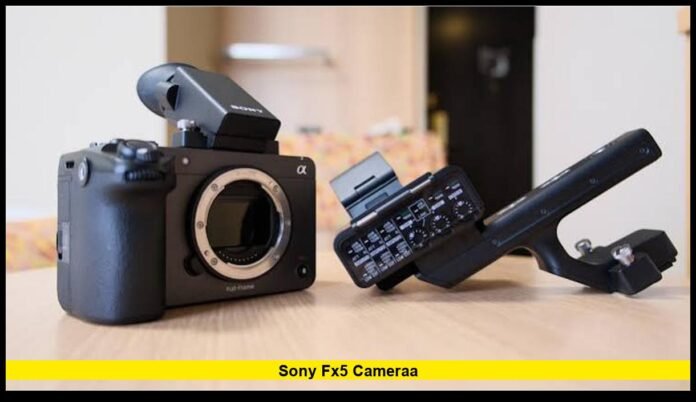

Key Points Summary
╔════════════════════════════════════════════════════════════════════╗
║ – Sony has introduced the Sony FX5 as the newest addition to its Cinema Line. ║
║ – The camera features a new 16.6MP full-frame stacked CMOS sensor. ║
║ – It supports 5K Open Gate recording, internal 16-bit X-OCN RAW, and 4K up to 120fps. ║
║ – Triple Base ISO, advanced AI autofocus, and more than 15 stops of dynamic range headline the feature list. ║
║ – The FX5 is designed for professional filmmaking, documentary production, and commercial video work. ║
╚════════════════════════════════════════════════════════════════════╝
The Sony FX5 camera has officially arrived, expanding Sony’s popular Cinema Line with a model that combines advanced imaging technology, professional recording options, and a compact body built for modern productions. Positioned between Sony’s lightweight cinema offerings and its larger professional systems, the new camera targets filmmakers who want premium image quality without sacrificing portability.
Sony has steadily refined its Cinema Line over the past several years, responding to growing demand from independent filmmakers, production companies, documentary creators, and commercial videographers. The latest model continues that strategy by delivering features that were once reserved for significantly larger and more expensive cinema cameras.
From a newly developed full-frame sensor to internal RAW recording and improved autofocus powered by artificial intelligence, the newest Cinema Line model introduces several capabilities designed to streamline production while maintaining exceptional image quality.
A New Full-Frame Sensor Built for Cinema
Rather than focusing on extremely high megapixel counts, Sony has prioritized larger individual pixels and faster sensor performance. This approach benefits filmmakers by improving light gathering, reducing rolling shutter, and enhancing image quality across a wide range of shooting conditions.
The stacked sensor architecture also enables quicker readout speeds, allowing the camera to capture fast-moving subjects more accurately while minimizing image distortion during pans or handheld movement.
For professionals working in sports documentaries, wildlife filmmaking, concerts, or fast-paced commercial productions, the faster sensor performance can make a noticeable difference in the final footage.
5K Open Gate Recording Brings Greater Creative Freedom
One of the biggest additions is support for 5K Open Gate recording.
Open Gate recording captures the camera’s full sensor area instead of limiting the image to a standard video aspect ratio. This provides editors with significantly more flexibility during post-production.
Instead of deciding on a final aspect ratio while filming, creators can crop footage for multiple delivery formats without losing important image information.
This workflow is becoming increasingly valuable because many productions now require multiple versions of the same project, including:
- Widescreen cinematic releases
- Television broadcasts
- Vertical videos for social platforms
- Square-format promotional clips
- Digital advertising campaigns
Recording the entire sensor provides additional room for stabilization, reframing, and creative cropping while maintaining excellent image quality.
Professional Internal RAW Recording
Another major highlight is internal 16-bit X-OCN RAW recording.
Traditionally, filmmakers often relied on external recorders to capture high-quality RAW footage. Internal recording simplifies production by reducing equipment, cables, and setup time.
RAW recording preserves significantly more image data than heavily compressed video files, giving editors greater flexibility when adjusting:
- Exposure
- White balance
- Color grading
- Shadow recovery
- Highlight preservation
For productions involving visual effects, green screen work, or complex color grading, RAW workflows offer substantial creative advantages.
More Than 15 Stops of Dynamic Range
Dynamic range remains one of the most important characteristics of a cinema camera.
Sony states that the new camera offers more than 15 stops of dynamic range, enabling it to capture remarkable detail across bright highlights and deep shadows.
High dynamic range becomes especially valuable when shooting scenes that contain challenging lighting conditions, such as:
- Sunlit outdoor interviews
- Backlit portraits
- City skylines at sunset
- Interior scenes with bright windows
- Nighttime environments illuminated by practical lights
The additional latitude allows cinematographers to retain natural-looking detail without sacrificing important parts of the image.
Triple Base ISO Enhances Low-Light Performance
Sony has also introduced Triple Base ISO technology.
Base ISO refers to the camera’s native sensitivity, where image quality is optimized and noise is minimized.
Having multiple native ISO settings allows cinematographers to maintain cleaner footage while working under different lighting conditions.
Whether filming outdoors during daylight, inside a controlled studio, or at night with limited available light, the camera can maintain excellent image quality without introducing excessive digital noise.
For documentary crews and event filmmakers who frequently move between changing environments, this flexibility can reduce setup time and improve consistency throughout a production.
Artificial Intelligence Powers Faster Autofocus
Autofocus technology has become increasingly important in professional video production, particularly for solo operators.
Sony continues to expand its AI-powered subject recognition system with improved tracking accuracy and faster response times.
The autofocus system is capable of recognizing:
- Human faces
- Human eyes
- Moving subjects
- Various shooting scenarios
The camera intelligently predicts subject movement while maintaining focus, making it particularly useful for handheld operation, gimbal work, interviews, and documentary filmmaking.
Even when subjects briefly leave the frame or change direction unexpectedly, the autofocus system is designed to recover quickly and maintain smooth focus transitions.
High Frame Rates for Slow Motion
Creative slow-motion footage continues to be an essential storytelling tool.
The camera supports:
- 4K recording up to 120 frames per second
- Full HD recording up to 240 frames per second
These recording options enable filmmakers to create dramatic slow-motion sequences while preserving excellent image quality.
Sports productions, commercials, wedding films, action scenes, and music videos can all benefit from the increased frame-rate flexibility.
Designed for Compact Professional Productions
Despite its advanced internal technology, the camera maintains a compact Cinema Line body.
A smaller camera offers practical advantages across numerous production environments.
Filmmakers can comfortably use it for:
- Handheld documentary filming
- Gimbal stabilization
- Vehicle-mounted shots
- Tight shooting locations
- Travel productions
- Independent feature films
Reducing camera size also helps minimize operator fatigue during extended shooting days.
Sony has complemented the body with professional accessories, including optional audio and monitoring solutions that allow users to customize the camera according to their production needs.
Professional Audio Support
Audio quality is just as important as image quality during professional production.
The camera supports Sony’s professional XLR audio ecosystem through compatible accessories, allowing filmmakers to connect broadcast-quality microphones directly to the camera.
This simplifies location recording by eliminating the need for separate external audio recorders in many production scenarios.
Documentary crews, interview teams, and event videographers will appreciate the streamlined workflow.
Improved Workflow for Modern Productions
Modern productions often require fast turnaround times.
Editors expect footage that integrates smoothly into professional editing applications while preserving maximum image quality.
Sony’s workflow improvements focus on reducing time between production and delivery.
Features that support efficient post-production include:
- Internal RAW recording
- High-quality codecs
- Fast media support
- Flexible recording formats
- Open Gate capture
- Advanced color science
These tools allow production teams to move quickly from filming to editing without unnecessary conversion steps.
Built for Today’s Content Creators
Although clearly aimed at professional filmmakers, the new camera also reflects the changing landscape of digital content creation.
Many production companies now deliver projects across multiple platforms simultaneously.
A single commercial may require:
- Television broadcast
- Streaming services
- Social media
- Vertical mobile video
- Promotional trailers
- Behind-the-scenes content
The camera’s versatile recording formats help accommodate these evolving distribution requirements without forcing crews to shoot multiple versions of the same project.
How It Fits Within Sony’s Cinema Line
Sony’s Cinema Line has steadily expanded to serve a wide variety of production needs.
Some models prioritize maximum portability, while others focus on large-scale cinematic productions.
The Sony FX5 camera occupies an important position by combining professional cinema features with a compact design that remains practical for solo creators and small production teams.
Rather than replacing existing models, it complements the lineup by giving filmmakers another option based on their specific workflow and production requirements.
This flexibility has become one of Sony’s strongest advantages in the professional camera market.
Who Is the Camera Best Suited For?
The new Cinema Line model is expected to appeal to a broad range of professionals, including:
- Independent filmmakers
- Documentary producers
- Commercial production companies
- Wedding filmmakers
- Corporate video teams
- Streaming content creators
- Educational institutions
- Broadcast journalists
- Wildlife filmmakers
- Travel videographers
Its combination of portability, image quality, and advanced recording capabilities makes it suitable for productions ranging from small independent projects to high-end commercial work.
Availability and Market Position
Sony plans to release the camera beginning in August 2026 in supported global markets.
The camera will be offered in multiple configurations, allowing buyers to select accessories that best fit their workflow.
Industry observers expect the model to strengthen Sony’s position in the growing market for compact professional cinema cameras, where demand continues to increase as filmmakers seek lightweight systems capable of producing theatrical-quality images.
Final Thoughts
Sony’s newest Cinema Line addition represents a significant step forward for compact cinema cameras. By combining a newly engineered full-frame stacked sensor, 5K Open Gate recording, internal 16-bit RAW capture, Triple Base ISO, advanced AI autofocus, and a body designed for mobile production, the company has created a versatile tool for filmmakers working across a wide variety of genres.
Whether producing documentaries, feature films, branded content, corporate videos, or digital media, professionals are likely to appreciate the balance between portability and high-end performance. As production workflows continue evolving toward faster delivery and multi-platform distribution, this latest Cinema Line model is well positioned to meet the needs of modern creators.
Excited about Sony’s latest Cinema Line release? Share your thoughts in the comments and follow us for more camera news, product launches, and filmmaking updates.