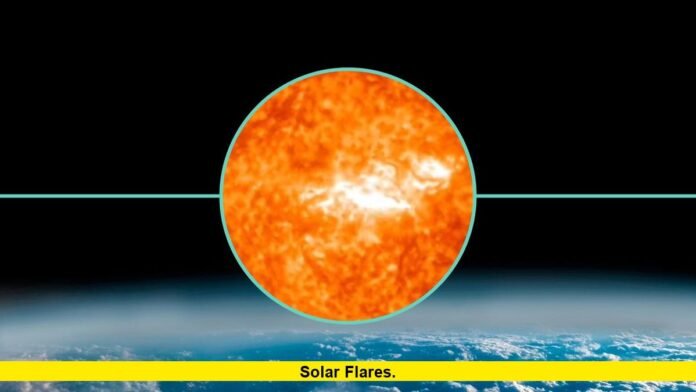

Solar flares are back in focus as the Sun produces elevated activity from a magnetically complex sunspot region. The latest solar-weather data show that Region 4513 produced an M6.9 solar flare on August 25, 2026, followed by a coronal mass ejection (CME) that NOAA is tracking for a possible impact on Earth.
NOAA’s Space Weather Prediction Center (SWPC) has now issued geomagnetic storm watches for August 27 and August 28, making the next few days important for space-weather observers, satellite operators, radio users and aurora watchers.
What Is the Latest Solar Flares Update?
The latest significant development is the M6.9 solar flare from NOAA Active Region 4513. NOAA reported that the flare peaked at 10:02 UTC on August 25 and was accompanied by a Type II radio sweep with an estimated speed of about 603 kilometers per second.
The flare also produced a strong 10.7-centimeter radio burst measured at 160 solar flux units. A CME was first observed by the LASCO coronagraph around 11:00 UTC.
The event was not isolated. NOAA’s latest daily discussion reported four M-class flares from Region 4513 during the 24-hour period, while the European Space Agency-affiliated Solar Influences Data Analysis Center reported five M-class flares during its latest reporting period.
Why Region 4513 Is Important
Region 4513 is currently the main source of significant solar-flare activity. Scientists describe its magnetic configuration as beta-gamma-delta, a configuration capable of storing substantial magnetic energy and producing stronger flares.
The region has remained magnetically complex while continuing to evolve. NOAA’s longer-range forecast says there is a chance of additional M-class flares and a smaller chance of X-class flares through early September, with Region 4513 identified as the primary source of that risk.
That means the current solar-flare episode may not be over even if no immediate X-class flare occurs.
M6.9 Solar Flare and CME: What Happened?
A solar flare is a sudden release of magnetic energy in the Sun’s atmosphere. Strong flares can produce intense X-rays and ultraviolet radiation that reach Earth within minutes and can disrupt radio communications on the sunlit side of the planet.
A CME is different. It is a much larger cloud of magnetized solar plasma launched into space. If a CME is directed toward Earth, it can take considerably longer to arrive and can disturb Earth’s magnetic field.
The August 25 M6.9 flare from Region 4513 was accompanied by a CME, and NOAA has incorporated CMEs launched on August 25 into its latest geomagnetic-storm outlook.
NOAA Issues G1 and G2 Geomagnetic Storm Watches
The most important near-term development is NOAA’s new storm watch.
NOAA has issued:
- G1 (Minor) geomagnetic storm watch for August 27
- G2 (Moderate) geomagnetic storm watch for August 28
NOAA says the August 27 activity is expected to be influenced by a coronal-hole high-speed stream, while the August 28 watch is associated with the anticipated arrival of CMEs that left the Sun on August 25.
This does not mean a major solar storm is guaranteed. A geomagnetic storm forecast can change as spacecraft collect additional measurements of the solar wind and as forecasters refine CME arrival estimates.
Could Solar Flares Cause Northern Lights?
Yes. Strong solar activity can increase the likelihood of auroras, particularly when an Earth-directed CME interacts strongly with Earth’s magnetic field.
The current G1-G2 watches could therefore create opportunities for enhanced auroral activity, especially at higher latitudes. However, the exact visibility of the northern lights depends on the strength and orientation of the incoming magnetic field, the timing of the disturbance, darkness and local viewing conditions.
People in parts of the northern United States and Canada could have a better chance of seeing auroras if the geomagnetic disturbance reaches or exceeds the forecast levels.
What Effects Can Solar Flares Have on Earth?
Solar flares and related space-weather events can affect technology in several ways.
Radio Communications
Strong flares can cause radio blackouts, particularly on the sunlit side of Earth. NOAA reported an R2-level radio blackout associated with the recent activity.
High-frequency radio communications used by aviation, maritime operations and other services can be affected during stronger events.
Satellites
Solar radiation and geomagnetic disturbances can interfere with satellite operations, communications and navigation systems. Increased radiation can also create additional risks for spacecraft electronics.
GPS and Navigation
Strong space-weather events can disturb Earth’s ionosphere, potentially degrading some navigation and positioning signals.
Power Grids
More powerful geomagnetic storms can induce currents in long-distance electrical infrastructure. The current NOAA forecast is for G1 and G2 conditions, which are classified as minor and moderate rather than extreme.
Auroras
One of the most visible effects is the aurora. When energized particles interact with gases in Earth’s upper atmosphere, they can produce the colorful northern and southern lights.
What Do the Solar Flare Classes Mean?
Solar flares are classified primarily according to their X-ray intensity.
- A-class: Smallest flares with minimal effects.
- B-class: Low-level solar flares.
- C-class: Minor flares that generally have limited effects on Earth.
- M-class: Moderate flares that can cause radio blackouts, particularly when directed toward Earth.
- X-class: Strongest category of solar flares and capable of producing significant space-weather effects.
The recent M6.9 flare is therefore a substantial event, although it remains below the X-class threshold.
The number following the letter provides additional information about the flare’s strength. An M6.9 flare is stronger than an M1 flare but weaker than an X1 flare.
Are More Solar Flares Expected?
Yes. Current forecasts indicate that M-class solar flares remain possible, while X-class flares have a smaller probability.
NOAA’s 27-day forecast covering August 24 through September 19 says solar activity should remain at low overall levels but includes a chance of M-class flares and a slight chance of X-class flares from August 24 through September 3, largely because of Region 4513. After September 4, the forecast calls for a lower chance of M-class activity.
This means observers should continue watching Region 4513 and any other emerging active regions on the visible solar disk.
What Is the Solar Activity Forecast for the Next Few Days?
The immediate outlook is more complicated than simply watching for another flare.
NOAA’s latest forecast points to two separate sources of geomagnetic activity. A high-speed solar-wind stream from a coronal hole could influence Earth around August 27, while CMEs launched from the Sun on August 25 are expected to contribute to possible storm conditions around August 28.
The combination could produce unsettled to storm-level geomagnetic conditions over the next several days.
Is a Major Solar Storm About to Hit Earth?
There is currently no basis for saying that a catastrophic solar storm is certain.
NOAA’s official watches are for G1 minor and G2 moderate geomagnetic storms. Forecasts can be upgraded or downgraded as the CME approaches and spacecraft positioned upstream of Earth provide more information.
The current situation is nevertheless worth watching because Region 4513 remains magnetically complex, additional M-class flares are possible, and the Sun has already produced a CME associated with the recent M6.9 flare.
How to Watch Solar Flares and Space Weather
People interested in following the latest solar activity can monitor official updates from NOAA’s Space Weather Prediction Center and NASA’s solar-observing missions.
NASA’s Solar Dynamics Observatory continuously observes the Sun in multiple wavelengths, allowing scientists to track sunspots, flares and other changes in the solar atmosphere. NOAA provides operational forecasts, watches and warnings for space-weather impacts.
For anyone hoping to see auroras, it is particularly useful to check the latest geomagnetic forecast rather than relying on a forecast issued several days earlier.
Solar Flares Outlook
The latest picture is one of elevated but closely monitored solar activity. Region 4513 produced the recent M6.9 flare and associated CME, while NOAA has issued G1 and G2 geomagnetic storm watches for August 27-28.
The immediate focus will be on whether the incoming CME produces the forecast geomagnetic response and whether Region 4513 generates additional M-class or potentially X-class flares. Conditions can change quickly, so the latest NOAA space-weather updates remain the best source for official warnings.
Solar flares are a normal part of the Sun’s activity, but stronger events can have measurable effects on modern technology. The coming days could provide another opportunity to observe how activity on the Sun translates into space weather around Earth.
What do you think about the latest solar flares and the upcoming geomagnetic storm watch? Share your thoughts below and stay tuned for the latest verified space-weather updates.