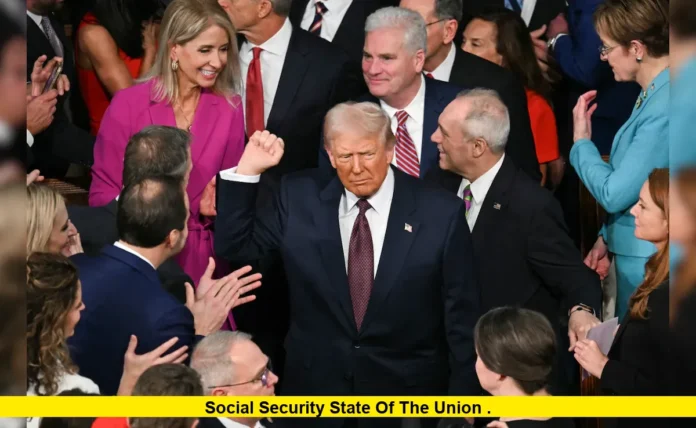

President Donald Trump took the stage on February 24, 2026, for his first State of the Union address of his second term, delivering what became the longest such speech in recorded history. Among the many topics he covered, Trump’s remarks on Social Security stood out for seniors and working Americans alike — and the details behind those claims deserve a closer look.
Stay informed on what Washington’s biggest moments mean for your retirement and financial future — share this article with someone who needs to know.
Trump’s Big Promise to Seniors
Standing before a joint session of Congress in the House Chamber, Trump declared that his administration had delivered “no tax on Social Security for our great seniors.” He credited this achievement to the One Big Beautiful Bill Act, his signature domestic policy legislation that passed and landed on his desk in July 2025.
“But we held strong,” Trump said, “and with the great Big Beautiful Bill, we gave you no tax on tips, no tax on overtime and no tax on Social Security for our great seniors.”
The crowd of Republican lawmakers erupted in applause. The moment was one of the most celebrated of the entire evening, with Trump presenting it as a landmark win for retirees across the country.
Read also-When Does the No Tax on Social Security Start — What 2026 Means for Retirees
What the Law Actually Does
The reality is more layered than the applause suggested. The One Big Beautiful Bill Act introduced a new deduction that allows many seniors to reduce what they owe in taxes on their Social Security income. However, it did not fully eliminate income taxes on Social Security benefits. Taxes on those benefits still apply for higher-income retirees who exceed certain thresholds.
Fact-checkers noted that while millions of seniors will pay less in taxes on their benefits, Trump’s repeated phrasing of “no tax on Social Security” overstates what the law actually delivers. Some seniors — particularly those in lower-to-middle income brackets — will see meaningful relief. Others, particularly those with significant retirement income beyond Social Security, will still face taxation on a portion of their benefits.
The distinction matters because tens of millions of Americans rely on Social Security as their primary or sole source of retirement income, and the specifics of any tax change have very real consequences for their monthly budgets.
A Pledge to “Always Protect” Social Security
Beyond the tax discussion, Trump went further during the address, making a broad vow to the American public. “Under this administration, we will always protect Social Security and Medicare,” he said. He accused Democrats of failing seniors on this front, pointing to the opposing side of the chamber and saying, “They are not protecting it for our seniors.”
Trump also pointed to the performance of retirement accounts as evidence of his administration’s positive impact. He told the audience that the typical 401(k) balance is up by at least $30,000 since he took office, citing the stock market’s strong performance in 2025, when the S&P 500 climbed 18%.
The Looming Threat That Wasn’t Mentioned
What Trump did not address during the speech is a critical piece of the Social Security picture. The Social Security trust fund is currently projected to be depleted by 2033. If Congress does not act before that deadline, recipients could face an automatic reduction in their monthly benefits — a steep cut that would hit retirees hard regardless of any tax deductions they currently enjoy.
Retirement policy experts point out that while the new deduction is a positive step for many seniors, the long-term solvency of the program remains an unresolved challenge. No plan to shore up the trust fund was announced during the February 24 address.
A New Retirement Plan for Workers Without One
In a significant policy announcement during the speech, Trump said his administration will move next year to give workers who currently lack access to employer-sponsored retirement plans access to the same type of plan offered to federal government employees. This initiative targets the roughly half of all working Americans who do not have a 401(k) or similar plan with employer matching contributions.
“Half of all working Americans still do not have access to a retirement plan with matching contributions from an employer,” Trump said. He called these workers “oft-forgotten” and pledged to remedy what he described as a “gross disparity.”
The announcement drew positive reactions from retirement policy advocates, though experts noted that the full impact of such a program would depend heavily on its specific structure, contribution limits, and implementation timeline.
The Bigger Picture of the Speech
Trump’s State of the Union address on February 24 was historic for more than one reason. At nearly two hours, it broke the record for the longest address of its kind. The president used the platform to tout his first year back in office, praising border security accomplishments, economic growth, and what he described as a “turnaround for the ages.”
He celebrated the U.S. men’s hockey team’s Olympic gold medal win, honored war veterans, and awarded the Presidential Medal of Freedom to goaltender Connor Hellebuyck. Chief Warrant Officer Eric Slover received the Medal of Honor for his actions in the raid that led to the capture of former Venezuelan President Nicolás Maduro.
Throughout the evening, Republicans gave repeated standing ovations while Democrats largely remained seated. Some Democratic lawmakers, including Rep. Al Green of Texas, left the chamber early or were escorted out. Rep. Ilhan Omar and Rep. Rashida Tlaib also left before the speech concluded.
Trump’s approval rating heading into the address stood at 39%, according to polling released days before the speech, reflecting a country still sharply divided over his second term.
What It Means for Retirees Going Forward
For seniors and those approaching retirement age, Trump’s State of the Union remarks carry practical significance. The new Social Security tax deduction included in the One Big Beautiful Bill Act represents real savings for many households — but the degree of relief varies depending on income. The pledge to protect the program is reassuring in tone, but the long-term funding gap remains a pressing policy issue that will require congressional action well before 2033.
The announcement of expanded retirement access for workers without employer plans is a step that could benefit millions of Americans over the coming years, provided the details are structured effectively.
As the administration moves into its second year, Social Security policy will remain one of the most closely watched issues — for voters, for Congress, and for the more than 70 million Americans who currently receive benefits.
What do you think about Trump’s Social Security promises — will they actually protect retirees, or is there more work to be done? Drop your thoughts in the comments below and keep checking back as this story develops.