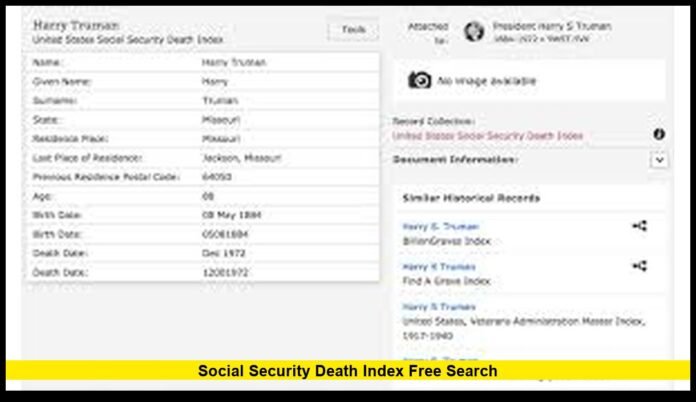

If you’re trying to access verified death records or research family history, you might have heard of the social security death index free search. This term refers to finding death records associated with Social Security numbers using online tools and databases. Many people—whether genealogists, historians, or family researchers—want clear, practical information on how these searches work today, what data is available, and the limitations you need to understand before investing time or money.
In this detailed guide, we explain what the Social Security Death Index is, how it can be searched for free in the United States, how access rules have changed in recent years, and what reliable tools you can use in 2026 to find older death records accurately.
What Is the Social Security Death Index?
The Social Security Death Index, commonly known as SSDI, is a database derived from the Social Security Administration’s Death Master File. The Death Master File contains death information reported to the federal government through funeral homes, family members, financial institutions, and state agencies.
For decades, genealogists relied on the SSDI to locate key details about deceased individuals. The index typically includes:
- Full name
- Date of birth
- Date of death
- State where the Social Security number was issued
- Last known residence or benefit payment location
The SSDI became widely accessible online in the early 2000s and was regularly updated. However, changes in federal law significantly altered how recent death data is released to the public.
Why Public Access Changed
In 2014, federal restrictions were placed on access to newly added death records. As a result:
- Public versions of the SSDI are no longer updated with new death entries in real time.
- Records of deaths reported within the last three years are generally restricted from public access.
- Updated Death Master File data is available only to certified entities through controlled systems.
Because of these changes, when you perform a free SSDI search today, you are typically accessing older records rather than current-year deaths.
Understanding this limitation is essential. A free search will not show very recent deaths, even if they were properly reported.
How to Perform a social security death index free search
Despite restrictions on recent data, millions of historical records remain searchable at no cost. Here’s how you can access them.
1. Use Free Genealogy Platforms
Several genealogy websites provide free access to older SSDI data. Most require you to create a no-cost account before searching. Once registered, you can enter:
- First and last name
- Approximate year of birth
- Approximate year of death
- State of residence
Search results may include birth and death dates, as well as the state where the Social Security number was originally issued.
Because these databases rely on archived SSDI information, they are best suited for researching individuals who passed away before 2014.
2. Check Public Library Access
Many public libraries in the United States provide free on-site access to genealogy databases that include SSDI records. Some libraries also offer remote access to cardholders.
Library access often unlocks additional historical records, including obituary archives and cemetery listings, which can help confirm SSDI findings.
If you prefer not to pay for subscription services, your local library can be a valuable resource.
3. Search Historical Archives and Family History Centers
Family history centers and genealogical societies often maintain archival access to SSDI datasets and related federal records.
These centers may provide:
- Assistance with advanced search techniques
- Access to broader Social Security application and claims indexes
- Help interpreting historical record formats
For researchers conducting in-depth family history projects, these facilities can provide valuable support beyond what a basic online search offers.
What Information You Can Expect to Find
When you conduct a social security death index free search, the results typically include limited but important data.
You may see:
- Legal name at time of death
- Date of birth
- Date of death
- Last residence ZIP code
- State where the Social Security number was issued
Earlier versions of the SSDI sometimes displayed full Social Security numbers, but many modern databases now partially redact those numbers for privacy reasons.
The index does not usually include cause of death, next-of-kin information, or full death certificate details.
What the SSDI Does Not Include
It’s important to understand what the SSDI is not.
It is not:
- A complete record of every death in the United States
- A real-time death reporting system
- A substitute for an official death certificate
The SSDI only reflects deaths reported to the Social Security Administration. If a death was never reported to the agency, it may not appear in the index.
In addition, individuals who never received a Social Security number will not appear in the database.
Common Reasons a Record May Not Appear
If your search does not return results, several explanations are possible:
- The death occurred within the last three years and is restricted.
- The death was never reported to the Social Security Administration.
- The name was recorded differently, such as a maiden name or alternate spelling.
- The individual never had a Social Security number.
Trying alternate spellings or searching by birth year range can improve your results.
Accuracy and Data Limitations
The SSDI has been widely used for decades, but it is not error-free.
Possible issues include:
- Misspelled names
- Incorrect birth dates
- Incorrect death dates
- Data entry errors
Because of this, researchers should use SSDI findings as a starting point rather than final proof. Pairing SSDI results with state death records, cemetery records, or obituary notices can provide confirmation.
Who Uses SSDI Data Today
Although it is most commonly associated with genealogy research, SSDI data serves several other purposes.
Researchers use it to:
- Trace family lineage
- Verify historical identities
- Support estate settlement research
- Confirm dates for legal documentation
- Study demographic trends
However, institutions that require up-to-date death verification rely on certified federal systems rather than public SSDI databases.
Privacy Considerations
The restrictions introduced in 2014 were largely driven by concerns about identity theft and fraud. Public release of newly reported deaths sometimes led to misuse of personal data.
Today’s limited public SSDI access reflects a balance between historical transparency and modern privacy protection.
As a result, anyone using SSDI data should respect privacy guidelines and avoid using the information for improper purposes.
Best Practices for Reliable Results
To maximize your success:
- Start with complete and accurate personal details.
- Search using multiple variations of a name.
- Cross-reference results with cemetery, obituary, and state records.
- Understand that recent deaths will not appear in free searches.
Patience and thorough cross-checking often lead to better outcomes.
The Continuing Value of SSDI Records
Even with modern restrictions, the Social Security Death Index remains one of the most important historical death databases in the United States.
It contains millions of records spanning decades of American history. For families researching ancestry or verifying historical details, it remains a trusted foundation.
By understanding how a social security death index free search works in 2026, you can use this powerful tool effectively while recognizing its boundaries.
Older records remain widely accessible. Recent records are restricted. And complete verification often requires additional documentation.
When used correctly, the SSDI remains a reliable stepping stone in family research.
Have you used the SSDI to trace your family history? Share your experience or questions in the comments and continue exploring your roots with confidence.