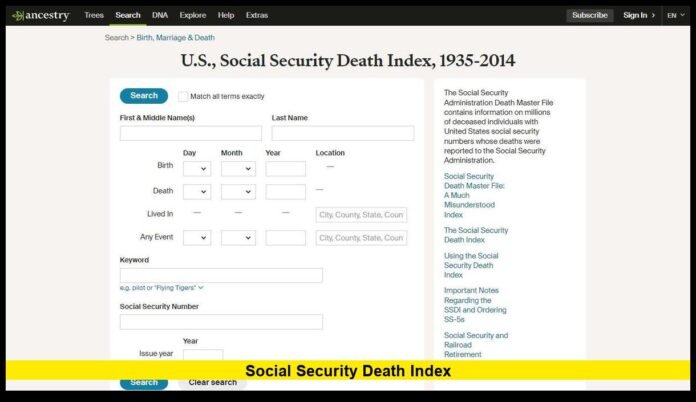

The social security death index remains a useful historical resource for Americans researching death records, family history, and genealogy. However, the database available through genealogy services is not a current list of every person who has died in the United States. Its historical records have a 2014 cutoff, while the federal Death Master File continues to receive new information.
That distinction matters in 2026.
Many people still search for a deceased relative through websites that provide Social Security death records. Those searches can produce valuable information, especially for older deaths. They can also create confusion when a recent death does not appear.
The current federal system operates differently from the historical database. Authorized organizations can access updated Death Master File information for legitimate purposes, including identity verification, fraud prevention, and payment screening.
What Is the Social Security Death Index?
The Social Security Death Index is a historical collection based on death information maintained by the Social Security Administration.
For many years, the database became one of the most popular tools for genealogy research. Researchers could use a person’s name or other identifying information to locate a death record.
Depending on the record, a historical entry can provide information such as:
- Full name
- Social Security number
- Date of birth
- Date of death
- State or geographic information connected to the Social Security number
- Other identifying details
These records can help researchers build family trees and confirm important dates.
They can also help distinguish between people with similar names. A confirmed date of death may give researchers a starting point for finding obituaries, cemetery records, probate documents, and other historical information.
The database has limits, however. It does not represent every death in the United States.
A death generally must reach the Social Security Administration through an appropriate reporting source before it can become part of Social Security’s death information.
Why the 2014 Cutoff Matters
The most important fact for people searching the historical database today is its 2014 cutoff.
The widely available historical collection received its last update in 2014. It does not function as a continuously updated public database of deaths.
That means a researcher should be careful when searching for someone who died recently.
For example, a person who died decades ago may appear in a historical Social Security record. Someone who died in 2025 may not appear in the same public genealogy collection.
The difference does not mean the newer death was never reported to Social Security.
It simply means the historical collection does not provide the same current coverage as the federal Death Master File.
The Death Master File Is Different
The Death Master File is the broader federal database containing death information maintained from Social Security records.
It continues to receive updates.
The National Technical Information Service distributes a version of the Death Master File to eligible organizations. The current system can contain information such as a person’s name, Social Security number, date of birth, and date of death.
The federal government also maintains more comprehensive death information that includes data supplied by states.
Access depends on the type of information requested and the organization seeking it.
This makes the Death Master File different from the historical database commonly used by genealogy researchers.
The historical collection is mainly valuable for older research. The current Death Master File also serves modern administrative and financial purposes.
What Is New About the Death Master File in 2026?
The Death Master File continues to receive regular updates during 2026.
The National Technical Information Service publishes monthly and weekly update files for eligible users.
Recent monthly files demonstrate that the system remains active.
A July 1, 2026 update contained 816,201 records. The June 1 update contained 2,359,009 records, while the May 1 update contained 380,927 records.
Those numbers should not be interpreted as the number of deaths that occurred during each month.
Update files can contain new records, corrections, and other changes. Organizations that maintain a current database must process the files correctly to keep their information up to date.
The continuing updates show the major difference between the historical index and the current federal system.
How Many Records Does the Current File Contain?
The National Technical Information Service describes its Limited Access Death Master File as containing more than 90 million records.
That figure refers to the broader current database rather than the smaller historical collections that genealogy websites may display.
The number can change as agencies add new information or correct existing records.
Researchers should therefore avoid comparing the size of a genealogy website’s historical collection with the current federal file as if they were identical databases.
They serve different purposes and have different access rules.
Who Can Use the Current Death Master File?
The current Death Master File is not an unrestricted public database.
The National Technical Information Service has a certification program for organizations that need access to the Limited Access Death Master File.
Approved users can receive death information through different services. These services can support searches, data processing, and other business needs.
Organizations may use the information for legitimate activities such as:
- Identity verification
- Fraud prevention
- Financial record management
- Insurance administration
- Government payment screening
- Compliance activities
Access to restricted death information comes with requirements.
This is one reason a person searching online cannot always find the same information that a government agency or certified organization can access.
Why the Federal Government Uses Death Information
Death information plays an important role in protecting government payments.
Federal agencies need reliable records to determine whether a person receiving a benefit or other payment is still living.
The Treasury Department uses death information as part of its Do Not Pay system. The system helps federal agencies identify payments that may require review before money reaches the recipient.
This process can help reduce improper payments.
Death information can also help agencies identify situations where a payment may go to a deceased person or where another record requires investigation.
The federal government’s use of the Death Master File therefore extends far beyond genealogy.
Recent Federal Payment Screening Developments
Federal payment verification has become an important part of the Death Master File’s modern role.
Treasury has used comprehensive Social Security death information to screen federal payments.
During a recent payment-screening effort, Treasury reported that hundreds of millions of federal payments had undergone checks involving death information.
The screening identified payments associated with deceased recipients and returned those payments to the appropriate agencies for review.
These efforts demonstrate why accurate death information matters.
A historical genealogy database may help a family researcher find an ancestor’s death date. A current federal death database can help agencies make decisions about billions of dollars in government payments.
The two uses are very different, even though both rely on Social Security death information.
Can a Social Security Death Record Be Wrong?
Yes.
A death record can contain an error. The Social Security Administration has acknowledged that mistakes can occur when death information enters its records.
A wrong Social Security number, incorrect personal information, or reporting error can cause a living person to appear as deceased.
That situation can create serious problems.
Financial institutions, government agencies, and other organizations may use death information when checking records. An incorrect entry can therefore trigger additional reviews or disrupt normal transactions.
The Social Security Administration has procedures for correcting erroneous death records.
Anyone who believes Social Security incorrectly recorded them as deceased should contact the agency and provide documentation that confirms they are alive.
Why Accuracy Matters for Living Americans
An incorrect death listing can have consequences beyond a genealogy search.
A person could face questions from financial institutions or government agencies. Automated systems may also flag the person’s records for additional review.
The federal government recognizes the need to correct these errors.
A 2026 Social Security audit examined the handling of erroneous death records. The review highlighted the importance of identifying and correcting cases in which living people appear in death records.
This reinforces an important point for anyone using the database.
A death record provides useful information, but it should not automatically be treated as unquestionable proof of death.
A Missing Record Does Not Prove Someone Is Alive
The opposite mistake can also cause confusion.
If a person does not appear in the historical Social Security database, that does not prove the person is alive.
The 2014 cutoff explains one major reason.
Recent deaths may fall outside the historical collection. Other deaths may not appear because the information was never reported to Social Security or because a particular database does not contain the relevant record.
Researchers should consider the age and coverage of the database before reaching a conclusion.
For genealogy research, additional records can help confirm important information.
Obituaries, death certificates, cemetery records, probate documents, and government records may provide useful evidence.
Why Genealogists Still Use the Historical Database
The historical Social Security database remains valuable for family-history research.
Researchers can use a death date to narrow down a person’s timeline. They can also use identifying details to separate one family member from another.
A Social Security record may provide a useful starting point for finding additional documents.
For older deaths, the database can save researchers considerable time.
However, it works best as one part of a broader research process.
A genealogy researcher should compare important information with other records whenever possible, especially when a name is common or several relatives have similar personal details.
Social Security Death Index vs. Death Master File
The two databases are closely connected, but they should not be treated as the same resource.
| Feature | Historical Social Security Death Index | Current Death Master File |
|---|---|---|
| Main purpose | Genealogy and historical research | Current verification and administrative uses |
| Regular updates | No | Yes |
| Public historical access | Available through genealogy services | Limited |
| Historical cutoff | 2014 | Ongoing |
| Government use | Limited historical research value | Payment and fraud prevention |
| Current death information | Limited | Available to authorized users |
| State death information | Not included in the public historical collection | Included in the full federal file |
This comparison explains why two searches for the same person can produce different results.
A genealogy website may show an older record. An authorized organization may have access to more recent information.
What Americans Should Know Before Searching
Anyone searching Social Security death information should first determine what type of record they need.
For historical research, the older database can provide useful information.
For a recent death, researchers should recognize that the public historical collection has a cutoff.
People should also avoid assuming that a missing record proves someone is alive.
Likewise, the presence of a death record should not always be treated as final proof without verification. Errors can occur, and the Social Security Administration has processes for correcting inaccurate records.
These basic distinctions can prevent many misunderstandings.
Why the 2026 Updates Matter
The latest developments show that Social Security death information remains an active part of the federal government’s data systems.
The historical public database has not become a new, continuously updated genealogy service.
Instead, current death information continues through the Death Master File and related federal systems.
The government also continues to use that information to improve payment accuracy and reduce improper payments.
At the same time, Social Security continues to address the possibility of incorrect death records.
For researchers, the message is clear: historical and current death databases have different purposes, different coverage, and different access rules.
The Bottom Line
The social security death index remains an important resource for historical research, but its coverage ends in 2014. It should not be confused with the current Death Master File, which continues to receive updates and serves government agencies and authorized organizations.
The distinction is especially important when researching a recent death.
Older records can provide valuable clues for genealogy and family-history projects. Current federal death information serves broader purposes, including payment verification and fraud prevention.
The latest developments in 2026 also show why accuracy matters. A missing record does not prove that someone is alive, and a database listing does not remove the need to verify an important death record.
Understanding these differences can make searches more accurate and prevent confusion when information from different databases does not match.
Have you used Social Security death records in your family research? Share your experience or questions in the comments and stay updated on the latest verified information.