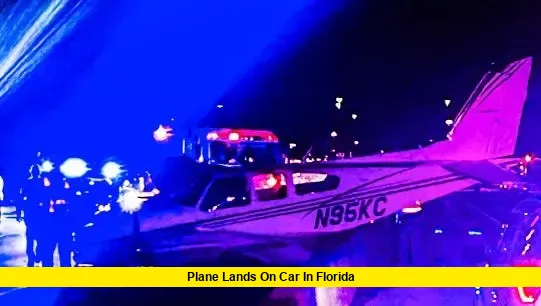

A routine evening commute turned into a chaotic and unforgettable scene when a small aircraft attempted an emergency landing on a busy stretch of Interstate 95 and collided with a moving vehicle. The rare incident, now under active investigation, has raised renewed questions about flight safety near populated corridors. In the opening minutes after the plane lands on car in florida, stunned drivers pulled over, first responders rushed in, and investigators began piecing together the moments that led to one of the most startling roadway emergencies the region has seen in years.
A Sudden Emergency in the Sky
Late Monday afternoon, a twin-engine aircraft was flying over Brevard County when the pilot encountered a critical loss of power. Both engines failed, leaving the aircraft unable to maintain altitude. With limited time and few landing options, the pilot aimed for the straightest stretch of pavement available: Interstate 95, one of Florida’s busiest traffic arteries.
Witnesses described the aircraft descending sharply, its nose angled as the pilot maneuvered to avoid multiple lanes of moving traffic. Commuters first saw the plane as a distant silhouette, then as a fast-approaching object dropping low enough to startle drivers. Some vehicles swerved. Others braked abruptly. Dashcams captured the final seconds before the impact, showing the aircraft coming in low and landing directly in the flow of southbound vehicles.
Impact on the Highway
As the aircraft touched down, one of its wheels collided with the rear of a southbound sedan. The impact crushed the vehicle’s trunk, shattered glass, and sent debris flying across multiple lanes. The plane continued its slide until coming to a stop along the center portion of the roadway, its engines silent and its fuselage resting at an angle.
Traffic immediately backed up for miles. Drivers scrambled to pull over and call emergency services. Some exited their vehicles to check on the injured, while others remained inside, stunned at what had occurred in front of them.
The car struck by the aircraft was driven by a 57-year-old Melbourne woman, who sustained minor injuries. She was transported to a local hospital, where her condition was described as stable. The aircraft’s pilot and passenger, both 27 years old, exited the plane without injuries and spoke with authorities as emergency crews arrived.
Rapid Response on the Ground
Fire-rescue units, highway patrol, and law enforcement agencies responded within minutes. Their first priority was to attend to the injured motorist, assess the aircraft for potential fuel leaks, and shut down the roadway to prevent secondary crashes.
Southbound lanes were immediately closed, with traffic diverted to local exits. The decision was necessary not only because of the debris field but also due to concerns about possible fire hazards, structural instability of the aircraft, and continued risk to drivers.
Recovery teams worked quickly to stabilize the scene. Tow operators and aviation specialists coordinated efforts to move the disabled aircraft from the interstate while investigators documented its position, markings, and damage. The highway remained closed for roughly three hours, creating significant delays during the evening commute.
Eyewitness Reactions Capture the Chaos
Dozens of drivers described the incident as “unreal,” comparing it to something out of an action film. Many said they initially thought the aircraft might overshoot the roadway or land on a grassy shoulder. Instead, the plane came down directly among vehicles traveling at highway speed.
One motorist driving behind the impacted sedan shared that he saw the aircraft descending far too fast to avoid traffic. His dashcam captured the moment the plane’s landing gear struck the car, sending a puff of debris into the air. Another driver said his only instinct was to slam the brakes and hope no one rear-ended him.
Passengers in nearby vehicles recounted watching the pilot tilt the aircraft slightly, seemingly trying to avoid a larger collision. Even so, the plane’s landing path intersected with the exact lane where the victim’s car was traveling. The impact happened so quickly that nearby drivers said they had only seconds to react.
Investigators Begin Their Work
Federal and state investigators are now working to determine what caused the sudden power loss. Their analysis will include:
- Detailed inspection of both engines
- Review of maintenance records and mechanical logs
- Interviews with the pilot and passenger
- Analysis of fuel systems and electrical components
- Examination of flight path data and communications
The crash has already drawn attention because twin-engine aircraft are designed with redundancy, meaning one functional engine should typically allow a pilot to maintain flight and reach a safer landing spot. The failure of both engines simultaneously is unusual and may indicate mechanical issues, fuel complications, or other technical failures.
Investigators will also evaluate the timing of the pilot’s emergency declaration, the altitude at which the engines lost power, and whether alternate landing sites were considered before selecting the interstate.
Traffic Disruption and Regional Impact
I-95 is one of the most heavily traveled highways on Florida’s east coast, and the crash occurred during a busy period when thousands of drivers were heading home. The closure caused extensive congestion, with backups stretching for several miles. Navigation apps began redirecting motorists through smaller local roads, causing secondary delays in nearby communities.
Local authorities credited the quick response of first responders with preventing additional injuries. They also noted that the public cooperated effectively with detours and lane closures, allowing cleanup crews to work as efficiently as possible.
How Rare Are Highway Plane Landings?
Emergency landings involving roadways are extremely rare, and collisions with moving vehicles are even less common. In most cases, pilots attempt to land on stretches of rural or empty roads, fields, or clearings. But when emergencies occur near densely populated regions or when altitude is extremely low, highways may become the only viable landing option.
Aviation experts note that pilots train for emergency descent procedures, but real-world execution can be complicated by weather, traffic, aircraft speed, and mechanical conditions. Interstate landings carry additional risks, especially during rush hour.
This incident is likely to renew discussions about:
- Safety of low-altitude flight routes over populated corridors
- Maintenance requirements for aging general-aviation aircraft
- Emergency landing protocols near major highways
- Driver awareness during unexpected roadside emergencies
Community Response and Public Concerns
Local residents expressed relief that the crash did not result in more severe injuries or fatalities. Many commented on the speed of the response and the surprising fact that both occupants of the aircraft were unharmed.
At the same time, the incident has created anxiety among commuters who travel the same route daily. Some expressed concern about the number of small aircraft that fly over the region and wondered whether more oversight may be needed.
Transportation officials assured the public that incidents like this are extremely rare and that a complete investigation would determine whether any policy adjustments are necessary.
Continuing Questions
Although much is now known about the sequence of events, several important questions remain unanswered, including:
- What caused both engines to fail at nearly the same time?
- Was there any indication of mechanical trouble prior to the emergency?
- How much time did the pilot have to choose a landing location?
- Were there any warning indicators or prior maintenance issues?
- Could the plane have reached a nearby airport or open field?
As forensic teams inspect the engines and avionics systems, officials expect to release preliminary findings in the coming days.
A Remarkable Outcome Amid a Dangerous Situation
Despite the dramatic nature of the crash, the lack of life-threatening injuries is being viewed as a fortunate outcome. The driver hit by the plane is expected to recover, and both aircraft occupants walked away without harm. Given the speed of highway traffic and the complexity of an airborne emergency, officials say the situation could have been far worse.
The scene on I-95 has now been cleared, but the images captured by drivers will leave a lasting impression. Investigators continue examining the aircraft, and the incident remains an active case as authorities work to determine the exact cause.
The event stands as a rare collision between aviation and roadway transportation, reminding the public of the unpredictable nature of mechanical failures and the quick decisions pilots must make under extreme pressure. As the investigation moves forward, officials hope to learn lessons that may help prevent similar incidents in the future. The keyword plane lands on car in florida underscores the unusual nature of this event and the reason it has captured national attention.
If you were traveling on I-95 at the time or witnessed the emergency landing, share your perspective below — your insight could help others better understand what unfolded on that unusual evening.