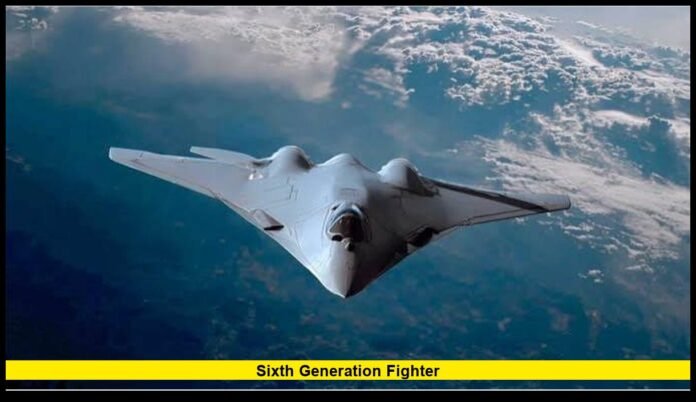

The sixth generation fighter race is moving deeper into development in 2026, with the U.S. Air Force advancing the Boeing F-47, the United Kingdom, Italy and Japan pushing ahead with GCAP, and China continuing flight testing of advanced next-generation aircraft.
For the United States, the F-47 remains the most important program in this category. The aircraft is being developed under the Next Generation Air Dominance program and is intended to become the Air Force’s future air-superiority fighter. Current plans call for the first F-47 flight in 2028.
The program has moved beyond early concept work. Boeing is now building test aircraft as the Air Force works through engineering, manufacturing and system-integration activities.
At the same time, other nations are moving forward with their own designs. The Global Combat Air Programme has secured major new funding and remains focused on a 2035 service target. China has also continued testing tailless aircraft widely viewed as part of its next-generation combat-aircraft development.
These developments are changing the direction of military aviation. Future fighters are being designed not simply as faster or stealthier aircraft, but as central nodes in a much larger network of crewed aircraft, autonomous systems, sensors and weapons.
F-47 Becomes the Center of the U.S. Fighter Modernization Strategy
The F-47 is the centerpiece of the U.S. Air Force’s future air-superiority strategy.
Boeing won the Air Force competition for the crewed NGAD platform in March 2025. The contract moved the program into Engineering and Manufacturing Development, giving the company responsibility for advancing the aircraft toward flight testing and eventual production.
The F-47 is intended to replace the F-22 Raptor as America’s next air-superiority fighter.
Unlike earlier fighter programs, the aircraft is being developed as part of a broader combat architecture. The Air Force plans to connect the F-47 with Collaborative Combat Aircraft, allowing crewed and uncrewed platforms to work together during future missions.
The service has publicly described the aircraft as a long-range, highly survivable platform designed for operations against sophisticated air defenses and advanced enemy aircraft.
Many technical details remain classified. The Air Force has not released a complete specification sheet covering the aircraft’s final dimensions, exact engine configuration, detailed radar performance or full weapons capacity.
That secrecy is deliberate. The program involves technologies that the Pentagon considers important to maintaining future air superiority.
F-47 First Flight Remains Targeted for 2028
One of the clearest confirmed milestones is the planned first flight in 2028.
Air Force officials have repeatedly maintained that schedule during 2026. The service has also confirmed that initial test aircraft are being built.
The 2028 milestone does not mean the F-47 will enter regular operational service immediately afterward. First flight begins a much longer period of developmental testing.
Engineers will need to evaluate flight performance, propulsion, sensors, communications, electronic warfare systems, software and weapons integration.
The aircraft will also need to demonstrate that its systems can work together in the demanding environments for which it was designed.
The Air Force previously discussed a first flight before January 2029. Moving the target to 2028 represents an effort to accelerate the program while maintaining the development process needed for a complex combat aircraft.
The schedule will remain an important indicator of program progress over the next two years.
What Makes the F-47 Different
The F-47 is designed around several capabilities that distinguish future combat aircraft from earlier generations.
Its development emphasizes:
- Advanced stealth and survivability
- Long-range air-superiority operations
- Integrated sensors
- High-speed data connections
- Electronic warfare
- Open-system architecture
- Artificial intelligence and automation
- Cooperation with autonomous aircraft
- Greater adaptability to future upgrades
- Operations in heavily contested airspace
Range is particularly important for U.S. air operations in the Indo-Pacific.
The distances involved in the region create challenges for fighters, tankers and forward bases. A fighter capable of operating farther from its base can provide commanders with more options and reduce dependence on vulnerable support infrastructure.
The F-47’s planned range is therefore a major part of its intended mission.
The Air Force has also indicated that the aircraft will be designed so its systems can evolve over time. That approach could help the fighter incorporate new sensors, software, weapons and electronic systems without requiring a completely new aircraft.
Collaborative Combat Aircraft Are Critical to the F-47
The F-47 will not operate alone.
Collaborative Combat Aircraft are a central part of the Air Force’s future combat-air concept. These autonomous systems are designed to accompany crewed fighters and perform missions across a wider battlespace.
A CCA could potentially support surveillance, electronic warfare, communications, targeting or weapons missions.
The exact mission mix will depend on the individual aircraft and future operational requirements.
The broader idea is straightforward. A single crewed fighter can control or coordinate with additional aircraft, increasing the number of platforms available to a commander.
This could also change how pilots approach missions.
Instead of operating as a single aircraft surrounded by supporting assets, a future pilot could manage a group of connected platforms. The crewed fighter would remain important, but autonomous aircraft could expand its reach and provide additional options.
This manned-unmanned relationship is one of the defining features of America’s future air-combat strategy.
Advanced Engines Remain an Important Technology
Propulsion is another major part of the future fighter effort.
The U.S. Air Force is developing adaptive-engine technology through the Next Generation Adaptive Propulsion program. The work involves competing industrial teams and focuses on technologies that could provide improvements in range, efficiency, power and thermal management.
The timing of engine development is important because advanced sensors and electronic systems require significant electrical power and generate heat.
Future fighters will need to manage those demands while maintaining speed, range and survivability.
The Air Force has not publicly established every detail of the final F-47 propulsion configuration. That means specific claims about the production engine should be treated carefully until officially confirmed.
The propulsion effort nevertheless demonstrates how many technologies must mature alongside the aircraft itself.
The U.S. Navy Has Its Own Future Fighter Program
The Air Force’s F-47 is not America’s only next-generation fighter effort.
The U.S. Navy is developing the F/A-XX, a future carrier-based fighter intended to replace the F/A-18E/F Super Hornet.
The program has progressed more slowly than the Air Force’s F-47 effort. Boeing and Northrop Grumman have remained involved in the competition, while the Navy continues to work through its acquisition plans.
F/A-XX must meet requirements that differ substantially from those of the F-47.
A carrier fighter needs to launch and recover from an aircraft carrier, operate within a naval air wing and withstand the demanding conditions associated with carrier operations.
It also needs to work with ships, aircraft, sensors and other systems across the fleet.
For that reason, F/A-XX should be viewed as a separate U.S. next-generation fighter program rather than simply a naval version of the F-47.
Read More – Northrop Grumman’s Latest Innovations Reshape Defense Technology
GCAP Remains a Major International Competitor
The Global Combat Air Programme is one of the most advanced international efforts to produce a future fighter.
The United Kingdom, Italy and Japan are jointly developing the aircraft through GCAP. The program combines British, Italian and Japanese aerospace expertise and aims to produce a new combat aircraft for the mid-2030s.
GCAP reached an important stage in July 2026 when the program awarded a £4.6 billion contract for continued design and development work.
The program remains committed to a 2035 target for deployment.
The three participating countries have also established an industrial structure centered on Edgewing, bringing together major aerospace companies from the partner nations.
The aircraft is expected to replace older fighter fleets, including the Eurofighter Typhoon in British and Italian service and Japan’s Mitsubishi F-2.
GCAP is not simply about producing a new aircraft. Like the F-47 program, it focuses on a broader combat system involving sensors, data networks, autonomous platforms and advanced weapons.
Canada Joins GCAP as an Observer
GCAP gained additional international attention in July when Canada joined the program as an observer.
Observer status is different from full participation. Canada does not hold the same decision-making role as the three founding nations.
The move nevertheless gives Ottawa an opportunity to engage with the program and evaluate future cooperation.
GCAP leaders have continued to emphasize the importance of protecting the 2035 schedule even as other countries show interest in closer involvement.
That commitment is significant because multinational defense programs can become more complicated when new participants enter during development.
For now, the three founding nations remain responsible for the core fighter program.
Japan Is Building Industrial Capacity Around GCAP
Japan’s role in GCAP is becoming increasingly important.
Mitsubishi Heavy Industries is one of the program’s principal industrial partners, while other Japanese companies are developing electronics and other technologies for the future aircraft.
In August 2026, Mitsubishi Electric announced plans to establish three new facilities connected to production of electronic systems for GCAP.
That development illustrates the transition from conceptual design toward industrial preparation.
A fighter program requires more than an aircraft design. It also needs factories, supply chains, specialized equipment, testing infrastructure and trained workers.
Building that industrial base years before service entry can help partners prepare for the production demands expected in the 2030s.
China Continues Testing Advanced Fighter Prototypes
China is also making visible progress in next-generation combat-aircraft development.
Two tailless aircraft have emerged in recent years and have been widely examined by aviation analysts. One is commonly referred to as the J-36, although that designation has not been officially confirmed as the final name.
The aircraft’s large tailless design has attracted particular attention.
Its configuration indicates that China is exploring a different approach from conventional fighter designs. The aircraft appears focused on low observability, range and internal weapons capacity.
A second advanced design has also been linked to China’s next-generation fighter development.
Flight testing provides evidence that the programs have moved beyond pure design studies. However, many details about their intended missions, final specifications and operational timelines remain unavailable publicly.
That makes direct comparisons with the F-47 difficult.
The United States has publicly disclosed development milestones for the F-47, while China has revealed less about its official program structure and future deployment plans.
Why Sixth-Generation Aircraft Focus on Networks
The biggest change in future fighter design is not necessarily the shape of the aircraft.
It is the way the aircraft connects with everything around it.
A modern fighter can already receive information from other aircraft, satellites, ground stations and naval platforms. Future designs aim to make that connectivity faster, more secure and more deeply integrated into mission operations.
The aircraft could combine information from several sensors and present it to pilots in a unified picture.
Artificial intelligence and automation can also help process large amounts of information.
That does not mean pilots disappear from future combat aviation. Instead, technology can reduce the workload involved in managing sensors, identifying threats and coordinating multiple systems.
The pilot remains responsible for critical decisions while software and autonomous platforms handle increasing amounts of supporting activity.
Stealth Remains Important, but It Is Not the Only Goal
Stealth remains a major requirement for future fighters.
However, modern air combat places pressure on stealth aircraft from increasingly sophisticated sensors and weapons.
That means future survivability must combine several capabilities.
A fighter can use low observability to make detection more difficult. It can also rely on electronic warfare, speed, maneuverability, long-range weapons and networked sensors.
The F-47 is being designed around this broader approach.
GCAP is following a similar direction, combining low observability with advanced sensors and connected combat systems.
This reflects a fundamental change from older fighter-development philosophies. The goal is no longer simply to build the aircraft with the highest speed or maneuverability.
Instead, designers are trying to create an aircraft that can detect threats first, share information quickly, remain difficult to target and coordinate with other platforms.
The 2026 Fighter Landscape
The current situation can be summarized through several major milestones:
| Program | Country or Partners | Current Position | Major Target |
|---|---|---|---|
| F-47 | United States | Development and test-aircraft production | First flight in 2028 |
| F/A-XX | United States | Navy development and competition | Future carrier fighter |
| GCAP | U.K., Italy, Japan | Design and development | Deployment in 2035 |
| Chinese next-generation programs | China | Advanced prototype flight testing | Operational date not publicly confirmed |
The programs are moving at different speeds.
The F-47 has a defined aircraft manufacturer and an established first-flight target. GCAP has entered a significant design-development phase with a firm 2035 objective. China’s aircraft have the advantage of visible flight-test activity, but far less official information is available about their final capabilities and service timelines.
This makes 2026 a significant period for future airpower.
What to Watch Next
The F-47’s first flight remains the most important upcoming U.S. milestone.
Before that event, additional test-aircraft production and ground testing should provide indications of how quickly the program is progressing.
The relationship between the F-47 and Collaborative Combat Aircraft will also remain important.
For GCAP, continued detailed design work and industrial development will determine whether the program stays aligned with its 2035 goal.
China’s ongoing flight testing will provide further information about its approach, although much of the program will remain difficult to assess from public evidence.
The Navy’s F/A-XX decisions will also shape America’s broader future fighter fleet.
Together, these programs demonstrate that the next phase of military aviation is being built around connected systems rather than individual aircraft.
The Future of U.S. Air Superiority
The F-47 represents the clearest expression of the U.S. Air Force’s next-generation fighter strategy.
Its importance comes from more than its stealth characteristics or expected performance. The aircraft is intended to function as the crewed centerpiece of a wider network involving autonomous aircraft, advanced sensors, electronic warfare and long-range weapons.
The 2028 first-flight target provides the next major checkpoint.
If development remains on schedule, the United States will move closer to testing the aircraft that is expected to replace the F-22 and form the foundation of future air-superiority operations.
GCAP and China’s advanced aircraft show that the United States is not pursuing this technology alone. Multiple major powers are investing in aircraft designed for highly contested airspace, long-range operations and increasingly automated combat environments.
The competition will ultimately be measured by more than who flies first. Production capacity, reliability, software development, weapons integration, training and sustained operational readiness will all determine how effective these aircraft become.
For now, the F-47 remains the most clearly defined U.S. program, while GCAP continues its international development and China advances its own next-generation prototypes.
What do you think the next major milestone will be for future fighter technology? Share your thoughts in the comments and stay updated as new confirmed developments emerge.