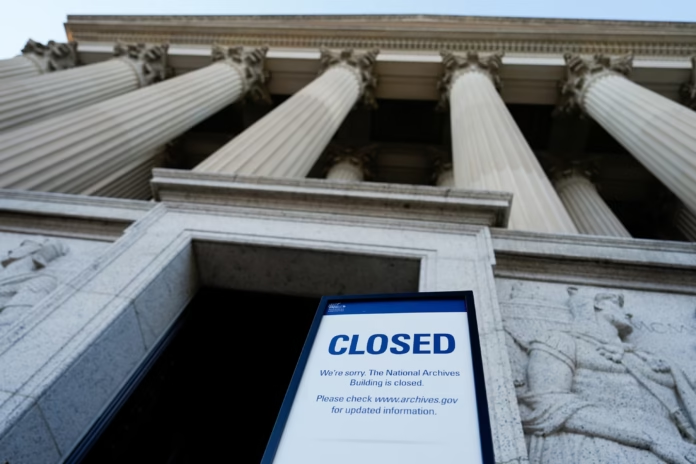

The Senate vote government shutdown crisis has entered one of its most intense phases in recent history. After multiple failed votes to advance temporary funding measures, the Senate remains locked in a fierce partisan standoff that has kept the federal government partially closed for weeks. The gridlock has left critical services frozen, federal employees without pay, and lawmakers under increasing pressure to deliver a breakthrough.
As the shutdown stretches into its third week, the Senate chamber has become the defining battleground, with each vote revealing deep political divisions, strategic calculations, and the high stakes for both parties heading into the next legislative showdown.
A Stalemate That Shows No Signs of Easing
The Senate has now failed repeatedly to pass a continuing resolution that would temporarily fund the government. On the most recent vote, the measure fell short of the 60 votes required to break the filibuster. This marked the eighth failed attempt in less than three weeks—a clear sign that neither party is willing to compromise on core priorities.
Republican leaders have pushed for a “clean” short-term spending bill to keep government operations running through late November, while Democrats have insisted on including long-term healthcare subsidies and additional domestic spending measures in any funding agreement. Neither side has shifted its stance, and each new vote has ended with nearly identical results, underscoring the depth of the impasse.
This gridlock has made the Senate, not the House, the true epicenter of the crisis. While the House passed a stopgap funding bill earlier in the month, Senate rules require bipartisan cooperation to overcome procedural hurdles. That cooperation simply hasn’t materialized.
Understanding the Senate’s Unique Role
Unlike the House of Representatives, the Senate operates under rules that give significant power to the minority. To advance major legislation, at least 60 votes are required to end debate. This means neither party can act alone, even if they hold a slim majority. Every successful funding measure requires bipartisan negotiation, making the Senate a natural pressure point during any government funding dispute.
The Senate vote government shutdown dynamic reflects this reality. Republicans currently hold a narrow majority but not enough seats to advance legislation on their own. Democrats have used the 60-vote threshold to block Republican bills that they view as inadequate or partisan. As a result, repeated cloture votes have failed, freezing the legislative process.
Core Issues Behind the Deadlock
Healthcare Subsidies and Domestic Spending
The most contentious issue in this standoff involves healthcare subsidies. Democrats are insisting on extending enhanced healthcare subsidies that are set to expire soon, arguing that failing to act would destabilize coverage for millions of Americans. Republicans argue that the shutdown should not be used to force policy changes and prefer to address the subsidies in separate legislation.
This disagreement has become symbolic of the broader ideological divide between the two parties. For Democrats, protecting healthcare subsidies is non-negotiable. For Republicans, allowing policy riders into a temporary funding bill sets a dangerous precedent.
Budget Cuts and Trust Deficit
Another factor driving the stalemate is the lingering mistrust created by earlier budget decisions. Republican-led efforts to roll back certain domestic programs and cut foreign aid have intensified Democratic resistance to a clean continuing resolution. Democrats fear that agreeing to temporary funding without policy concessions could weaken their negotiating position in future budget debates.
Republicans, on the other hand, argue that spending cuts are essential for fiscal responsibility. They have framed the debate as one of discipline versus expansion, insisting that new spending should not be attached to a stopgap bill.
The Executive Branch’s Aggressive Shutdown Strategy
Unlike some past shutdowns, the executive branch has taken a more active role in shaping the shutdown’s impact. Several federal agencies have been partially dismantled, with thousands of workers laid off and certain programs halted indefinitely. The administration has prioritized funding for military operations and certain essential services, effectively choosing which parts of the government to keep operational.
This selective funding approach has raised the stakes in the Senate. Lawmakers now face pressure not only to reopen the government but also to address the growing list of permanent cuts and administrative decisions that could reshape federal operations even after the shutdown ends.
Nationwide Impact of the Shutdown
The effects of the prolonged shutdown are spreading across the country, touching nearly every sector:
- Federal Workforce: Roughly 900,000 federal workers have been furloughed, while hundreds of thousands more are working without pay. Agencies like the IRS, EPA, and national parks have reduced staff, creating delays and service gaps.
- Economic Disruptions: Financial markets are grappling with uncertainty as key economic indicators are delayed. Agencies responsible for jobs reports, inflation data, and housing statistics are unable to release regular updates.
- Public Health and Safety: Some programs supporting low-income families have been suspended, while research at major health agencies has slowed or stopped. Food safety inspections have also been affected, increasing strain on supply chains.
- Housing Market Strain: Federal flood insurance program suspensions are delaying thousands of home sales daily, particularly in flood-prone regions where private insurance is limited.
- Travel and Transportation: While airports remain open, security lines have grown longer due to staffing shortages. Some nonessential transportation programs have been paused entirely.
These cascading effects have turned the shutdown from a political fight in Washington into a tangible national crisis.
Timeline of Senate Votes
The Senate’s repeated failures can be traced through a clear timeline that shows just how entrenched both sides have become:
| Date | Action | Outcome |
|---|---|---|
| Oct 1, 2025 | Initial funding votes in Senate | Both party proposals failed to reach 60 votes |
| Oct 6–10, 2025 | Multiple GOP-led continuing resolution votes | Each failed, with Democrats holding firm |
| Oct 14, 2025 | Eighth Senate vote on GOP bill | Fell short again, signaling deep divisions |
| Upcoming | Ninth vote expected | Unclear if negotiations will shift dynamics |
Each failed vote has been followed by leadership statements blaming the other side. Behind the scenes, informal talks have begun, but no clear compromise has emerged.
Political Stakes for Both Parties
The Senate vote government shutdown standoff carries enormous political implications:
- For Republicans, breaking the impasse is essential to avoid being blamed for the economic and social consequences of a prolonged shutdown. Their strategy has been to pressure Democrats by repeatedly bringing the same funding bill to the floor.
- For Democrats, holding firm on policy demands is seen as a critical test of their ability to protect healthcare programs and domestic priorities. Compromising too soon could alienate their base and weaken their leverage in broader budget negotiations.
- For individual senators, each vote is being closely watched by constituents, party leadership, and future challengers. Vulnerable senators in swing states face particular pressure to explain their votes to frustrated voters.
This combination of legislative gridlock and political calculation has turned the Senate chamber into the focal point of a high-stakes national drama.
Possible Paths to a Resolution
1. Continued Votes with Political Pressure
Republicans may continue to bring the same bill up for repeated votes, hoping that mounting public frustration pushes a handful of Democrats to switch sides. This is a risky strategy, as each failed vote also reinforces the image of dysfunction.
2. Bipartisan Compromise Negotiations
A more likely path may involve a narrowly tailored compromise. Senators from both parties have floated the idea of a short-term funding extension that includes limited healthcare subsidy measures or targeted spending adjustments. Such a deal would require careful negotiation but could provide a face-saving way for both sides to claim victory.
3. Executive or Judicial Action
Some legal challenges to the administration’s selective funding decisions are expected, which could add new pressure on lawmakers. Meanwhile, the executive branch appears prepared to maintain the shutdown strategy for as long as necessary, adding urgency to Senate negotiations.
Why the Senate Vote Is the Decisive Factor
At its core, the Senate vote government shutdown battle is about the Senate’s unique power structure. With the 60-vote threshold in place, no single party can dictate the outcome. Every successful resolution depends on finding at least some bipartisan consensus. The House can pass bills, the executive can set policies—but without Senate agreement, the government remains at a standstill.
This makes each Senate vote more than just a procedural step; it is a critical moment in the broader struggle over national priorities, fiscal strategy, and political power.
The Road Ahead
The government shutdown shows no signs of ending in the immediate future. Public frustration is rising, economic impacts are growing, and political risks are mounting on both sides. The next Senate vote will be watched closely as a potential turning point. If neither side changes its position, however, the shutdown could stretch well into the coming weeks.
For now, the Senate remains the arena where the outcome will be decided. All eyes are on the next vote, the negotiations behind closed doors, and the shifting political pressures that could finally break the deadlock.
This is a critical moment in U.S. politics, and the unfolding Senate battle will shape the trajectory of the shutdown in the days ahead. Share your thoughts below and stay tuned for the next developments in this defining political showdown.