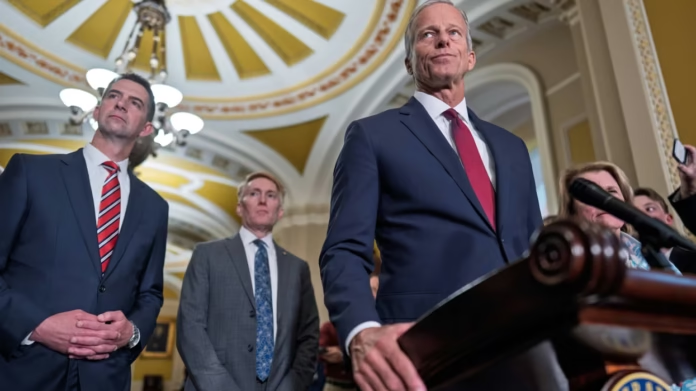

The U.S. Senate has passed one of the most significant immigration enforcement funding bills in American history, sending a $70 billion package to the House to fund Immigration and Customs Enforcement (ICE) and the Border Patrol through the remainder of President Donald Trump’s term. The final vote, which came just before 5 a.m. on June 5, 2026, marks a decisive moment in a months-long political standoff over border security and immigration enforcement.
What the Senate Just Passed: The $70 Billion ICE Funding Bill
Senators voted 52–47 in favor of the legislation, which would fund ICE and the U.S. Customs and Border Protection’s (CBP) Border Patrol operations for the next three years, covering the rest of Trump’s presidential term through January 2029. The bill passed along party lines using the budget reconciliation process, a procedural maneuver that allowed Republicans to bypass the 60-vote filibuster threshold and pass the measure with a simple Senate majority.
The breakdown of the funding package includes approximately $38.2 billion for ICE operations, $26 billion for CBP and Border Patrol activities, $1.5 billion for several Justice Department bureaus, and a $5 billion reserve fund for the Secretary of Homeland Security.
Why Did It Take So Long? The Months-Long DHS Shutdown
The bill’s passage follows an extended partial shutdown of the Department of Homeland Security (DHS) that began in mid-February 2026. Democrats had refused to fund ICE and Border Patrol after two individuals — identified as Renee Good and Alex Pretti — were fatally shot by federal immigration agents in Minneapolis in January 2026. Democrats demanded sweeping policy reforms before agreeing to any new funding, including requirements that immigration agents obtain judicial warrants before entering private homes and that ICE and Border Patrol be held to the same operational standards as local law enforcement agencies. Those negotiations ultimately collapsed without a deal.
The Senate had previously passed a separate bipartisan measure to reopen other parts of DHS, but House Republican leaders refused to consider it until progress was made on the ICE and Border Patrol funding. That dynamic left the agencies in limbo for months, creating pressure on Republicans to act.
The Vote-A-Rama and the DOJ Settlement Fund Fight
Before the final vote, the Senate held a marathon “vote-a-rama” session — a procedural gauntlet in which senators can offer an unlimited number of amendments to a reconciliation bill before final passage. Democrats used the session to launch multiple attempts to derail or amend the legislation.
The most contentious fight centered on a separate $1.776 billion Department of Justice settlement fund, which critics called a “slush fund” for Trump political allies who claim to have been victimized by the federal government. Some Republicans, including several facing tough reelection races in 2026, joined Democrats in trying to permanently ban the fund through amendments. Those efforts failed narrowly as Republican leadership kept enough members in line. Senate Minority Leader Chuck Schumer said Republicans were “leaving taxpayers to rely on nothing more than a promise from Donald Trump’s personal fixer.”
Democrats also attempted to block payments to January 6, 2021 defendants who injured law enforcement officers, but that amendment was also defeated. A proposal by Sen. Jeff Merkley to ban funding for Trump’s planned White House ballroom was similarly voted down, though a handful of Republicans crossed the aisle to support it. Republicans had already stripped the $1 billion White House ballroom provision from the bill prior to the vote-a-rama after facing intense pushback from within their own caucus.
Who Voted Against It? Republican Dissent
The bill was not without Republican opposition. During the earlier April budget resolution vote, Senators Rand Paul of Kentucky and Lisa Murkowski of Alaska were the only two Republicans to break ranks and vote against the measure. Paul cited fiscal concerns, arguing that the spending should be fully offset. Murkowski had previously voted to rescind ICE funding earlier in the year. The final bill passed 52–47, reflecting a consolidated Republican majority on the legislation.
Senate Majority Leader John Thune acknowledged that there remained “a multistep process ahead” but expressed confidence that the House would move quickly given the pressure to end the DHS funding lapse.
How Did Congress Get to This Point? The Reconciliation Strategy
Congressional Republicans chose to fund ICE and Border Patrol through the budget reconciliation process for the second time in recent legislative history. Last year, Republicans used the same procedure to pass the “One Big Beautiful Bill Act,” which included $325 billion for immigration enforcement and defense. That bill provided ICE with $75 billion — giving the agency more than eleven times its standard 2025 annual budget when combined with this new $70 billion package.
The reconciliation strategy allows Republicans to move budget-related bills with only 51 votes in the Senate, making Democratic opposition irrelevant. With 53 Senate seats, Republicans have enough votes to pass reconciliation measures without needing any Democratic support.
The budget resolution framework was adopted in the Senate by a 50–48 vote in late April and cleared the House on a narrow 215–211 vote days later, setting the stage for the legislation that ultimately passed June 5.
What Comes Next: The House Vote
The $70 billion bill now heads to the House of Representatives for final passage. Republican leaders in the House have signaled strong support, and the measure is expected to clear the chamber before heading to President Trump’s desk for signature. If enacted, the legislation would formally end the DHS partial shutdown, restore full funding to ICE and Border Patrol, and lock in those agency budgets through fiscal year 2029.
Democratic Response and Oversight Concerns
Democrats and immigration reform advocates have raised serious concerns about the lack of accountability provisions in the bill. The American Immigration Council noted that all $70 billion would be available through fiscal year 2029 with no meaningful congressional oversight mechanisms. Critics pointed to a troubling precedent from earlier ICE funding: after receiving $45 billion for detention through prior legislation, ICE immediately used $38 billion to convert warehouses into immigration detention centers rather than spreading spending over time.
House Appropriations Ranking Member Rosa DeLauro called the bill “a billion-dollar giveaway” that does nothing to lower the cost of gas, groceries, or healthcare for ordinary Americans. She and other Democrats vowed continued opposition to what they characterized as unchecked enforcement spending.
The Broader Context: ICE Funding Under Trump
To understand the scale of this legislation, consider that ICE’s standard annual budget is approximately $10 billion. With this $70 billion bill added on top of the $75 billion the agency received through the One Big Beautiful Bill Act, ICE will have received more than eleven times its regular annual budget in new supplemental funding under the Trump administration. CBP would also receive approximately 3.5 times its standard 2025 budget from this measure.
DHS officials previously indicated they were on track to commit 75 percent of their earlier supplemental funds by the end of September 2026, suggesting agencies are moving rapidly to build out infrastructure and operations with the new money.
Frequently Asked Questions (FAQ)
What did the Senate pass on June 5, 2026? The Senate passed a $70 billion immigration enforcement funding bill to fund ICE and Border Patrol through the end of President Trump’s term in January 2029. The bill passed 52–47 along party lines.
Why were ICE and Border Patrol not funded before this? Democrats refused to fund the agencies since mid-February 2026, demanding policy reforms after two people were fatally shot by immigration agents in Minneapolis in January 2026.
What is budget reconciliation? Budget reconciliation is a legislative process that allows certain budget-related bills to pass the Senate with a simple majority of 51 votes, bypassing the usual 60-vote threshold required to overcome a filibuster.
What is the $1.776 billion DOJ settlement fund controversy? The fund would compensate individuals who claim to have been politically persecuted by the federal government. Critics said it could serve as a payout mechanism for Trump allies, including January 6 rioters. Efforts to permanently ban it during the vote-a-rama were unsuccessful.
Does the bill include any oversight provisions? Critics say the bill contains no meaningful congressional oversight or spending guardrails. Democrats pushed for accountability measures but were unable to get them included.
What happens next? The bill moves to the House of Representatives for final passage before heading to President Trump for his signature.
How much money will ICE have received in total under Trump? Combined with earlier supplemental funding, ICE will have received more than eleven times its standard annual budget in new funding under the Trump administration.
This $70 billion vote is one of the most consequential immigration policy decisions in years — drop your thoughts in the comments below and stay with us for live updates as the House takes up this historic bill.