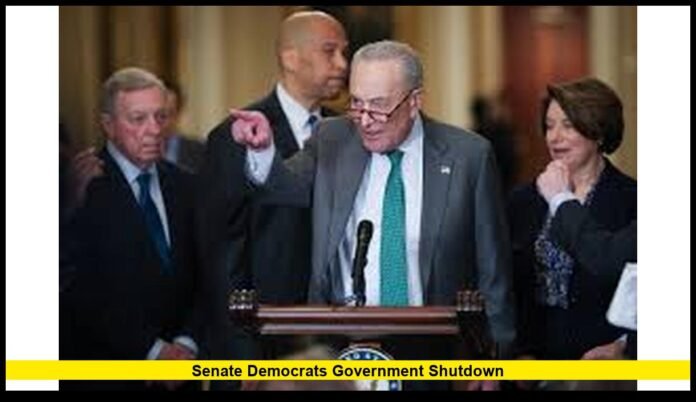

As Washington moves closer to a critical federal funding deadline, senate democrats government shutdown has emerged as the central issue dominating Capitol Hill. The debate has intensified as lawmakers struggle to finalize legislation that would keep the federal government operating, avoid disruption to public services, and maintain fiscal stability across the country.
With deadlines looming, Senate Democrats find themselves balancing procedural constraints, political pressure, and the urgent need to prevent a lapse in funding that could impact millions of Americans.
Where the Funding Fight Stands Right Now
Congress must approve new funding legislation to prevent a shutdown. Lawmakers can either pass full-year appropriations bills or adopt a temporary funding measure to extend current spending levels. As of today, negotiations remain unresolved, and no final agreement has cleared both chambers.
In the Senate, Democrats are working to advance funding legislation that preserves previously negotiated spending levels while keeping federal agencies open. However, opposition from Republicans over spending limits and policy conditions has stalled progress.
Because most legislation in the Senate requires a supermajority to advance, Democrats cannot move forward without bipartisan cooperation. That reality has made negotiations increasingly complex and time-sensitive.
Why Senate Democrats Are Holding Firm
Senate Democrats have outlined clear priorities during the funding standoff, emphasizing stability and predictability in government operations.
Preserving negotiated spending levels
Democrats argue that reopening spending agreements undermines the budget process and increases the likelihood of recurring shutdown threats. They maintain that honoring existing agreements is essential to restoring credibility to federal budgeting.
Blocking policy conditions tied to funding
Democratic leaders oppose attaching non-budgetary policy demands to funding bills. They argue that using government operations as leverage for unrelated political goals increases the risk of shutdowns.
Avoiding short-term disruption
While temporary funding measures can prevent immediate shutdowns, Democrats have warned that repeated short-term extensions create uncertainty for agencies, workers, and state governments.
Senate Rules Shape the Outcome
The structure of the Senate plays a decisive role in how the shutdown debate unfolds. Even with a majority, Senate Democrats must secure enough votes to overcome procedural hurdles.
Key factors include:
- The 60-vote threshold required to advance most bills
- Limited floor time amid competing legislative priorities
- The need to pass legislation that can also gain approval in the House
These constraints force Senate Democrats to pursue compromise while defending their core positions.
White House Coordination
The White House has remained closely involved in discussions with Senate Democrats. Administration officials have consistently supported funding measures that keep agencies operating without major policy changes.
The President has warned that a shutdown would disrupt federal services, delay payments, and weaken economic confidence. That position has reinforced Democratic efforts to move forward with clean funding legislation.
Consequences of a Government Shutdown
If funding lapses, the effects would be immediate and far-reaching.
Federal employees
Large numbers of federal workers would be furloughed, while others would be required to work without pay until funding is restored.
Agency operations
Non-essential government services would pause. National parks, research programs, and regulatory agencies would scale back operations.
Economic impact
Previous shutdowns have slowed economic growth, delayed contracts, and disrupted markets.
Public trust
Repeated funding crises have historically eroded public confidence in Congress and increased voter frustration.
Senate Democrats have pointed to these consequences as a reason to act quickly.
House Challenges Add Uncertainty
Even if the Senate passes a funding bill, it must also clear the House of Representatives. Deep divisions in the House have complicated negotiations and raised concerns that any Senate compromise could stall.
This dynamic has made Senate Democrats cautious about advancing legislation that may not survive the next stage of the process.
Why This Shutdown Fight Matters More Than Usual
Several factors have elevated the stakes in this funding battle:
- Narrow margins in both chambers limit flexibility
- Internal party disagreements carry greater influence
- External pressure from states, federal workers, and businesses continues to grow
Democrats have acknowledged that even a brief shutdown could have outsized political and economic consequences.
What Comes Next
Senate Democratic leaders have confirmed that talks will continue as the deadline approaches. Options still under consideration include:
- A short-term funding extension with minimal changes
- A broader bipartisan agreement covering the remainder of the fiscal year
- Procedural strategies to accelerate action
No final decision has been announced, and negotiations remain fluid.
Growing Pressure Outside Washington
Federal employee groups, state leaders, defense officials, and business organizations have raised concerns about the cost of a shutdown. Senate Democrats have cited these warnings as evidence that delays are becoming increasingly risky.
As pressure mounts, lawmakers face growing demands to act before time runs out.
The Bottom Line
The funding standoff highlights ongoing challenges in the federal budget process. Senate Democrats are attempting to prevent disruption while maintaining negotiated agreements and Senate norms. The outcome will depend on whether bipartisan cooperation emerges before deadlines expire.
What should Congress prioritize as the deadline approaches? Join the conversation and stay updated as developments continue.