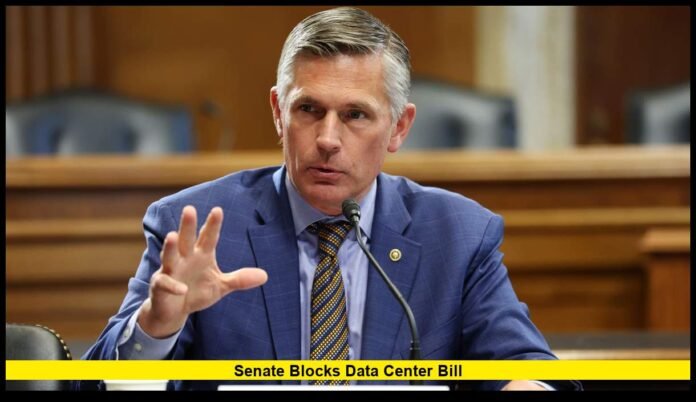

Senate blocks data center bill efforts after lawmakers failed to reach an agreement on legislation designed to address the electricity infrastructure costs associated with large data centers. The development came one day after the House approved the Ratepayer Protection Act by a 417-3 vote, giving the measure overwhelming bipartisan support before it reached the Senate.
The Senate dispute centered on two competing approaches to data center electricity costs. Sen. Jon Husted, R-Ohio, sought quick approval of the Ratepayer Protection Act through unanimous consent. Sen. Martin Heinrich, D-N.M., objected and instead sought consideration of his GRID Savings Act. Sen. Bernie Moreno, R-Ohio, then objected to Heinrich’s proposal.
The result left both measures without Senate approval. The House-passed Ratepayer Protection Act remains pending, while the debate over how large electricity users should pay for the infrastructure needed to serve them continues.
Why the Senate Bill Became a Major Issue
The legislation addresses a growing question surrounding large data centers: Who should pay when a new facility requires major upgrades to the electric system?
A large computing facility can create substantial new electricity demand. Meeting that demand can require utilities to invest in generation, transmission, and distribution infrastructure.
The Ratepayer Protection Act seeks to address those costs through a federal standard that state utility regulators would consider.
The legislation focuses on large-load customers primarily using electricity for information technology infrastructure, data storage, and computing services. The bill’s definition covers facilities with peak demand of at least 100 megawatts at a single site or campus.
That threshold places the legislation’s attention on very large electricity users rather than ordinary commercial customers.
The House Vote Put Pressure on the Senate
The House passed H.R. 9340, the Ratepayer Protection Act, on September 16 by a vote of 417-3.
Reps. Gabe Evans, R-Colo., and Kathy Castor, D-Fla., sponsored the House legislation. The measure had already received unanimous approval from the House Energy and Commerce Committee before reaching the floor.
The overwhelming House vote gave the legislation strong momentum heading into the Senate.
However, the Senate operates under different procedural rules. Husted attempted to move the Senate companion, S. 5028, by unanimous consent.
That procedure allows legislation to move quickly when senators do not object. A single objection can prevent the request from succeeding.
Heinrich objected.
The bill therefore did not receive Senate approval through that expedited process.
What the Ratepayer Protection Act Would Do
The legislation would amend the Public Utility Regulatory Policies Act of 1978.
Its central provision would establish a federal standard concerning the recovery of the full incremental costs of upgrades needed to serve qualifying large-load customers.
Those costs can include new generation, transmission, and distribution infrastructure.
The legislation also addresses the possibility that a large customer could stop purchasing electricity after a utility has invested heavily in infrastructure to serve the facility.
Under the proposed framework, the utility would structure rates so that the large-load customer covers the applicable incremental costs. The bill also calls for financial assurances or contributions before qualifying upgrades are built.
The goal is to make the customer responsible for infrastructure costs directly associated with its electricity demand.
The Bill Does Not Automatically Become a Nationwide Data Center Rule
One important detail is that the legislation does not simply impose a uniform national electricity rate on every data center.
Instead, it would require state regulators and certain utilities to consider the federal standard.
The Congressional Budget Office said the bill would expand the criteria electric utilities must consider when establishing electricity rates. Its analysis also identified an intergovernmental mandate but found no direct spending or revenue effects from the legislation.
The distinction matters because electricity regulation involves both federal and state authorities.
The legislation attempts to establish a federal standard while leaving implementation within the existing regulatory framework.
That structure has become one of the central points of disagreement in the Senate.
Why Martin Heinrich Objected
Heinrich said the House-backed approach does not go far enough.
His criticism focuses on the fact that the legislation directs states to consider the standard rather than creating the stronger federal requirement he supports.
Heinrich instead offered his GRID Savings Act.
His proposal seeks to require large-load customers, including data centers, to pay for facilities needed to connect them to the electric grid. Heinrich argued that large technology companies should cover the infrastructure costs associated with their electricity demand rather than leaving those costs to other customers.
Heinrich also raised issues beyond electricity infrastructure during his Senate remarks, including water use and local environmental concerns.
However, those additional issues are not provisions of the Ratepayer Protection Act.
The GRID Savings Act Takes a Different Approach
Heinrich’s alternative would establish stronger federal requirements for qualifying large-load customers.
The disagreement is therefore not simply about whether large data centers should face infrastructure costs.
Both senators have emphasized that large electricity users should bear costs associated with the infrastructure needed to serve them.
The difference involves how those requirements should be established and enforced.
The Ratepayer Protection Act works through a federal standard that state regulators would consider.
The GRID Savings Act seeks a more direct federal requirement.
Neither proposal has become federal law.
Bernie Moreno Also Objected
After Heinrich blocked the unanimous-consent request for the Ratepayer Protection Act, he attempted to move his own legislation using the same expedited procedure.
Moreno objected to that request.
That prevented the GRID Savings Act from advancing through unanimous consent.
The Senate therefore ended the exchange without approving either proposal.
The sequence is significant because both sides presented legislation addressing large electricity users, but neither could secure the unanimous agreement required for the expedited process.
The 100-Megawatt Threshold
The Ratepayer Protection Act specifically focuses on large electricity loads.
The legislation defines a qualifying large-load customer around a 100-megawatt threshold at a single site or campus.
The covered customer must primarily use electricity for information technology infrastructure and related data storage or computing services.
That definition is important because it connects the bill directly to large-scale data center operations.
The legislation is not designed around ordinary offices, stores, homes, or small businesses.
Instead, it targets facilities whose electricity demand can require substantial investments in the power system.
Financial Protection for Utilities
Another significant element involves financial assurances.
Before a utility makes generation, transmission, or distribution upgrades required to serve a qualifying large-load customer, the customer would need to provide financial assurances or contributions covering the cost of those upgrades.
This provision addresses the risk associated with building infrastructure for a customer whose electricity needs could later change.
The bill also addresses situations in which a large-load customer terminates its electricity agreement or stops purchasing electricity.
The proposed cost-recovery framework is designed to ensure that the infrastructure investment does not simply become an obligation for other customers.
How the Proposal Relates to Data Center Growth
Large data centers require significant amounts of electricity to operate computing equipment, cooling systems, networking infrastructure, and other supporting equipment.
As facilities become larger, utilities may need additional infrastructure to provide reliable service.
That creates a direct connection between data center development and electricity planning.
The Ratepayer Protection Act focuses on the financial side of that relationship.
Rather than regulating how many data centers can operate, it addresses how utilities and regulators should account for the additional infrastructure costs created by qualifying large loads.
The Debate Is Broader Than One Senate Bill
The Senate dispute is part of a wider congressional discussion about data center development.
Lawmakers have introduced multiple proposals addressing electricity demand, water use, environmental impacts, taxes, grid connections, and other issues.
The Ratepayer Protection Act addresses electricity infrastructure costs.
Heinrich’s GRID Savings Act takes a different approach to large-load interconnections and cost responsibility.
Other legislation has addressed transparency involving data center energy and water consumption.
These proposals remain separate measures and should not be treated as provisions automatically included in the Ratepayer Protection Act.
The White House Ratepayer Protection Pledge
The congressional debate also follows a voluntary initiative from the White House.
The Ratepayer Protection Pledge was launched as a voluntary commitment involving major technology companies and other participants.
Its purpose is to keep the costs associated with new data center electricity demand from being shifted to ordinary electricity customers.
The House legislation seeks to establish a statutory framework related to that principle through the federal utility law.
The important distinction is that a pledge is voluntary, while legislation would establish requirements through federal law if enacted.
The Senate disagreement has focused partly on whether the congressional proposal provides sufficient enforceability.
What Happens to the Bill Now
The Ratepayer Protection Act has already cleared the House.
Its Senate companion, S. 5028, was introduced by Husted on July 16 and referred to the Senate Energy and Natural Resources Committee.
The September 17 unanimous-consent attempt did not succeed.
That does not mean the legislation has been permanently rejected.
The Senate could consider the measure through another legislative procedure. Such a process could involve committee action, floor consideration, debate, and a vote.
For the legislation to become law, the House and Senate would ultimately need to approve the same legislation before it could proceed to the president.
As of September 18, that process remains incomplete.
What the Senate Dispute Means for Electricity Customers
The immediate Senate action does not change electricity rates.
It does not automatically impose new charges on data centers.
It also does not require utilities to change their existing rate structures.
Those changes would depend on legislation becoming law and subsequent regulatory action.
The current dispute instead concerns what rules Congress should establish for future large-load electricity projects.
At the center is a basic question about infrastructure costs.
When a major electricity customer requires new generation, transmission, or distribution facilities, lawmakers are debating how much of that cost should be assigned directly to the customer and how much, if any, should be recovered through broader utility rates.
The Current Status
The latest congressional sequence is clear.
The House passed the Ratepayer Protection Act by 417-3 on September 16.
Husted then sought unanimous Senate approval of the measure on September 17.
Heinrich objected and proposed his GRID Savings Act instead.
Moreno objected to Heinrich’s request.
Neither bill advanced through the expedited procedure.
The legislation therefore remains an active congressional issue rather than an enacted federal requirement.
The next major step would require the Senate to take up the legislation through another available procedure or reach a new agreement on how to proceed.
For now, the debate remains focused on the cost of connecting large electricity users to the American power grid and the rules that should determine who pays for the infrastructure those connections require.
Stay informed on the latest developments as Congress continues debating the costs, regulations, and future of America’s rapidly growing data center infrastructure.