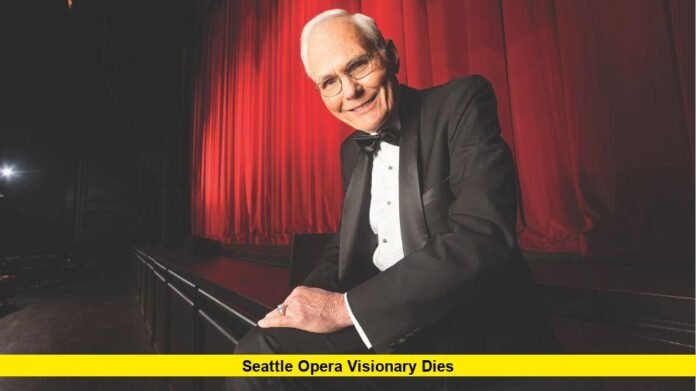

The world of opera is mourning a towering loss. Speight Jenkins, the transformative general director who turned Seattle Opera into one of the most respected opera companies in the United States — and a globally recognized destination for Wagner — died on Saturday, May 31, 2026. He was 89. His passing marks the end of an era for American opera and leaves a profound legacy in the Pacific Northwest and far beyond.
Who Was Speight Jenkins?
Speight Jenkins was born on January 31, 1937, in Dallas, Texas. His love affair with opera began remarkably early — he was just six or seven years old when he attended his first opera performance and was immediately captivated by the art form. That passion never left him.
He earned his undergraduate degree at the University of Texas at Austin and went on to graduate from Columbia Law School in 1961. Though trained as a lawyer, Jenkins first served in the U.S. Army as a member of the Judge Advocate General’s Corps before ultimately following his true calling into the world of music.
From Critic to Impresario: Jenkins’ Path to Seattle
Before taking the helm at Seattle Opera, Jenkins built a distinguished career as a music journalist and broadcaster. He worked as an editor for Opera News from 1967 to 1973 and later as a music critic for the New York Post from 1973 to 1981. He also became one of the most familiar voices and faces in American classical music, hosting the celebrated Live from the Metropolitan Opera television broadcasts on public television from 1981 to 1983.
His connection to Seattle came almost by chance. In 1982, Jenkins traveled to the city to deliver pre-show talks on Wagner’s Ring cycle. His enthusiasm and depth of knowledge captivated the Seattle Opera Board of Directors, who invited him to succeed the company’s founding General Director, Glynn Ross — even though Jenkins had never previously worked directly for an opera company. He accepted, and the rest is history.
A 31-Year Reign That Transformed Seattle Opera
Jenkins served as General Director of Seattle Opera from 1983 to 2014 — a remarkable 31-year tenure during which he reshaped the company from a respected regional house into an institution of international stature.
Under his leadership, Seattle Opera grew into one of the largest and most respected opera companies in the United States, acclaimed worldwide for its ambitious programming, its nurturing environment for emerging artists, and above all, its landmark presentations of the works of Richard Wagner.
The Wagner Legacy: Making Seattle a Global Opera Destination
Jenkins was a self-described zealot for Richard Wagner — famously known to close the office on Wagner’s birthday. His defining achievement was producing all ten of Wagner’s major operas in Seattle, effectively turning the company into the most important Wagner house in North America.
His groundbreaking productions of Wagner’s four-opera epic Der Ring des Nibelungen attracted audiences from every U.S. state and dozens of countries around the world. The landmark 1986 Ring cycle, directed by François Rochaix and designed by Robert Israel, was widely regarded as one of the most memorable opera productions in American history. Jenkins presented subsequent Ring cycles in 1987, 1991, and 2013, each drawing international acclaim.
A particularly celebrated moment came in 1998, when Jenkins produced Wagner’s Tristan und Isolde featuring tenor Ben Heppner and soprano Jane Eaglen performing the title roles together for the first time — a pairing that became legendary in the opera world.
Beyond Wagner: An Ambitious Artistic Vision
Jenkins’ programming ambitions extended well beyond Wagner. Highlights of his tenure included Prokofiev’s War and Peace in 1990, heralded as the crown jewel of the Goodwill Games cultural program; Poulenc’s Dialogues des Carmélites in 1990; and a deeply celebrated production of Gluck’s Orphée et Eurydice directed by Stephen Wadsworth and choreographed by Mark Morris, which the London Financial Times called America’s finest tribute to Gluck in his bicentenary year.
Over 31 years, Jenkins produced 92 different operas in more than 1,200 performances — a staggering body of work that cemented Seattle’s place in the opera world.
McCaw Hall and Nurturing Young Artists
Among Jenkins’ most lasting institutional contributions was overseeing the 2003 opening of McCaw Hall, Seattle Opera’s permanent home. He was equally passionate about developing the next generation of singers, founding the International Wagner Competition to create a pipeline for young performers entering the demanding world of Wagnerian performance. His belief — that great artists are those who understand that the words inspired the composer to write the music — guided his approach to mentorship throughout his career.
Tributes Pour In From Across the Opera World
The response to Jenkins’ death has been swift and heartfelt across the international opera community.
Former Seattle Opera Board Chair John Nesholm said Jenkins brought “Seattle Opera into the first rank of opera companies nationally and internationally,” adding that his Ring productions attracted audiences from across the country and around the globe, and that in retirement he continued teaching and inspiring others through his passion for the art form.
Current Seattle Opera General and Artistic Director James Robinson praised Jenkins as “a force, a true impresario who launched countless careers” and called him “exacting, demanding, and utterly committed to excellence,” saying he remains an inspiration to opera leaders across the United States.
Acclaimed stage director Stephen Wadsworth, a frequent Jenkins collaborator, called him “a brilliant, hands-on producer unique in American opera” who spurred careers through his encouragement and loyalty. Wadsworth recalled the final night of the 2013 Ring cycle, when he called Jenkins out alone for a solo bow — and the entire audience rose and responded with what he described as an overwhelming outpouring of affection rarely seen in any opera house.
Music journalist Norman Lebrecht, writing in Slipped Disc, titled his tribute “America’s Greatest Opera Boss Has Died” — a sentiment echoed widely across the classical music press.
The National Endowment for the Arts, which honored Jenkins with its NEA Opera Honor in 2011, called him “a leading authority on opera and one of the most influential and accomplished general directors in the United States.”
Awards, Honors, and Civic Recognition
Jenkins’ contributions were recognized at every level — artistic, civic, and national.
- 2009 – Mayor’s Arts Award from the City of Seattle
- 2011 – National Endowment for the Arts Opera Honor
- 1996–2000 – Service on the National Council on the Arts
- 2014 – The City of Seattle and King County proclaimed August 9 as Speight Jenkins Day upon his retirement
- A street in Seattle was named in his honor
Jenkins was also recognized as one of the 150 most influential people to shape the character of Seattle and King County.
Post-Retirement: Still Teaching, Still Inspiring
After stepping down as General Director in 2014, Jenkins remained connected to the opera world he loved so deeply. He continued teaching and mentoring aspiring artists, sharing his encyclopedic knowledge of opera and the infectious enthusiasm for the art form that had defined his entire career.
His post-show audience talkbacks — a beloved Seattle Opera tradition during his tenure — often stretched well into the night, with hundreds of patrons staying long after curtain to hear his free-wheeling commentary on the operas they had just experienced.
FAQ: Speight Jenkins and Seattle Opera
When did Speight Jenkins die? Speight Jenkins passed away on Saturday, May 31, 2026, at the age of 89.
How long was Speight Jenkins General Director of Seattle Opera? Jenkins served as General Director of Seattle Opera for 31 years, from 1983 to 2014.
What is Speight Jenkins best known for? Jenkins is best known for transforming Seattle Opera into a world-class institution, particularly through his landmark productions of Wagner’s Ring cycle, which attracted audiences from across the United States and dozens of countries.
Where was Speight Jenkins born? He was born on January 31, 1937, in Dallas, Texas.
What awards did Speight Jenkins receive? Among his many honors, Jenkins received the National Endowment for the Arts Opera Honor in 2011, the Mayor’s Arts Award in 2009, and in 2014 was given his own named day — Speight Jenkins Day — by the City of Seattle and King County.
Did Speight Jenkins work anywhere before Seattle Opera? Yes. Before joining Seattle Opera, Jenkins was a music critic for the New York Post, an editor at Opera News, and the host of Live from the Metropolitan Opera television broadcasts on public television.
Speight Jenkins was more than an opera director — he was a visionary who believed that great art belongs to everyone. Share your memories of Speight Jenkins or what his work meant to you in the comments below.