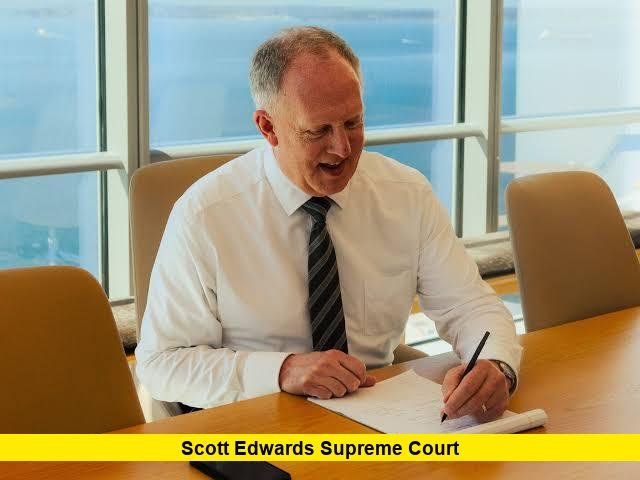

Scott Edwards Supreme Court campaign enters its final stretch as Washington voters prepare to cast primary ballots by Tuesday, August 4, 2026. Edwards, a Seattle-based tax attorney, is one of three candidates competing for Position 1 on the Washington State Supreme Court, and the race has drawn attention from both major parties ahead of Election Day.
The primary field includes incumbent Justice Colleen Melody, challenger Laura Christensen Colberg, and Edwards himself. Voters must return their ballots, signed and dated, by 8 p.m. Pacific Time on August 4, 2026. The top two finishers will advance to the November general election.
Who Is Scott Edwards?
Edwards grew up in Anchorage, Alaska, where his father served as Alaska Attorney General and later as a U.S. Attorney. That upbringing, he says, shaped his early interest in the law and in judicial independence.
He earned a bachelor’s degree in economics, magna cum laude, from Princeton University. He then completed his law degree at the University of Washington School of Law. Since 2002, Edwards has also worked as an adjunct professor at that same law school, teaching future attorneys while continuing to practice law full time.
Professionally, Edwards has built a nearly thirty-year career centered on constitutional, appellate, and state tax law. His resume includes stints at three major firms:
- Bogle & Gates, from 1996 to 1999
- Perkins Coie, from 1999 to 2010
- Ballard Spahr, from 2010 to 2025
As of 2025, Edwards moved to Lane Powell, where he continues his tax and appellate practice. Over his career, he has argued more than a dozen cases before the Washington Supreme Court, with much of his work focused on disputes between taxpayers and the Washington Department of Revenue.
Edwards is married to Christine Edwards. The couple has three children and a granddaughter, and Edwards has cited time with family as a grounding influence outside the courtroom.
Why Edwards Is Running
Edwards is campaigning on a message of judicial restraint. His slogan, “take politics out of the courtroom,” anchors nearly every public statement he has made this cycle.
He frames his candidacy around three ideas: the Washington State Constitution, the statutes passed by lawmakers, and the people the court ultimately serves. Edwards has repeatedly argued that judges should interpret laws as written rather than rewrite them from the bench.
In interviews, including a Q&A published by The Center Square, Edwards said his tax-law background sets him apart from his opponents. He pointed to his direct courtroom experience with Washington’s constitution, particularly through cases touching the state’s capital gains tax, as proof he understands how the court’s decisions ripple through everyday finances.
Community involvement also features in his campaign biography. Edwards says he has been active with the American Red Cross, St. Cecilia Parish, Scouting America, the Bainbridge Island Youth Orchestra, and Kids in Concert.
The Seat and the Competition
Position 1 is currently held by Justice Colleen Melody, who joined the Washington Supreme Court through a gubernatorial appointment in late 2025. That appointment drew praise from much of the state’s legal community when it happened, and Melody now seeks to keep the seat through election.
Melody has built a wide base of institutional support. Her endorsement list includes every sitting justice on the Washington Supreme Court, Governor Bob Ferguson, former Governors Christine Gregoire and Jay Inslee, Attorney General Nick Brown, Congresswoman Pramila Jayapal, the King County Democrats, and the Washington State Labor Council.
Laura Christensen Colberg, the third candidate, brings a different résumé to the race. She is a family law attorney and a longtime pro tem court commissioner in Snohomish County, a role that functions as a substitute judge assigned by elected judges in that jurisdiction. Colberg graduated from Ferris High School in Spokane before earning her bachelor’s and law degrees from the University of Washington.
The Washington State Republican Party’s state committee recommended both Edwards and Colberg for Position 1, following a special meeting in early July where county chairs and committee members met a two-thirds supermajority threshold. WAGOP Chairman Jim Walsh confirmed the recommendation, noting the party would weigh in separately on a fourth Supreme Court seat, Position 4, after the August primary.
Where the Money and the Polling Stand
Campaign finance filings tell part of the story heading into the primary. Edwards has raised more than $53,000 as of July 10, 2026, with contributions from Tradewinds Capital Management managing partner Bryant Engebretson, Joseph P. Gildner Consulting, and Collins Homes Inc.
Colberg’s fundraising sits far lower, at almost $27,000 as of the same date, a total that includes roughly $4,700 she personally loaned her campaign plus close to $10,000 in direct contributions from her own funds.
Melody’s fundraising advantage is significant. Reporting has placed her total at roughly six times that of her nearest challenger, reflecting the broad institutional backing behind her campaign.
Public polling on the race remains thin, as is typical in nonpartisan judicial elections. A Civic Heartbeat statewide poll from the Northwest Progressive Institute, fielded after candidate filing closed, found the following breakdown:
| Candidate | Support |
|---|---|
| Colleen Melody | 14% |
| Laura Christensen Colberg | 9% |
| Scott Edwards | 7% |
| Undecided | 70% |
That level of undecided voters is common in judicial races, where name recognition tends to run low. Analysts note that undecided voters in these contests often ultimately break toward the candidate already polling highest, which would favor Melody heading into November if the trend holds.
The Broader 2026 Washington Supreme Court Picture
Position 1 is just one of five Washington Supreme Court seats on the ballot in 2026, making this an unusually consequential year for the state’s highest court. Sixteen total candidates filed across the various open seats, and voter attention to these races has been building throughout the summer as outlets work to introduce lesser-known judicial candidates to the electorate.
A separate seat, Position 4, will appear only on the November general election ballot. Just two candidates filed for that position, so it bypasses the August primary entirely.
Because Washington Supreme Court seats are nonpartisan by design, all three Position 1 candidates, including Scott Edwards, run without party labels on the ballot itself. Still, party organizations on both sides have taken clear public stances, with Republicans coalescing around Edwards and Colberg while Democrats have largely lined up behind Melody.
What Happens Next
Washington runs its elections almost entirely by mail, so voters need to return their ballots, not merely postmark them in some cases, by the August 4 deadline depending on the method used. Ballots must be signed, dated, and returned through an official drop box or the postal service in time to count.
If Edwards fails to place in the top two on August 4, his campaign ends at the primary stage. If he advances, he would face either Melody or Colberg in the November general election, setting up a runoff over who fills the state’s highest judicial bench for Position 1.
For now, the Scott Edwards Supreme Court campaign rests on a straightforward pitch: decades of courtroom experience, a tax-law specialty few other candidates can match, and a promise to keep the bench focused on the law as written rather than on political pressure from either direction.
Voters across Washington will render the first verdict on that pitch within days, as ballots close on August 4, 2026, and the state moves one step closer to filling five seats on its Supreme Court.
Stay tuned for the latest primary results and share your thoughts on this race in the comments below.