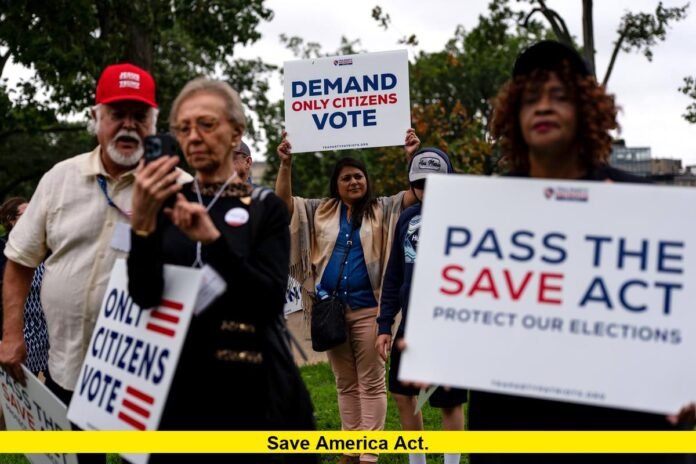

The Save America Act has become one of the most closely watched political battles in Washington as lawmakers prepare for a critical Senate debate over the sweeping election legislation. The bill, which has already passed the U.S. House of Representatives, would introduce new nationwide rules for voter registration and voting identification in federal elections.
Supporters say the proposal strengthens election integrity and ensures that only American citizens participate in federal elections. Critics warn the legislation could create significant barriers for millions of eligible voters. With the 2026 election cycle approaching, the fight over the bill has quickly evolved into one of the biggest political flashpoints in Congress.
Quick Context
The Save America Act is a federal election bill that would amend existing voting law by requiring documentary proof of U.S. citizenship for voter registration and stricter identification requirements for casting ballots in federal elections.
If enacted, voters would need documents such as a passport, birth certificate, or other official citizenship records to register. The proposal also requires government-issued photo identification for voting and includes additional procedures intended to verify citizenship status through federal and state systems.
Supporters describe the bill as a necessary step to strengthen confidence in elections. Opponents argue that the requirements could complicate voter registration and make participation more difficult for eligible citizens who do not have immediate access to official documents.
Stay tuned as this developing political fight continues to shape the national conversation around voting laws.
Timeline: How the Story Developed
January 2025
Republican lawmakers introduced the original Safeguard American Voter Eligibility Act, commonly called the SAVE Act, to require proof of citizenship for federal voter registration.
April 2025
The House of Representatives passed the earlier version of the legislation, though it stalled in the Senate.
January 2026
Lawmakers introduced an expanded version known as the Save America Act, adding additional verification rules and federal oversight provisions.
February 2026
The House passed the updated bill by a narrow vote of 218–213, advancing the proposal to the Senate for consideration.
March 2026
Senate leaders scheduled debate on the measure as political pressure increased from both supporters and critics.
What Supporters and Critics Noticed
The legislation immediately drew attention because it would significantly change how Americans register to vote.
Supporters emphasize that the proposal requires proof of citizenship before registering to vote, arguing that such verification would ensure only eligible citizens participate in elections.
Critics highlight the documentation requirements as the most controversial part of the bill. Many Americans do not have immediate access to documents such as passports or certified birth certificates, which could complicate voter registration.
Election administrators have also raised questions about the logistics of verifying documents and implementing new federal rules across thousands of local election offices.
Social Media Reaction
Online platforms quickly became a battleground for the issue.
Supporters of the bill have promoted the legislation as a common-sense reform, arguing that identification requirements are already common in many aspects of daily life and should apply to voting as well.
Critics have used social media to warn about potential barriers to participation. Activists and advocacy groups argue that strict documentation requirements could disproportionately affect older voters, rural residents, and people who do not have easy access to official records.
As a result, hashtags related to voter ID laws and election integrity have repeatedly trended during congressional debate over the proposal.
What Leaders Actually Said
Prominent political figures have taken strong positions as the debate intensified.
Supporters of the legislation argue that citizenship verification is essential to maintaining trust in the election system. They say federal elections should include uniform national standards that guarantee only eligible citizens register and vote.
Opponents in Congress have sharply criticized the proposal, warning it could create unnecessary obstacles for voters and impose major administrative burdens on election officials.
Political leaders on both sides have continued to push their arguments as the Senate prepares to determine the bill’s future.
Why the Story Is Trending
The Save America Act continues to dominate headlines for several reasons.
First, voting rights remain one of the most sensitive and politically charged issues in the United States. Any proposal that changes federal election rules immediately attracts national attention.
Second, the legislation arrives during a politically significant moment. With the 2026 midterm elections approaching, changes to voting procedures could affect campaign strategies, turnout, and election administration across the country.
Finally, the bill faces a difficult path in the Senate. Passing the legislation would likely require at least 60 votes to overcome a filibuster, making bipartisan support essential for it to become law.
What Happens Next
The next phase of the debate will unfold in the U.S. Senate, where lawmakers are preparing for a major discussion and potential vote on the bill.
Even if the proposal receives majority support, Senate rules requiring a 60-vote threshold could prevent it from advancing without significant bipartisan backing.
Meanwhile, advocacy groups, election officials, and political organizations across the country continue to monitor the legislation closely as the national debate over voting laws intensifies ahead of the next election cycle.
The outcome of the Senate debate will determine whether the bill moves forward or becomes another major piece of election legislation stalled in Congress.
What do you think about the ongoing debate over voting laws in the United States? Share your opinion and keep following the latest updates as this story continues to unfold.